





UAlbany, Downstate Researchers Demo Prototypes for AI-Supported Mental Health Care
By Erin Frick
ALBANY, N.Y. (Sept. 30, 2025) — As demand for mental health care surges worldwide, many people are unable to access the help they need. These gaps are felt most acutely in disaster zones, remote regions and among underserved populations. Researchers at the Global Center for AI in Mental Health are developing tools that harness the power of artificial intelligence (AI) to close this divide.
Launched in 2023 through a partnership between UAlbany, SUNY Downstate Health Sciences University and the Health Innovation Exchange, the Global Center for AI in Mental Health is a collaborative research enterprise dedicated to improving prevention, diagnosis and treatment of mental health conditions using emerging technologies powered by AI.
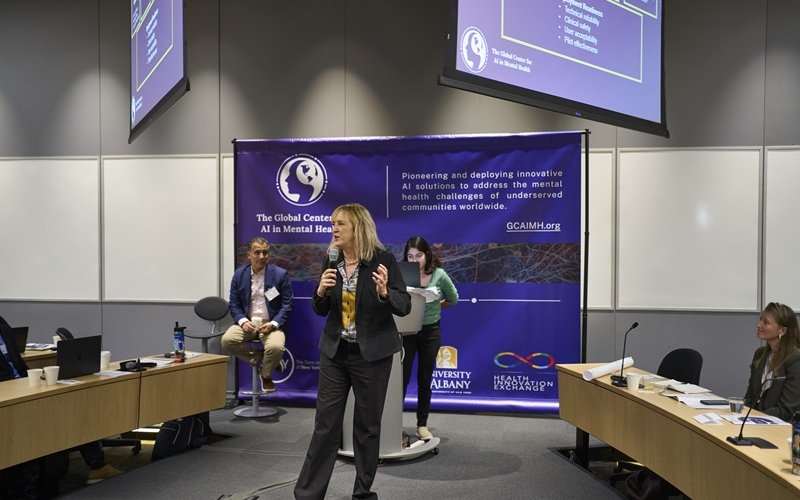
At the Center’s annual summit held earlier this month at the SUNY Global Center in Manhattan, researchers from UAlbany and SUNY Downstate, together with developers from Google and other tech collaborators, debuted prototypes of their latest tools to expand mental health care capacity.
“Despite rising need, accessing mental health care is impossible for too many people,” said Thenkurussi (Kesh) Kesavadas, vice president for research and economic development at UAlbany. “Clinicians are scarce, resources are stretched and, especially in the wake of a disaster, need can spike without warning. At the Global Center for AI in Mental Health, we believe that artificial intelligence can help forge new pathways to care. Unveiling prototypes of our tools developed with Google and other leading tech companies, and demonstrating truly innovative AI projects at our campuses, marks an important milestone towards addressing mental health service gaps felt around the world.”
Supporting disaster survivors
The SUNY PFA Assistant (short for psychological first aid) is designed to assist humanitarian aid organizations in expanding mental health support in the aftermath of natural disasters, terrorism and other large-scale traumatic events.
“Far too often, the mental health needs of disaster survivors exceed the capacity of available providers,” said Amy Nitza, director of the Global Center for AI in Mental Health at UAlbany. “By harnessing the power of generative AI, we aim to extend that capacity so that every survivor has timely access to the support they need.
“We are developing tools to help disaster response and humanitarian organizations bridge critical gaps in mental health care. These tools are not a replacement for face-to-face support but are a way to strengthen and scale it. While the tools are still in development, we are committed to using AI responsibly and ethically to make disaster mental health care more accessible, immediate and inclusive.”
With both provider- and survivor-facing modes accessible via smartphone, the tool will help clinicians tailor psychological first aid interventions to the unique needs of their client. It will also feature a “refresher” training mode to support and maintain providers’ psychological first aid skills. The platform will be adaptable to different linguistic and cultural contexts, and disaster types.
Facilitating Evidence-based Treatment
Developed with Google, “Ther-Assist” is a generative-AI tool designed to support mental health providers as they implement evidence-based treatment methods with patients in real time. The platform could be used to tailor treatment for conditions such as anxiety, depression and trauma-related disorders.
“The Ther-Assist AI tool has the potential to transform psychotherapy worldwide by giving clinicians the tools to deliver more personalized, evidence-based care,” said Salvador Dura-Bernal, Global Center for AI in Mental Health director and assistant professor of physiology and pharmacology at SUNY Downstate Health Sciences University. “This tool is about equity as much as it is about innovation. Ther-Assist can help ensure that high-quality psychotherapy reaches communities that have historically been left behind.”
Designed to run during a therapy session, Ther-Assist analyzes the conversation and provides several streams of instant feedback. The tool is trained to identify an established therapy technique proven to help address the mental health challenges being discussed. With real-time prompts, the tool can offer suggestions for ways to guide the conversation that align with the evidenced-based technique.
Post-session, therapists can use the tool to help determine their own efficacy and potentially make adjustments for the next time they speak with their client. Beyond in-session use, Ther-Assist holds strong potential as a training tool to help students pursuing careers in psychology or social work.
Resilient Innovation in Mental Health
The Global Center for AI in Mental Health annual summit brought together researchers, clinicians, tech companies, international policymakers and humanitarian leaders to explore how artificial intelligence can expand access to mental health care worldwide.
The event featured presentations by United Nations representatives including Emily Knowles, program manager of the Global Victims of Terrorism Support Programme run by the UN Office of Counter-Terrorism. Zeinab Hijazi, Global Mental Health Lead at UNICEF, underscored the need to consider the dual imperatives of rights and equity as artificial intelligence approaches are applied to health care, especially in applications developed for use with children and adolescents.
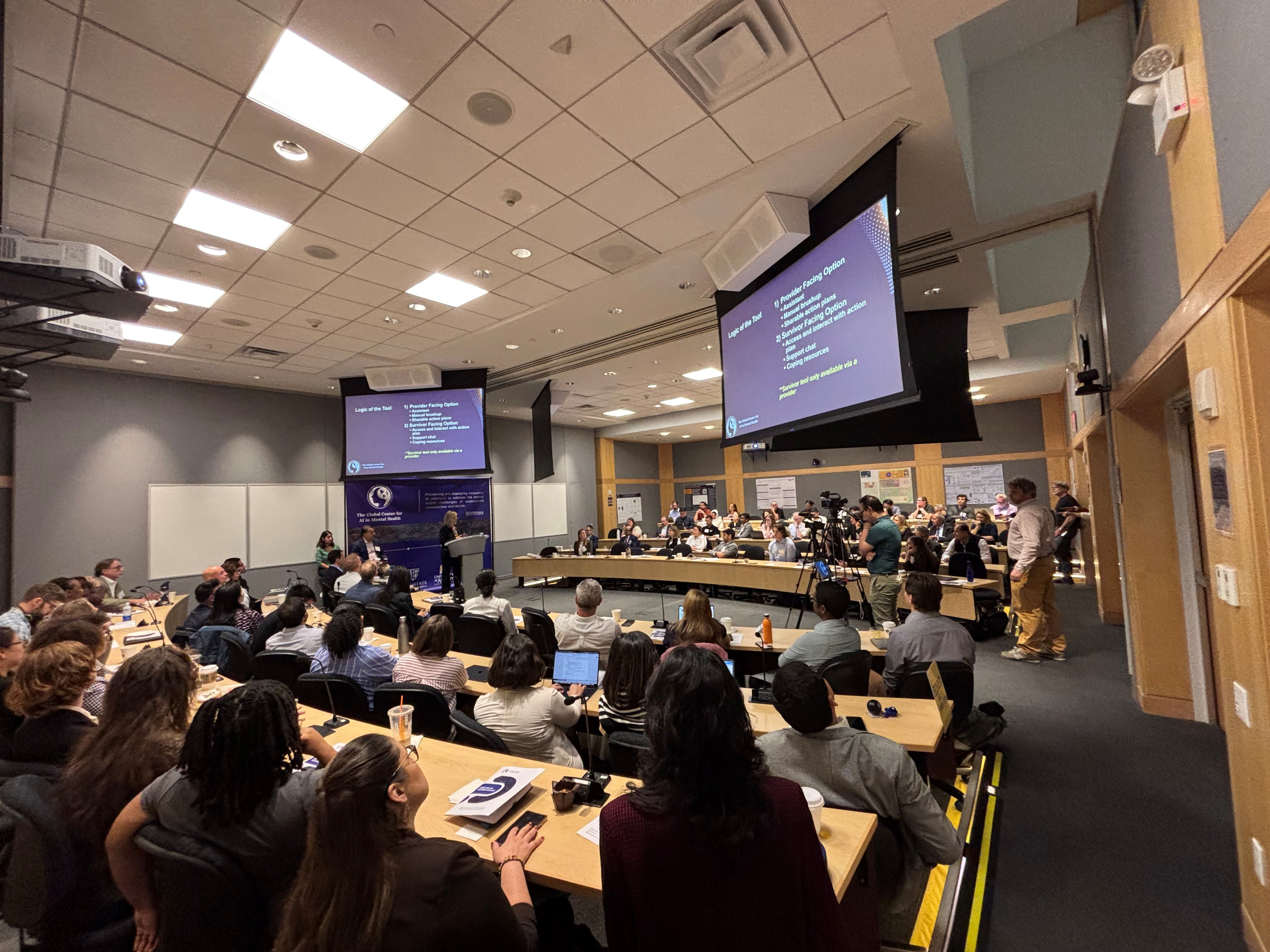
The summit showcased the center’s commitment to pursuing research for real-world impact. By uniting the strengths of UAlbany, SUNY Downstate and the Health Innovation Exchange, and demonstrating how cutting-edge technology can help address today’s most pressing health needs, the Global Center for AI in Mental Health is pioneering new opportunities for mental health care.