





Showcase 2025: CEHC Students Study Real World Impact of Cyber Attacks

By Mike Nolan
ALBANY, N.Y. (April 15, 2025) — The power grid is a prime target for cyberattacks, with the potential to lead to widespread blackouts, economic losses and threats to national security.
In 2024, Check Point Research documented 1,162 cyberattacks on utilities, a 70 percent increase compared to the same period in 2023. Power grids are also becoming increasingly vulnerable to cyberattacks, with the number of susceptible points in electrical networks increasing by about 60 per day, according to the North American Electric Reliability Corporation.
Students at the College of Emergency Preparedness, Homeland Security and Cybersecurity (CEHC) are spending the semester developing real solutions to help improve those numbers.
Ariel Pinto, professor and chair of the Cybersecurity Department at CEHC, has teamed up this spring with the Electrical Power Research Institute (EPRI), a non-profit energy research and development organization, on a cybersecurity research course for sophomores and juniors.
“I’ve been in talks with EPRI for several years on how we can work together to strengthen the cybersecurity workforce pipeline,” said Pinto. “This course introduces students to the basic principles and techniques of cyber research, while also having a more practical aspect of working directly with an industry partner.”
“Collaborating with Dr. Pinto and the UAlbany team brings together research backgrounds across several industries,” added Jeremy Lawrence, principal technical leader at EPRI. “It is exciting to share cybersecurity protection insights with the students and help shape future defenders.”
Tackling cyber threats
Among Pinto’s course objectives is a semester-long project that explores published research around two high-profile cyber incidents, the Colonial Pipeline and Stuxnet attacks.
In May 2021, a ransomware attack forced Colonial Pipeline, a major fuel pipeline, to shut down its operations, leading to fuel shortages and panic buying across the southeastern United States. Stuxnet is a malicious computer worm, discovered in 2010, that was used to attack Iranian nuclear facilities and has since mutated and spread to other industrial and energy-producing facilities.
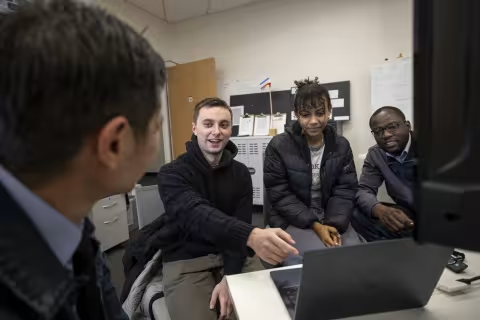
Matthew Waskiewicz, a junior cybersecurity major, is one of 20 students in Pinto’s course this semester.
His project explores the Colonial Pipeline attack, with a specific focus on how artificial intelligence can help with improving threat detection and better secure the pipeline’s industrial control systems.
“I’ve never done anything like this before,” said Waskiewicz, who transferred to UAlbany from Suffolk County Community College last fall. “Presenting research to a real company puts you in a different mindset, you have to think outside the box. This work can make a difference in protecting the digital world.”
Izaria Dicks, a sophomore and double major in cybersecurity and criminal justice, is also researching the Colonial Pipeline attack through the course.
“I’m focusing on ransomware and vulnerability scanning, as we know that the cyber criminals were able to get into the Colonial Pipeline through a hacked account,” said Dicks, a native of Newburgh, N.Y “I’d like to continue to do more research like this. I think it’s really cool to be able to use your skills to help society defend against cyber attacks.”
Featured at Showcase
The students are currently working on their projects with opportunities for feedback from EPRI’s educational outreach team, who have also provided learning materials, including a 20-minute video explainer on how the energy industry views cybersecurity.
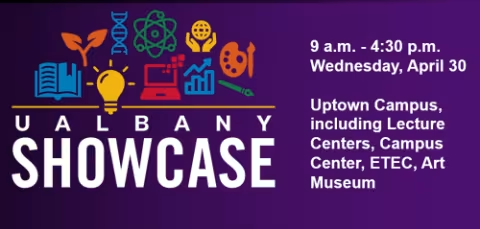
Their final research posters will be on display on Wednesday, April 30, for UAlbany Showcase, which brings together the entire University community to highlight the academic excellence of students through their research, scholarship, creative activities and experiential learning.
The EPRI team will be reviewing the posters and selecting a best in class prior to Showcase day.
“Working with a real company has motivated our students and made them confident in their research,” said Pinto. “I’m excited to see their hard work on display.”
Showcase events will be held across the Uptown Campus, including the Lecture Center Concourse, Campus Center, University Art Museum, University Libraries, Performing Arts Center, ETEC and Broadview Center.
Students, faculty and staff, as well as prospective students, donors, sponsors, legislators, community leaders, school groups, institutional partners and other visitors are all invited to attend.