


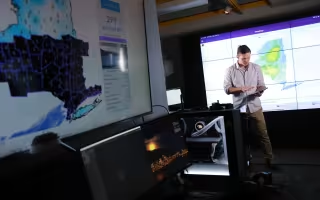
CTG UAlbany Study Examines Role of Technology in Emergency Messaging
Relaying information to the public during emergencies is critically important. However, gaps remain in understanding how technology can and should be used for disseminating messages. A new study from the University at Albany’s Center for Technology in Government (CTG UAlbany) aims to address these gaps, particularly as it pertains to local municipalities.

Noteworthy: Research grants, awards and publications
The latest developments on University at Albany faculty and staff who are receiving research grants, awards and other noteworthy attention.

UAlbany Atmospheric Scientist Partners to Study Factors Behind Contrail Formation
Fangqun Yu, a senior researcher at the Atmospheric Sciences Research Center, has released a new paper that examines the contrail formation process.
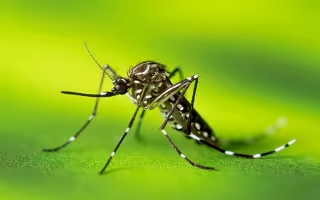
RNA Institute Study Explores Cellular Response to Zika Virus Infection
In a new study published in the Journal of Virology, University at Albany researchers investigated how the human body fights off Zika virus at the cellular level. Their findings illuminate new potential intervention points for therapeutics against Zika, as well as other RNA viruses.
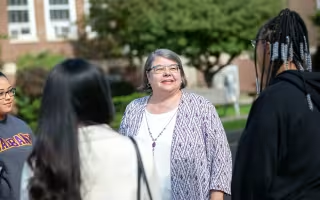
Victoria Rizzo Named Director of UAlbany’s Center for Healthy Aging
University at Albany’s Victoria Rizzo, senior vice dean of the College of Integrated Health Sciences and director of the School of Social Welfare, will lead UAlbany’s new Center for Healthy Aging as its inaugural director.
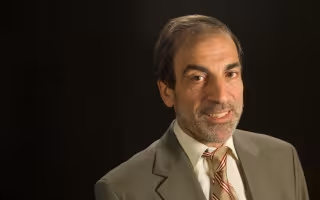
UAlbany Professor Authors Definitive Book on Private Higher Education Around the World
Daniel Levy, a SUNY Distinguished Professor in UAlbany's Department of Educational Policy and Leadership, has authored a new book titled, "A World of Private Higher Education," a definitive account on the private higher education sector, which accounts for one-third of the world’s 200 million higher education enrollments.
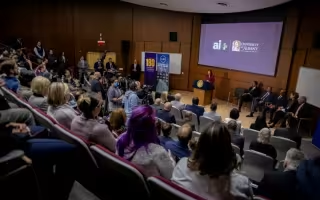
Four Faculty Members Win SUNY-IBM AI Research Grants
The research grants will advance the efficiency and trustworthiness of artificial intelligence systems, and UAlbany was one of two SUNY Research Centers to receive four grants this year out of a total of 14 projects funded systemwide.