



UAlbany Researcher Developing Radio Frequency Interference Solutions for U.S. Weather Satellites
Mustafa Aksoy, an associate professor in UAlbany’s College of Nanotechnology, Science, and Engineering, is part of a large research team that was awarded a two-year, $1.1 million grant to develop radio frequency interference detection and mitigation strategies for future U.S. weather and climate satellites.

UAlbany Climate Scientists Among World’s Most Highly Cited Researchers
A new report has listed Department of Atmospheric and Environmental Sciences Professors Aiguo Dai and Liming Zhou among the world’s most-cited researchers.

UAlbany Receives Major Gift to Advance Scientific Research on Unidentified Aerial Phenomena
The University at Albany has received a transformational endowment gift from longtime businessman Tony Gorman to support cutting-edge physics research on unidentified aerial phenomena.
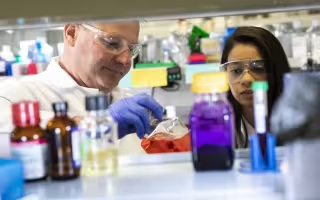
Gov. Hochul Announces $50M Life Sciences Expansion for RNA Institute research
The Life Sciences Research Building, which is home to cutting-edge labs where researchers from the RNA Institute blend bench science with AI to help accelerate the development of RNA-based treatments for deadly diseases, will expand by 20,000 s.f.

UAlbany Study Finds Disparities in Risks for Reading Difficulties Emerge by Kindergarten
Early struggles with reading can have lifelong impacts on mental, physical and emotional health. Understanding who is most at risk of experiencing reading difficulties can inform strategies for early interventions to support students before they fall further behind. A new UAlbany study reports on disparities in the prevalence of early reading difficulties among U.S. elementary school students.
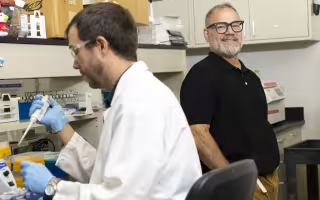
UAlbany Spinoff Secures New Funding in Bid to Transform Biotechnology
UAlbany’s Professor Scott Tenenbaum, CEO of UAlbany spinoff company sxRNA Technologies, Inc., brought in over $625,000 in new awards to the company in 2025. With the help of this new funding, the company is positioned to advance their technology for applications in medical research, pharmaceutical production and the development of new precision therapeutics.
New Podcast Spotlights Short Talks on Big News and Big Ideas
The Short Version is a weekly podcast from UAlbany's Office of Communications and Marketing featuring brief conversations with the makers, knowers and doers on campus. Look for new episodes every Wednesday on Simplecast, Spotify and Apple Podcasts.