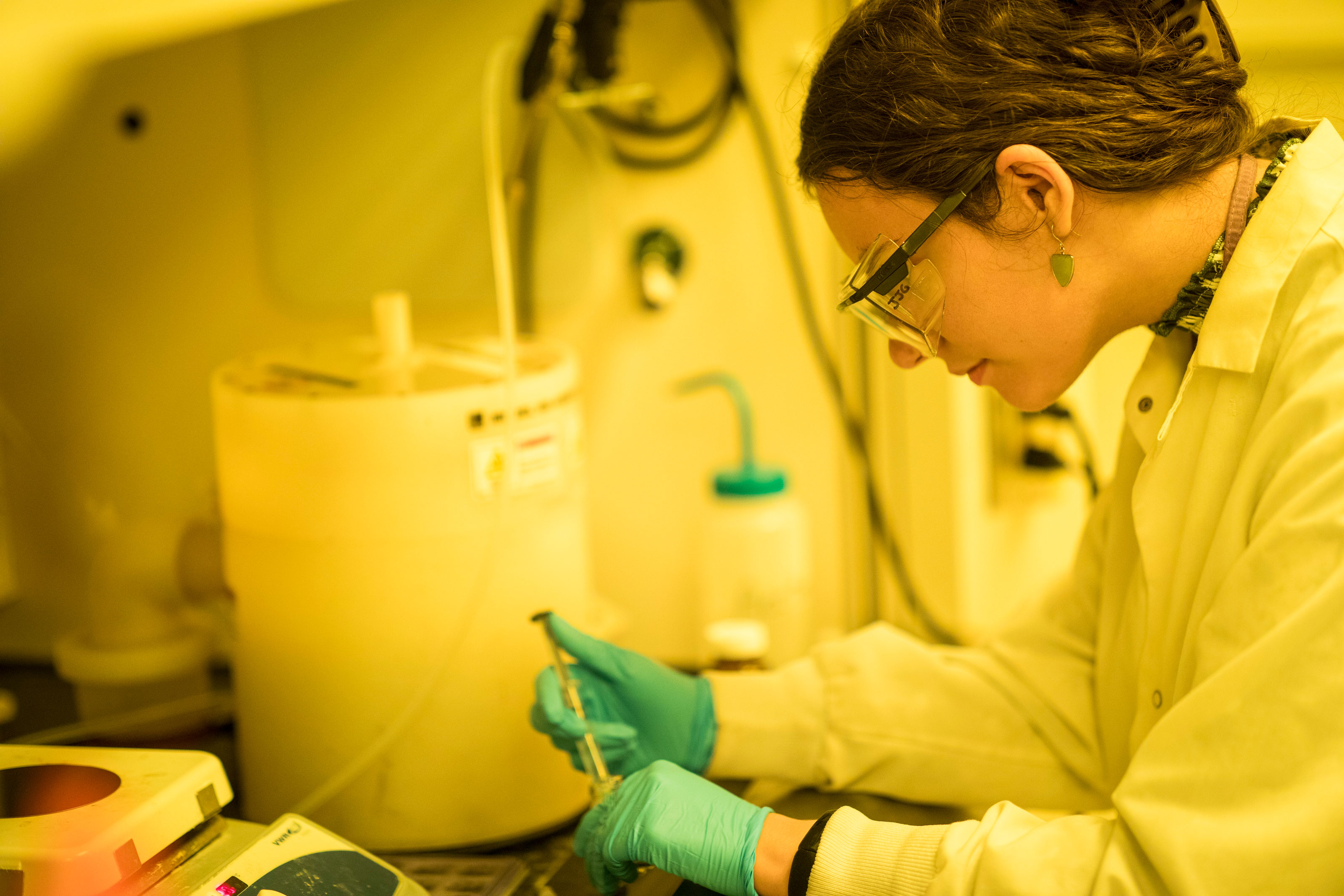
Members of the Brainard Research Group design, synthesize and characterize new molecules and polymers for their use in state-of-the-art technologies in use around the world.
Our projects are divided between those involving the synthesis of new compounds and those involving characterizing the functionality of these new materials in chemical systems relevant to nanotechnology.
Much of our research is focused on photoresists. Photoresists are light-sensitive layers used in nearly every step in the manufacture of integrated circuits and the building of circuit boards. Photoresists are also essential to the fabrication of micro-electro-mechanical systems (MEMs).
To fully understand these fascinating materials, the students in our group must be able to apply concepts that originate in areas such as organic chemistry, inorganic chemistry, polymer science, photochemistry, physics and material science.
We study many of the components of photoresists, including:
Organic polymers
Photoacid generators
Organometallic compounds
Acid amplifiers
Much of this research is based on first developing mechanistic understanding of how these components work (using kinetics and computer modelling) and then redesigning and synthesizing small molecules and polymers.
Ultimately, the new materials are evaluated as photoresists by exposure to 365-nm, 193-nm or 13.5-nm light. Many of our studies also involve the exposure of photoresists with electron beams with energies from 5-2000 eV.
UAlbany students developed wearable haptic devices that provide navigation assistance to the visually impaired as part of the College of Nanotechnology, Science, and Engineering’s 10-week Summer Undergraduate Research Program.
UAlbany junior Alma Kolakji is spending her summer tying to help make rocket fuel more environmentally friendly. She is one of 24 students taking part in the College of Nanotechnology, Science, and Engineering's Summer Undergraduate Research Program.
UAlbany senior Kevin Reyes has always been fascinated with engineering concepts, whether building complex lego sets or folding the perfect airplane. At UAlbany's College of Nanotechnology, Science, and Engineering, Reyes has found a home to explore the cutting edge technology of the future.
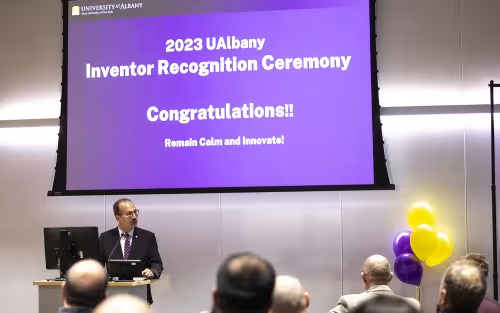
From filing a first disclosure to an issued patent, the process to take an invention from an idea to the marketplace can be long and arduous. For the first time, UAlbany recognized the faculty, staff and students who submitted a patent application as part of Research and Entrepreneurship Week.
The University at Albany’s College of Nanotechnology, Science, and Engineering (CNSE) welcomes the Capital Region community to campus for a series of conversations in celebration of NANOvember.
Extreme ultraviolet (EUV) lithography is used today to pattern the most critical layers (smallest features) in today's fastest integrated circuits using EUV (13.5 nm) light.
Starting in 1998, Dr. Brainard was the first chemist in the world to design photoresists for EUV lithography. Although this work was done before he joined the faculty of CNSE, it is included here because this early work provides a foundation upon which his academic work is built.
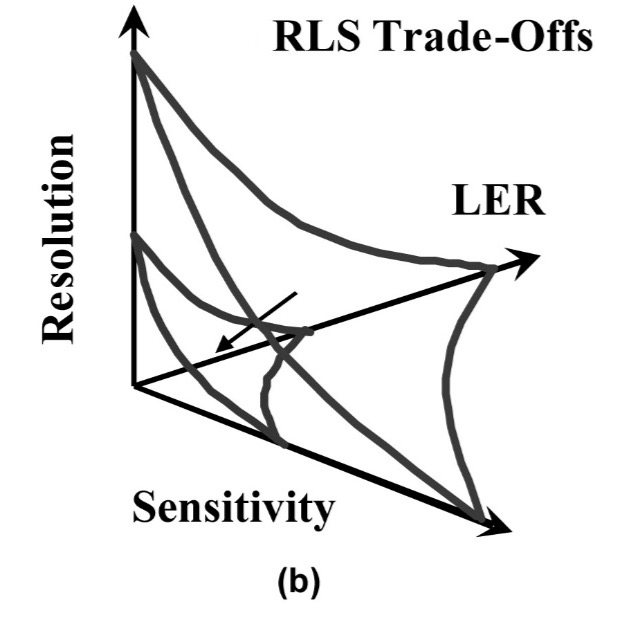
This RLS Triangle describes the trade-off between Resolution, line edge roughness (LER) and Sensitivity for extreme ultraviolet (EUV) photoresists.
The transition from the blue surface to the red surface represents how improvements in materials or processes can move to a better response surface.
About Our Research into Early EUV Photoresists & RLS Trade-Off
The RLS Trade-off
Three of the most important properties of EUV resists are their resolution, line-edge-roughness (LER) and sensitivity. The lowest value of each property is best.
Unfortunately, these three properties are in opposition to each other such that within one resist platform, an improvement in one property leads to a degradation of another.
For this reason, the relationship between these properties is known as the RLS tradeoff. Figure 1 shows the first graphical representation of this relationship, first used in a proposal by Dr. Brainard to DARPA in 1999.
Although resist chemists had observed the nature of the RLS trade-off during the early development of EUV resists (1998-2002), it was not until 2005 that a theoretical model was developed to mathematically define the RLS trade-off.
Although Dr. Brainard was involved in creating the final mathematical model, this section will focus on two experimental studies that led to the full model.
Figure 1. Resolution, line-edge-roughness (LER) and sensitivity are in opposition to each other. The figure shows that improvement in resist design can allow resist performance to improve from the outer response surface to the inner (better) response surface.
References
R. Brainard, C. Henderson, J. Cobb, Jonathan, V. Rao, J. Mackevich, U. Okoroanyanwu, S. Gunn, J. Chambers, S. Connolly, "Comparison of the lithographic properties of positive resists upon exposure to deep- and extreme-ultraviolet radiation", J. Vac. Sci. Tech., B17(6), 3384-3389 (1999).
C. Szmanda, R. Brainard, J. Mackevich, A. Awaji, T. Tanaka, Y. Yamada, J. Bohland, S. Tedesco, B. Dal'Zotto, W. Bruenger, M. Torkler, W. Fallmann, H. Loeschner, R. Kaesmaier, P. Nealey, A. Pawloski, "Measuring acid generation efficiency in chemically amplified resists with all three beams", J. Vac. Sci. Tech., B17(6), 3356-3361 (1999).
V. Rao, J. Cobb, C. Henderson, U. Okoroanyanwu, D. Bozman, P. Mangat, R. Brainard, J. Mackevich, "Ultrathin photoresists for EUV lithography", Proceed. SPIE, 3676, 615-626 (1999).
R. Brainard, “Multiple Anion Nonvolatile Acetals (MANA) proposal to DARPA (1999).
R. Brainard, G. Barclay, E. Anderson, L. Ocola, "Resists for next generation lithography", Microelectron. Eng. 61-62, 707-715 (2002).
J. Cobb, R. Brainard, D. O'Connell, P. Dentinger, "EUV lithography: patterning to the end of the road", Mater. Res. Soc. Symp. P., 705, 91-100 (2002).
R. Brainard, J. Cobb, C. Cutler, "Current status of EUV photoresists", J. Photopoly. Sci. Tech., 16(3), 401-410 (2003).
S. Robertson, P. Naulleau, D. O'Connell, K. McDonald, T. Delano, K. Goldberg, S. Hansen, K. Brown, R. Brainard, “Calibration of EUV-2D photoresist simulation parameters for accurate predictive modeling", Proceed. SPIE, 5037, 900-909 (2003).
C. Cutler, J. Mackevich, J. Li, D. O'Connell, G. Cardinale, R. Brainard, "Effect of polymer molecular weight on AFM polymer aggregate size and LER of EUV resists", Proceed. SPIE, 5037, 406-417 (2003).
R. L. Brainard, P. Trefonas, J. H. Lammers, et al., “Shot noise, LER, and quantum efficiency of EUV photoresists,” Proc. SPIE 5374, 74–85 (2004).
A. Eckert, C. Seiler, R. Brainard, "Resist formulation effects on contrast and top-loss as measured by 3D-SEM metrology", Proceed. SPIE, 5374, 460-467, (2004).
M. Chandhok, H. Cao, Y. Wang, E. Gullikson, R. Brainard, S. Robertson, "Techniques for directly measuring the absorbance of photoresists at EUV wavelengths", Proceed. SPIE, 5374, 861-868 (2004).
T. Köhler, R. Brainard, P. Naulleau, D. Steenwinckel, J. Lammers, K. Goldberg, J. Mackevich, P. Trefonas, "Performance of EUV Photoresists on the ALS Micro Exposure Tool", Proceed. SPIE, 5753, 754-764 (2005).
D. Van Steenwinckel, J. Lammers, T. Koehler, R. Brainard, P. Trefonas, "Resist Effects at Small Pitches", J. Vac. Sci. Tech., B24(1), 316-320 (2006).
G. M. Gallatin, P. Naulleau, and R. Brainard, “Fundamental limits to EUV photoresist,” Proc. SPIE 6519, 651911/1–651911/10 (2007).
E. Hassanein, C. Higgins, P. Naulleau, R. Matyi, G. Gallatin, G. Denbeaux, A. Antohe, J. Thackeray, K. Spear, C. Szmanda, C. Anderson, D. Niakoula, M. Malloy, A. Khurshid, C. Montgomery, E. Piscani, A. Rudack, J. Byers, A. Ma, K. Dean, R. Brainard, "Film quantum yields of EUV and ultra-high PAG photoresists", Proceed. SPIE, 6921, 69211I/1-69211I/13 (2008) doi: 10.1117/12.774009].
C. Higgins, A. Antohe, G. Denbeaux, S. Kruger, J. Georger, and R. L. Brainard, “RLS tradeoff vs. quantum yield of high PAG EUV resists,” Proc. SPIE 7271, 727147 (2009) [doi: 10.1117/12.814307].
A. Narasimhan, L. Wisehart, S. Grzeskowiak, L. E. Ocola, G. Denbeaux, R. L. Brainard, “What We Don’t Know About EUV Exposure Mechanisms”, J. Photopolym. Sci. Technol. 30(1), 113-120 (2017).
Acid Amplifiers
Acid amplifiers are organic molecules that react with acids to create more acid. Although our group did not invent these types of molecules, we specifically designed acid amplifiers that could be used in EUV photoresists.
About Our Research into Acid Amplifiers
Acid amplifiers (AAs) are molecules that decompose in the presence of catalytic acid to generate more acid.
From 1998 to 2002, there were 26 AAs reported in the literature. For the most part, the AAs presented in this early work almost always generated weak sulfonic acids, typically, toluene sulfonic acid. Only two AAs generated fluorinated sulfonic acids.
In 2007, we wrote a proposal to Intel to develop Acid Amplifiers that could be used as additives to chemically amplified resists (CAR), most specifically for use in EUV photoresists.
The idea was to use AAs to amplify the amount of acid generated by photoacid generators (PAGs) during exposure and make progress against the RLS tradeoff. These AAs were specifically designed to create very strong fluorinated acids since they give the best lithographic performance in chemically amplified resists.
Our AAs are composed of three parts: a body, a trigger, and an acid precursor (Figure 1). In the presence of catalytic acid, the trigger is “pulled,” generating an intermediate that has a weak bond between the body and the acid precursor. The acid is released from the body and can then catalyze further decomposition of the AA.
Figure 1. Generic description of acid amplifiers (AAs) developed by our group. Conceptually, our AAs are composed of a body, a trigger and an acid precursor.
References
S. Kruger, S. Revuru, C. Higgins, S. Gibbons, D. A. Freedman, W. Yueh, T. R. Younkin, and R. L. Brainard, “Fluorinated acid amplifiers for EUV lithography,” J. Am. Chem. Soc.131(29), 9862–9863 (2009).
S. A. Kruger, C. Higgins, B. Cardineau, T. R. Younkin, and R. L. Brainard, “Catalytic and autocatalytic mechanisms of acid amplifiers for use in EUV photoresists,” Chem. Mat.22(19), 5609–5616 (2010).
S. A. Kruger, “Fluorinated acid amplifiers for extreme ultraviolet lithography,” Ph.D. Thesis, University at Albany, Albany, New York, 2011.
S. Kruger, K. Hosoi, B. Cardineau, K. Miyauchi, and R. Brainard, “Stable, fluorinated acid amplifiers for use in EUV lithography,” Proc. SPIE 8325, 832514 (2012) [doi: 10.1117/12.917015].
K. Hosoi, B. Cardineau, S. Kruger, K. Miyauchi, and R. Brainard, “Fluorine-stabilized acid amplifiers for use in EUV lithography,” J. Photopolym. Sci. Technol. 25, 575–581 (2012).
G. M. Gallatin, P. P. Naulleau and R. L. Brainard, "Modeling the effects of acid amplifiers on photoresist stochastics," Proc. SPIE 8322, 83221C/83221-83221C/83229 (2012).
S. A. Kruger, C. Higgins, S. Revuru, S. Gibbons, D. Freedman, and R. L. Brainard, “Can acid amplifiers help beat the resolution, line edge roughness and sensitivity trade-off?” Jap. J. App. Phys. 49(4), 041602 (2010).
R. Brainard, S. Kruger, C. Higgins, S. Revuru, S. Gibbons, D. Freedman, Y. Wang, and T. Younkin, “Kinetics, chemical modeling and lithography of novel acid amplifiers for use in EUV photoresists,” J. Photopolym. Sci. Technol. 22, 43–50 (2009).
K. Hosoi, B. Cardineau, W. Earley, S. Kruger, K. Miyauchi and R. Brainard; "Synthesis of stable acid amplifiers that produce strong highly-fluorinated polymer-bound acid," Proc. SPIE 8325, 83251S/83251-83251S/83257 (2012).
S. Kruger, C. Higgins, G. Gallatin and R. L. Brainard; "Lithography and chemical modeling of acid amplifiers for use in EUV photoresists," J. Photopolym. Sci. Technol.24 (2), 143-152 (2011).
R. Brainard, C. Higgins, S. Kruger, S. Revuru, B. Cardineau, S. Gibbons, D. Freedman, H. Solak, Y. Wang, T. Younkin, "Lithographic evaluation and chemical modeling of acid amplifiers used in EUV photoresists", Proceed. SPIE, 7273, 72733Q/1-72733Q/10 (2009).
C. D. Higgins, C. R. Szmanda, A. Antohe, G. Denbeaux, J. Georger, and R. L. Brainard, “Resolution, line-edge roughness, sensitivity tradeoff, and quantum yield of high photo acid generator resists for extreme ultraviolet lithography,” Jpn. J. Appl. Phys. 50(3), 036504 (2011).
Organic Molecules & Polymers
These projects explore how mechanistic hypotheses can be explored using chemical synthesis, modelling and kinetics can be used to make polymers with improved chemical properties.
The Brainard group has a large body of work where we use specific mechanisms rooted in organic chemistry in order to create materials to improve lithography. Acid Amplifiers is our largest body of work in this area, and in the following section we show two more similar ideas:
Double-Deprotected Chemically Amplified Photoresists (DD-CAMP) was designed to use higher-order reaction kinetics to improve photoresist imaging quality.
Chain Scission Polymers for EUV Lithography were investigated to find a way of improving resolution capability of resists with the improving resolution of the optical image.
Both of these platforms were developed starting from a chemical mechanism and a lithographic principle and applying them in conjunction.
About Our Research into Double-Deprotected Chemically Amplified Photoresists (DD-CAMP)
Double-Deprotected Chemically Amplified Photoresists (DD-CAMP) were developed to utilize higher-order reaction kinetics to create photoresists with improved lithographic performance.
DD-CAMP uses an acid-body-trigger design similar to what we have used previously for acid amplifiers, in which two acid-catalyzed reactions are required to completely remove the blocking group (Figure 1A and B).
For DD-CAMP, the removal of the blocking group yields a polymer-bound carboxylic acid which provides the solubility switch in positive-tone chemically amplified photoresists. For acid amplifiers, the removal of the blocking group yields a sulfonic acid that can catalyze reactions in chemically amplified photoresists.
The primary hypothesis behind DD-CAMP is that two sequential acid-catalyzed reactions (Figure 1A and B) will create an overall reaction (ester deprotection) that will be higher than first order in acid (e.g. k is proportional to [H+]^x, where x is greater than 1) if:
The two reaction steps occur at roughly the same rate, and
The bake time (PEB) is optimized.
Figure 1. (A) Basic design and mechanism of DD-CAMP photoresists. (B) A specific example of a DD-CAMP blocking group. (C) A mathematical expression describing the proposed kinetics of acid-catalyzed decomposition of DD-CAMP blocking groups.
References
D. Soucie W. Earley, K. Hosoi, A. Takahashi, T. Aoki, B. Cardineau, K. Miyauch, R. Brainard; “Higher-Order Lithography: Double-Deprotected Chemically Amplified Photoresists (DD-CAMP)”, J. Photopolym. Sci. Technol. 30(3), 351-360 (2017).
W. Earley, D. Soucie, K, Hosoi, A. Takahashi, T. Aoki, B. Cardineau, K. Miyauchi, J. Chun, M. O'Sullivan, R. L. Brainard; "Double-deprotected chemically amplified photoresists (DD-CAMP): higher-order lithography”; Proc. SPIE, 9779, Adv. Pat. Mat. Proc., 101460H (2017).
S. Kruger, S. Revuru, C. Higgins, S. Gibbons, D. A. Freedman, W. Yueh, T. R. Younkin, and R. L. Brainard, submitted to J. Am. Chem. Soc. (2009).
Brainard, R.; Kruger, S.; Higgins, C.; Revuru, S.; Gibbons, S.; Freedman, D.; Wang, Y.; Younkin, T. Kinetics, chemical modeling and lithography of novel acid amplifiers for use in EUV photoresists. J. Photopolym. Sci. Technol. 2009a, 22, 43-50.
S. A. Kruger, C. Higgins, S. Revuru, S. Gibbons, D. Freedman, and R. L. Brainard, “Can acid amplifiers help beat the resolution, line edge roughness and sensitivity trade-off?” Jap. J. App. Phys., 2010, 49(4), p. 041602/1-041602/5.
S. A. Kruger, C. Higgins, B. Cardineau, T. R. Younkin, and R. L. Brainard, “Catalytic and Autocatalytic Mechanisms of Acid Amplifiers for Use in EUV Photoresists,” Chem. Mat., 2010, 22 (19), p. 5609-5616.
R. L. Brainard, S. Kruger, C. Higgins, S. Revuru, S. Gibbons, D. Freedman, Y. Wang, T. Younkin, J. Photopoly. Sci. Tech., 2009, 22, 43-50.
About Our Research into Chain-Scission Polymers for EUV Lithography
Our group has explored the use of chain-scission polymers in an effort to simultaneously improve resolution, line-edge-roughness and sensitivity.
Traditional resist polymers have an acid-sensitive pendant group that is cleaved during photolithography, allowing dissolution of the polymer in alkaline aqueous developer.
Chain-scission polymers are polymers that undergo backbone cleavage during the photolithographic process. Cleaving the main chain converts the polymer from a single high molecular-weight chain to many low molecular-weight segments. These low molecular-weight segments dissolve faster than the starting polymer thereby producing positive-tone imaging.
Our group explored two approaches for incorporating acid-cleavable polyester groups into the polymer backbone. The first approach utilized diacids chlorides (Figure 1A); the second utilized alpha-chloroesters (Figure 1B).
Figure 1. (A) Synthetic scheme for the first set of chain scission polymers by diacyl chloride condensation with diols. (B) Example synthesis for the second set of chain scission polymers by condensation of alpha-chloroesters and diphenols.
References
D. Soucie W. Earley, K. Hosoi, A. Takahashi, T. Aoki, B. Cardineau, K. Miyauch, R. Brainard; “Higher-Order Lithography: Double-Deprotected Chemically Amplified Photoresists (DD-CAMP)”, J. Photopolym. Sci. Technol. 30(3), 351-360 (2017).
W. Earley, D. Soucie, K, Hosoi, A. Takahashi, T. Aoki, B. Cardineau, K. Miyauchi, J. Chun, M. O'Sullivan, R. L. Brainard; "Double-deprotected chemically amplified photoresists (DD-CAMP): higher-order lithography”; Proc. SPIE, 9779, Adv. Pat. Mat. Proc., 101460H (2017).
S. Kruger, S. Revuru, C. Higgins, S. Gibbons, D. A. Freedman, W. Yueh, T. R. Younkin, and R. L. Brainard, submitted to J. Am. Chem. Soc. (2009).
Brainard, R.; Kruger, S.; Higgins, C.; Revuru, S.; Gibbons, S.; Freedman, D.; Wang, Y.; Younkin, T. Kinetics, chemical modeling and lithography of novel acid amplifiers for use in EUV photoresists. J. Photopolym. Sci. Technol. 2009a, 22, 43-50.
S. A. Kruger, C. Higgins, S. Revuru, S. Gibbons, D. Freedman, and R. L. Brainard, “Can acid amplifiers help beat the resolution, line edge roughness and sensitivity trade-off?” Jap. J. App. Phys., 2010, 49(4), p. 041602/1-041602/5.
S. A. Kruger, C. Higgins, B. Cardineau, T. R. Younkin, and R. L. Brainard, “Catalytic and Autocatalytic Mechanisms of Acid Amplifiers for Use in EUV Photoresists,” Chem. Mat., 2010, 22 (19), p. 5609-5616.
R. L. Brainard, S. Kruger, C. Higgins, S. Revuru, S. Gibbons, D. Freedman, Y. Wang, T. Younkin, J. Photopoly. Sci. Tech., 2009, 22, 43-50.
B. Cardineau, P. Garczynski, W. Earley and R. L. Brainard; "Chain-scission polyethers for EUV lithography", J. Photopolym. Sci. Technol. 26 (5), 665-671 (2013).
B. Cardineau, S. Kruger, W. Earley, C. Higgins, S. Revuru, J. Georger, R. Brainard, "Chain-scission polyesters for EUV lithography", J. Photopoly. Sci. Tech., 23(5), 665-671, (2010).
EUV Mechanisms
This research primarily focuses on the physics of the exposure of photoresists by EUV light.
About Our Research into EUV Mechanisms
The physics of EUV exposure mechanisms
In EUV lithography, photons can interact strongly with any resist components, generating electrons through photo-ionization.
An initial photoelectron with an energy range of about 75 to 82 eV may cause further ionization in the resist, generating additional electrons that contribute to the chemical reactions during exposure.
In this section, we describe the physics of the interactions of these electrons as they interact with molecules from their initial creation with energies of about 80 eV until they decay to energies of about 2 eV.
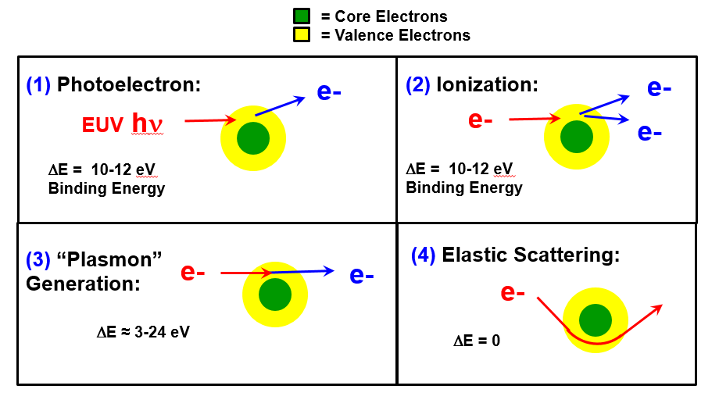
There are four underlying elementary interactions between these about 2 to 80 eV photo- and secondary electrons (Figure 1):
Photoionization: A photon is absorbed by an atom and liberates an electron with enough kinetic energy to interact further. The ionized resist component may yield further electrons or charged ion fragments through electronic and atomic relaxation processes.
Electron ionization: A ballistic electron scatters off an atom and produces another electron such that the total kinetic energy of the two electrons equals the energy of the incident electron less the binding energy of the “daughter” electron.
Plasmon generation: An incident electron scatters off an atom, losing energy and causing a coherent displacement wave in the bound electrons. It is currently unclear if plasmons can be an additional source of electron–hole pairs.
Elastic scattering: The trajectory of an incident electron is altered by the Coulombic potential of an atom with no associated energy loss. In CARs, ionization and plasmon generation of PAG or polymer may directly produce acid.
Figure 1. A schematic drawing of the four elementary physical electron–matter interactions described above.
References
J. Torok, R. Del Re, H. Herbol, S. Das, I. Bocharova, A. Paolucci, L. E. Ocola, C. Ventrice, Jr., E. Lifshin, G. Denbeaux, and R. L. Brainard, “Secondary electrons in EUV lithography,” J. Photopolym. Sci. Tech. 26(5), 625–634 (2013).
R. Brainard, E. Hassanein, J. Li, et al., “Photons, electrons, and acid yields in EUV photoresists: a progress report,” Proc. SPIE 6923, 692325 (2008) [doi: 10.1117/12.773869].
Narasimhan, S. Grzeskowiak, B. Srivats, H. Herbol, L. Wisehart, J. Schad, C. Kelly, W. Earley, L. E. Ocola, M. Neisser, G. Denbeaux, and R. L. Brainard, “Studying thickness loss in extreme ultraviolet resists due to electron beam exposure using experiment and modeling” J. Micro/Nanolith. MEMS MOEMS 14(4), 043502 (2015). [doi: 10.1117/1.JMM.14.4.043502].
J. Thackeray, J. Cameron, V. Jain, P. LaBeaume, S. Coley, O. Ongayi, M. Wagner, A. Rachford, and J. Biafore, “Progress in resolution, sensitivity, and critical dimensional uniformity of EUV chemically amplified resists,” Proc. SPIE 8682, 868213 (2013) [doi: 10.1117/12.2011565].
A. Narasimhan, S. Grzeskowiak, J. Ostrander, J. Schad, E. Rebeyev, M. Neisser, L. E. Ocola, G. Denbeaux, and R. L. Brainard, “Studying electron-PAG interactions using electron-induced fluorescence,” Proc. SPIE 9779, 97790F (2016) [doi: 10.1117/12.2219850].
S. Enomoto, A. Oshima, and S. Tagawa, “Reaction mechanisms of various chemically amplified EUV and EB resist,” Proc. SPIE 8679, 86792C (2013) [doi: 10.1117/12.2011634].
S. Ptasińska, D. Gschliesser, P. Bartl, I. Janik, P. Scheier, and S. Denifl, “Dissociative electron attachment to triflates,” J. Chem. Phys. 135(21), 214309 (2011).
D. L. Goldfarb, A. Afzali-Ardakani, and M. Glodde, “Acid generation efficiency: EUV photons versus photoelectrons,” Proc. SPIE 9779, 97790A (2016) [doi: 10.1117/12.2218457].
S. Tarutani, H. Tsubaki, H. Tamaoki, H. Takahashi, and T. Itou, “Study on approaches for improvement of EUV-resist sensitivity,” Proc. SPIE 7639, 763909 (2010) [doi: 10.1117/12.846031].
T. H. Fedynyshyn, R. B. Goodman, and J. Roberts, “Polymer matrix effects on acid generation,” Proc. SPIE 6923, 692319 (2008) [doi: 10.1117/12.7716692].
T. H. Fedynyshyn, R. B. Goodman, A. Cabral, C. Tarrio, and T. B. Lucatorto, “Polymer photochemistry at the EUV wavelength,” Proc. SPIE 7639, 76390A (2010) [doi: 10.1117/12.845997].
R. L. Brainard, P. Trefonas, J. H. Lammers, et al., “Shot noise, LER, and quantum efficiency of EUV photoresists,” Proc. SPIE 5374, 74–85 (2004).
R. L. Brainard, G. G. Barclay, E. H. Anderson, and L. E. Ocola, “Resists for next generation lithography,” Microelec. Eng. 61-62, 707–715 (2002).
R. L. Brainard, C. Henderson, J. Cobb, et al., “Comparison of the lithographic properties of positive resists upon exposure to deep- and extreme-ultraviolet radiation,” J. Vac. Sci. Tech. B 17(6), 3384–3389 (1999).
S. P. Pappas, B. C. Pappas, L. R. Gatechair, and W. Schnabel, “Photoinitiation of cationic polymerization. II. Laser flash photolysis of diphenyliodonium salts,” J. Polymer Sci. 22(1), 69–76 (1984).
J. L. Dektar and N. P. Hacker, “Photochemistry of triarylsulfonium salts,” J. Amer. Chem. Soc. 112(16), 6004–6015 (1990); J. L. Dektar and N. P. Hacker, “Photochemistry of diaryliodonium salts,” J. Org. Chem. 55(2), 639–647 (1990).
J. F. Cameron, N. Chan, K. Moore, G. Pohlers, “Comparison of acid-generating efficiencies in 248 and 193-nm photoresists,” Proc. SPIE 4345, 106–118 (2001).
N. P. Hacker, D. C. Hofer, and K. M. Welsh, “Photochemical and photophysical studies on chemically amplified resists,” J. Photopolymer Sci. Tech. 5(1), 35–46 (1992); K. M. Welsh, J. L. Dektar, M. A. Garcia-Garibaya, N. P. Hacker, and N. J. Turro, “Photo-CIDNP and nanosecond laser flash photolysis studies on the photodecomposition of triarylsulfonium salts,” J. Org. Chem. 57(15), 4179–84 (1992).
T. Kozawa and S. Tagawa, “Basic aspects of acid generation processes in chemically amplified resists for electron beam lithography,” Proc. SPIE 5753, 361–367 (2005); T. Kozawa and S. Tagawa, “Basic aspects of acid generation processes in chemically amplified electron beam resist,” J. Photopoly. Sci. Tech. 18(4), 471–474 (2005).
S. Tagawa, S. Nagahara, T. Iwamoto, et al., “Radiation and photochemistry of onium salt acid generators in chemically amplified resists,” Proc. SPIE 3999, 204–213 (2000).
A. Nakano, K. Okamoto, Y. Yamamoto, et al., “Deprotonation mechanism of poly(4-hydroxystyrene) and its derivative,” Proc. SPIE 5753, 1034–1039 (2005).
T. Kozawa, A. Saeki, and S. Tagawa, “Modeling and simulation of chemically amplified electron beam, x-ray, and EUV resist processes,” J. Vac. Sci. Tech. B 22(6), 3489–3492 (2004).
H. Yamamoto, T. Kozawa, A. Nakano, et al., “Dependence of acid generation efficiency on the protection ratio of hydroxyl groups in chemically amplified electron beam, x-ray and EUV resists,” J. Vac. Sci. Tech. B 22(6), 3522–3524 (2004).
T. Kozawa, A. Saeki, A. Nakano, Y. Yoshida, and S. Tagawa, “Relation between spatial resolution and reaction mechanism of chemically amplified resists for electron beam lithography,” J. Vac. Sci. Tech. B 21(6), 3149–3152 (2003).
E. Hassanein, C. Higgins, P. Naulleau, R. Matyi, G. Gallatin, G. Denbeaux, A. Antohe, J. Thackeray, K. Spear, C. Szmanda, and C. N. Anderson, “Film quantum yields of EUV and ultra-high PAG photoresists” Proc. SPIE 6921, 69211I (2008) doi: 10.1117/12.774009].
C. Higgins, A. Antohe, G. Denbeaux, S. Kruger, J. Georger, and R. L. Brainard, “RLS tradeoff vs. quantum yield of high PAG EUV resists,” Proc. SPIE 7271, 727147 (2009) [doi: 10.1117/12.814307].
R. Hirose, T. Kozawa, S. Tagawa, T. Kai, and T. Shimokawa, “Dependence of acid generation efficiency on molecular structures of acid generators upon exposure to extreme ultraviolet radiation,” Appl. Phys. Express 1(2), 027004 (2008).
Narasimhan, S. Grzeskowiak, C. Ackerman, T. Flynn, G. Denbeaux, R. L. Brainard; "Mechanisms of EUV exposure: electrons and holes”; Proc. SPIE, 10143, EUVL, 101430W (2017).
Molecular Organometallic Resists for EUV (MORE)
These projects explore EUV photoresists that are composed of compounds that contain elements in the periodic table that strongly absorb EUV (13.5 nm) light. A total of five chemical platforms have been invented and developed by students in our group.
About Our Research into MORE
For decades chemists in the microelectronics industry designed resists with two accepted goals:
To minimize the absorption of the light used to pattern them
To minimize the amount of contaminant metals below 20 ppm
However, in 2011, two discoveries reversed these accepted goals:
A paper by Jim Thackeray demonstrated that EUV absorption by resists should increase dramatically.
Researchers at Oregon State University and Cornell demonstrated that the relatively-transparent hafnium-oxide films could be excellent photoresists.
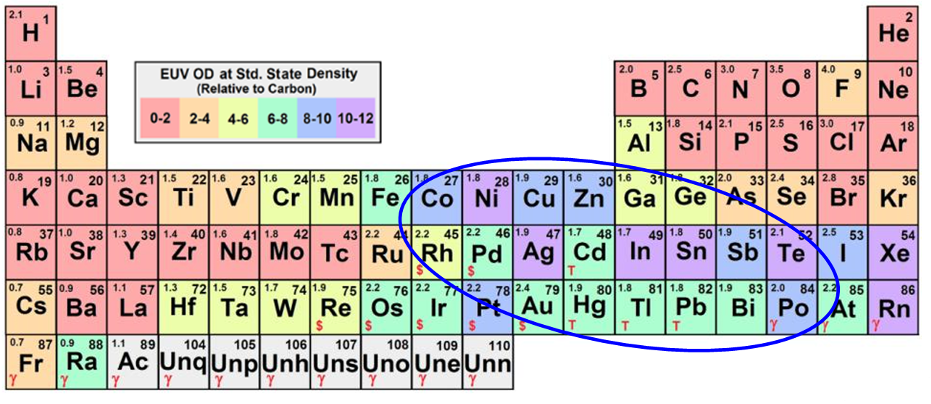
Our group responded to these two discoveries by proposing to develop resists containing metals that strongly absorb EUV light (Figure 1).
Figure 1. Periodic Table of Elements colored by EUV Optical density of the element. Our group has focused on designing, synthesizing and lithographically evaluating compounds containing the metals within the oval that strongly absorb EUV (13.5 nm) light.
A distinct shift of one amu is observed between d0-JP-18 and d6-JP-18 for the outgassing of phenol. With a minimum of 95% isotopic purity, we concluded that a hydrogen is abstracted from the acetate ligand to generate phenol during EUV exposure.
Summary
Since 2011, two new directions in the development of EUV photoresists has been explored — increased EUV absorption and metal-containing resists.
Our group is one of only a handful of academic research groups in the world working on the development of these fascinating materials. We were one of the first groups to develop EUV resists containing main-group metals.
This remains an active area of research in our group.
References
J. M. Amador, S. R. Decker, S. E. Lucchini, R. E. Ruther, and D. A. Keszler, “Patterning chemistry of HafSOx photoresist,” Proc. SPIE 9051, 90511A (2014) [doi: 10.1117/12.2046606].
J. Stowers and D. A. Keszler, “High resolution, high sensitivity inorganic resists,” Micro. Eng. 86, 730–733 (2009).
M. Trikeriotis, W. J. Bae, E. Schwartz, M. Krysak, N. Lafferty, P. Xie, B. Smith, P. A. Zimmerman, C. K. Ober, and E. P. Giannelis, “Development of an inorganic photoresist for DUV, EUV, and electron beam imaging,” Proc. SPIE 7639, 76390E (2010) [doi: 10.1117/12.846672].
M. Krysak, M. Trikeriotis, E. Schwartz, N. Lafferty, P. Xie, B. Smith, P. Zimmerman, W. Montgomery, E. Giannelis, and C. K. Ober, “Development of an inorganic nanoparticle photoresist for EUV, e-beam, and 193 nm lithography,” Proc. SPIE 7972, 79721C (2011) [doi: 10.1117/12.879385].
M. Trikeriotis, M. Krysak, Y. S. Chung, C. Ouyang, B. Cardineau, R. Brainard, C. K. Ober, E. P. Giannelis, and K. Cho, “Nanoparticle photoresists from HfO2 and ZrO2 for EUV patterning,” J. Photopolym. Sci. Technol. 25, 583–586 (2012).
M. Kryask, M. Trikeriotis, C. Ouyang, A. Chakrabarty, E. P. Giannelis, and C. K. Ober, “Nanoparticle photoresists: ligand exchange as a new and sensitive EUV patterning mechanism,” J. Photopolym. Sci. Technol. 26, 659–664 (2013).
S. Chakrabarty, C. Ouyang, M. Krysak, M. Trikeriotis, K. Cho, E. P. Giannelis, and C. K. Ober, “Oxide nanoparticle EUV resists: toward understanding the mechanism of positive and negative tone patterning,” Proc. SPIE 8679, 867906 (2013) [doi: 10.1117/12.2011490].
C. Y. Ouyang, Y. S. Chung, L. Li, M. Neisser, K. Cho, E. P. Giannelis, and C. K. Ober, “Non-aqueous negative-tone development of inorganic metal oxide nanoparticle photoresists for next generation lithography,” Proc. SPIE 8682, 86820R (2013) [doi: 10.1117/12.2011282].
M. E. Krysak, J. M. Blackwell, S. E. Putna, M. J. Leeson, T. R. Younkin, S. Harlson, K. Frasure, and F. Gstrein, “Investigation of novel inorganic resists materials for EUV lithography,” Proc. SPIE 9048, 904805 (2014) [doi: 10.1117/12.2046677]
J. Jiang, S. Chakrabarty, M. Yu, and C. K. Ober, “Metal oxide nanoparticle photoresists for EUV patterning,” J. Photopolym. Sci. Technol. 27(5), 663–666 (2014).
J. Jiang, B. Zhang, M. Yu, L. Li, M. Neisser, J. S. Chun, E. P. Giannelis, and C. K. Ober, “Oxide nanoparticle EUV (ONE) photoresists: current understanding of the unusual patterning mechanism,” J. Photopolym. Sci. Technol. 28, 515–518 (2015).
L. Li, S. Chakrabarty, J. Jiang, B. Zhang, C. Ober, and E. P. Giannelis, “Solubility studies of inorganic-organic hybrid nanoparticle photoresists with different surface functional groups,” Nanoscale 8, 1338–1343 (2016).
Y. Ekinci, M. Vockenhuber, L. Wang, and N. Mojarad, “Evaluation of EUV resist performance with interference lithography towards 11 nm half-pitch and beyond,” Proc. SPIE 8679, 867910 (2013) [doi: 10.1117/12.2011533].
B. Cardineau, R. Del Re, M. Marnell, H. Al-Mashat, M. Vockenhuber, Y. Ekinci, C. Sarma, D. A. Freedman, and R. L. Brainard, “Photolithographic properties of tin-oxo clusters using extreme ultraviolet light (13.5 nm),” Microelectron. Eng. 127, 44–50 (2014).
B. Cardineau, R. Del Re, H. Al-Mashat, M. Marnell, M. Vockenhuber, Y. Ekinci, C. Sarma, M. Neisser, D. A. Freedman, and R. L. Brainard, “EUV resists based on tin-oxo clusters,” Proc. SPIE 9051, 90511B (2014) [doi: 10.1117/12.2046536].
R. Del Re, J. Passarelli, M. Sortland, B. Cardineau, Y. Ekinci, E. Buitrago, M. Neisser, D. A. Freedman, and R. L. Brainard, “Low-line edge roughness extreme ultraviolet photoresists of organotin carboxylates,” J. Micro/Nanolith. MEMS MOEMS 14(4), 043506 (2015) [doi: 10.1117/JMM.14.4.043506].
R. Del Re, M. Sortland, J. Pasarelli, B. Cardineau, Y. Ekinci, M. Vockenhuber, M. Neisser, D. Freedman, and R. L. Brainard, “Low-LER tin carboxylate photoresists using EUV,” Proc. SPIE 9422, 942221 (2015) [doi: 10.1117/12.2086597].
M. Sortland, J. Hotalen, R. Del Re, J. Passarelli, M. Murphy, T. S. Kulmala, Y. Ekinci, M. Neisser, D. A. Freedman, and R. L. Brainard, “Platinum and palladium oxalates: positive-tone extreme ultraviolet resists,” J. Micro/Nanolith. MEMS MOEMS 14(4), 043511 (2015) [doi: 10.1117/1.JMM.14.4.043511].
M. Sortland, R. Del Re, J. Passarelli, J. Hotalen, M. Vockenhuber, Y. Ekinci, M. Neisser, D. A. Freedman, and R. L. Brainard, “Positive-tone EUV resists: complexes of platinum and palladium,” Proc. SPIE 9422, 942227 (2015) [doi: 10.1117/12.2086598].
R. S Paonessa, A. L. Prignano, and W. C. Trogler, “Photochemical generation of bis(phosphine)palladium and bis(phosphine)platinum equivalents,” Organometallics 4(4), 647–657 (1985).
D. M. Blake and C. J. Nyman, “Photochemical reactions of oxalatobis(triphenylphosphine)platinum(II) and related compounds,” J. Am. Chem. Soc. 92(18), 5359–5364 (1970).
Y. J. Pan, J. T. Mague, and M. J. Fink, “Synthesis, structure, and unusual reactivity of a d10-d10 palladium(0) dimer,” J. Am. Chem. Soc. 115(9), 3842–3843 (1993).
G. K. Anderson, G. J. Lumetta, and J. W. Siria, “Photochemical reactions of diphosphineplatinum(II) oxalate complexes,” J. Organometallic Chemistry 434(2), 253–259 (1992).
J. Passarelli, M. Murphy, R. Del Re, M. Sortland, J. Hotalen, L. Dousharm, Y. Ekinci, M. Neisser, D. Freedman, R. Fallica, D. A. Freedman, and R. L. Brainard, “Organometallic carboxylate resists for extreme ultraviolet with high sensitivity,” J. Micro/Nanolith. MEMS MOEMS 14(4), 043503 (2015) [doi: 10.1117/1.JMM.14.4.043503].
J. Passarelli, M. Murphy, R. Del Re, M. Sortland, L. Dousharm, M. Vockenhuber, Y. Ekinci, M. Neisser, D. A. Freedman, and R. L. Brainard, “High-sensitivity molecular organometallic resist for EUV (MORE),” Proc. SPIE 9425, 94250T (2015) [doi: 10.1117/12.2086599].
M. Murphy, J. Sitterly, S. Grzeskowiak, G. Denbeaux, R. L. Brainard, "Isotopic labeling studies of EUV photoresists containing antimony"; J. Photopolym. Sci. Technol. 31(2) 233 (2018).
M. Murphy, A. Narasimhan, S. Grzeskowiak, J. Sitterly, P. Schuler, J. Richards, G. Denbeaux, R. L. Brainard; "Antimony photoresists for EUV lithography: mechanistic studies”; Proc. SPIE, 10143, EUVL, 1014307 (2017).
M. Murphy, S. Hasan, S. Novak, G. Denbeaux, R. L. Brainard, "ToF-SIMS analysis of antimony carboxylate EUV photoresists," Proc. SPIE 10960, 1096010 (2019).
S. Hasan, M. Murphy, M. Weires, S. Grzeskowiak, G. Denbeaux, R. L. Brainard "Oligomers of MORE: Molecular Organometallic Resists for EUV," Proc. SPIE 10960, 109601Q (2019).
M. Wilklow-Marnell, D. Moglia, B. Steimle, B. Cardineau, H. Al-Mashat, P. Nastasi, K. Heard, A. Aslam, R. Kaminski, M. Murphy, R. Del Re, M. Sortland, M. Vockenhuber, Y. Ekinci, R. L. Brainard, D. A. Freedman, "First-row transitional-metal oxalate resists for EUV," J. Micro/Nanolith. MEMS MOEMS 17(4), 043507 (2018).
M. Murphy, J. Sitterly, S. Grzeskowiak, G. Denbeaux, R. L. Brainard, "Mechanisms of photodecomposition of metal-containing EUV photoresists: isotopic labelling studies"; Proc. SPIE 10586, Adv. Pat. Mat. Proc., 1058608 (2018).
J. Sitterly, M. Murphy, S. Grzeskowiak, G. Denbeaux, R. L. Brainard, "Molecular organometallic resists for EUV (MORE): Reactivity as a function of metal center (Bi, Sb, Te and Sn)"; Proc. SPIE 10586, Adv. Pat. Mat. Proc., 105861P (2018).
M. Murphy, A. Narasimhan, S. Grzeskowiak, J. Sitterly, P. Schuler, J. Richards, G. Denbeaux and R. L. Brainard, “EUV Mechanistic Studies of Antimony Resists”, J. Photopolym. Sci. Technol. 30(1), 121-131 (2017).
S. Grzeskowiak, A. Narasimhan, M. Murphy, L. Napolitano, D. A. Freedman, R. L. Brainard, G. Denbeaux; "Reactivity of metal-oxalate EUV resists as a function of the central metal”; Proc. SPIE, 10146, Adv. Pat. Mat. Proc., 1014605 (2017).
J. Hotalen, M. Murphy, W. Earley, M. Vockenhuber, Y. Ekinci, D. A. Freedman, R. L. Brainard; "Advanced development techniques for metal-based EUV resists”; Proc. SPIE, 10143, EUVL, 1014309 (2017).
J. Passarelli, M. Sortland, R. Del Re, B. Cardineau, C. Sarma, D. Freedman, R. Brainard; “Bismuth resists for EUV lithography,” J. Photopolym. Sci. Technol. 27(5), 655-661 (2014).
J. Passarelli, B. Cardineau, R. Del Re, M. Sortland, M. Vockenhuber, Y. Ekinci, C. Sarma, M. Neisser, D. Freedman, R. Brainard, “EUV resists comprised of main group organometallic oligomeric materials,” Proceedings of SPIE, 9051 (2014).
B. Cardineau, M. Krysak, M. Trikeriotis, E. Giannelis, C. K. Ober, K. Cho and R. L. Brainard; "Tightly bound ligands for hafnium nanoparticle EUV resists," Proc. SPIE 8322, 83220V/83221-83220V/83210 (2012).
M. Trikeriotis, M. Krysak, Y. Sook Chung, C. Ouyang, B. Cardineau and R. Brainard, C. K. Ober, E. P. Giannelis, K. Cho; "Nanoparticle photoresists from HfO2 and ZrO2 for EUV patterning," J. Photopolym. Sci. Technol. 25 (5), 583-586 (2012).
M. Trikeriotis, M. Krysak, Y. Sook Chung, C. Ouyang, B. Cardineau and R. Brainard, C. K. Ober, E. P. Giannelis, K. Cho; "A new inorganic extreme-UV resist with high-etch resistance," Proc. SPIE 8322, 83220U/83221-83220U/83226 (2012).