



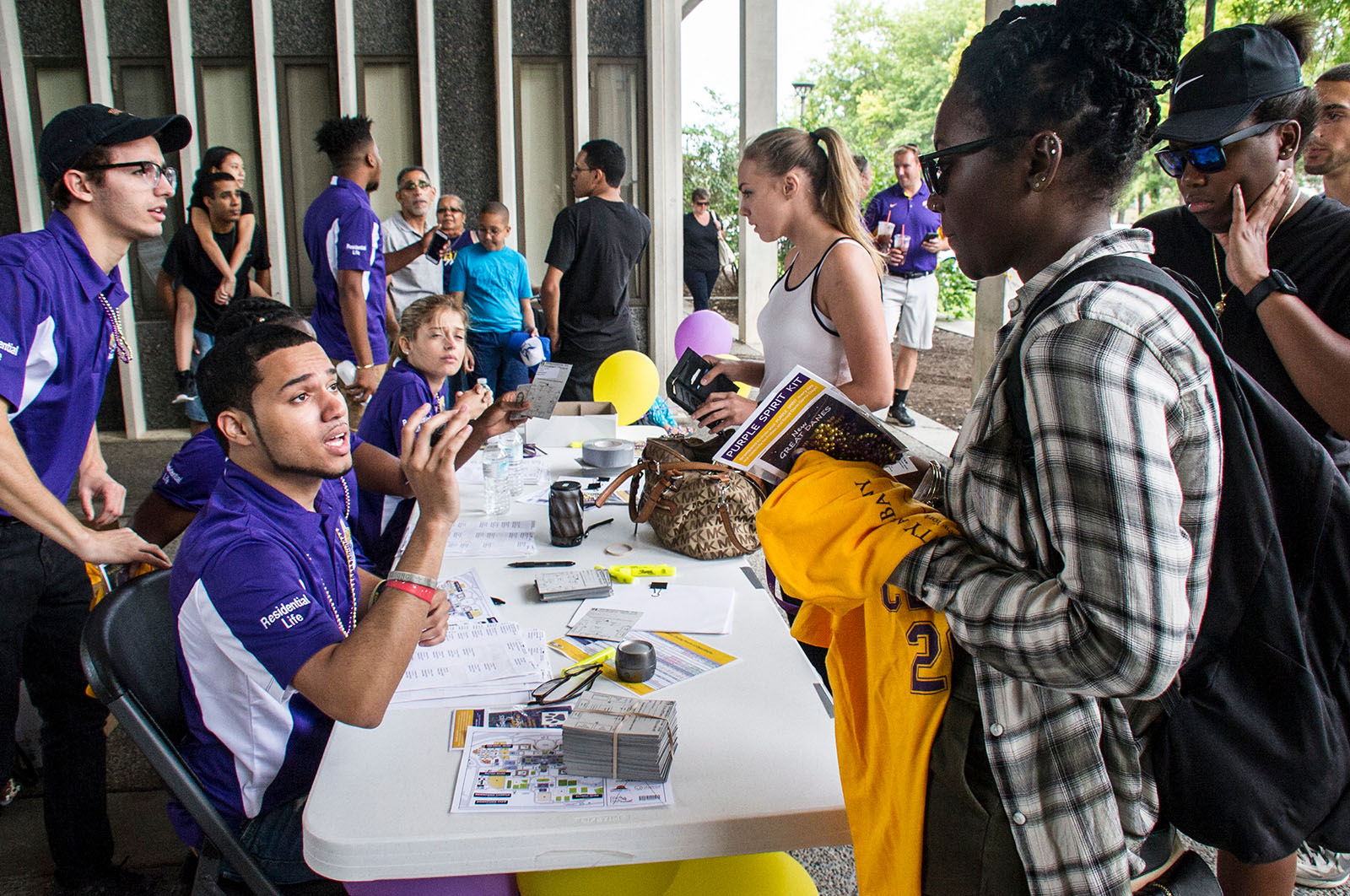
Two students having a conversation outside on a UAlbany residential quad.

Bachelor of Science in
Data Science

Program of Study

programofstudy

In the Data Science BS program you’ll learn to use and understand the language of data through a curriculum that balances the theoretical principles of mathematics with modern applications.

The required coursework along with practical training in programming tools and database development and management will help you gain a strong foundation in the mathematical, statistical and computational principles of data science.

Your capstone project will allow you to use real-world data and situations from a range of industries to demonstrate your new knowledge and skills.


Foundational Courses

  • Calculus I & II
  • Calculus of Several Variables
  • Linear Algebra
  • Information Literacy in Mathematics and Statistics
  • Introduction to Computer Science

Choose one:

  • Artificial Intelligence for Everyone
  • Information Technologies for Business
  • Improving Business Performance with Information Technologies
  • Introduction to Combinatorics

Upper-Division Courses

  • Introduction to Proofs
  • Introduction to Computational Thinking
  • Probability for Statistics
  • Statistics
  • Applied Statistics
  • Geometric and Topological Analysis
  • Optimization
  • Statistical Machine Learning
  • Practical Methods in Topological Data Analysis OR Practical Methods in Machine Learning


Research and Experiential Learning

Through a practicum/capstone course, you’ll have the chance to work with real-world datasets.  

You’ll be directly involved with analysis and model building, gaining hands-on experience you can use in your future career or graduate studies. 

Accelerated Undergraduate/Graduate Options


You can save time and money by beginning your graduate degree coursework while still enrolled as an undergraduate student. Up to 12 academic credits, billed at the undergraduate rate, will count towards both degrees – so you’ll complete your combined program in only 5 years and spend less than you would if you completed each program separately. Choose to combine your Mathematics undergraduate degree with the following graduate programs:

combined

MA in Mathematics
This master’s program studies complex statistics and data analysis to develop relative risk models, as well as tools and techniques for conducting research.

MS in Data Science
This master’s program explores the theories and applications that enable machines to learn and make predictions, allowing you to process, analyze and present complex data to make better management and policy decisions.

MS in Information Science 
This ALA-accredited master's program covers a broad range of interdisciplinary topics related to library science, information processing, information management and data analysis.

MS in Secondary Education
This New York State-approved teacher preparation program provides you with initial certification to teach a specific subject to students in grades 7-12 in New York State public schools.


UAlbany student at the Commencement ceremony

Career Outlook


A BS in Data Science from UAlbany will help you develop knowledge and skills that you can apply to a career in broad range industries, including tech, healthcare and finance.  

Or, if you are interested in going on to an advanced degree program, you’ll be well prepared to continue your studies in data science, statistics or a related quantitative field.  

Whichever path you choose, with this degree you’ll have the theoretical depth you need to adapt to evolving technologies and find success in this growing profession.  

Potential job titles with a Data Science BS include:  

  • Junior Data Scientist
  • Data Analyst
  • Data Engineer
  • Business Intelligence Engineer 


Three students with laptops sitting at a table in UAlbany's Massry Center for Business
careers
Student Learning Objectives


Learning objectives that UAlbany students are expected to attain through their course of study within their academic program.

Bachelor of Science

Students who successfully complete the BS in Data Science are able to:

  • Apply multivariable calculus, linear algebra and statistical theory to construct and validate predictive models.
  • Use high-level programming and database management tools to automate data collection, cleaning and analysis.
  • Select and implement appropriate machine learning algorithms to solve complex problems and optimize data-driven decision-making.
slo

What Makes the University at Albany Great

Student move-in day.

Living-Learning Communities

Live and take classes with other incoming freshmen who share your personal interests, passions or intended academic major.

A student abroad visiting a monument.

Study Abroad

Become a global citizen: international experience is crucial to success in business, education, research, and public policy.

A student conducting undergraduate research.

Undergraduate Research

Research, scholarship, and creative activities at the University at Albany is an option for all students, across all academic disciplines. You will be able to learn more about a specific academic field or career path all while building a long-lasting mentoring relationship with a faculty member or principal investigator.

Explore Minors

Build competency in a passion or strengthen your resume.

A minor consists of 18–24 graduation credits which must include a minimum of 9 graduation credits of advanced coursework at or above the 300 level. Most undergraduate degrees require completing a minor and it has to have a different title from your major.

Full List of Minors
  • Acting
  • Africana Studies
  • Anthropology
  • Art
  • Art History
  • Atmospheric Science
  • Bioethics
  • Biology
  • Business
  • Chemistry
  • Chinese Studies
  • Climate Science
  • Cognitive Science
  • Communication (Fully Online Option)
  • Computer Science
  • Creative Writing
  • Criminal Justice Studies (Fully Online Option)
  • Cybersecurity (Fully Online Option)
  • Documentary Studies
  • East Asian Studies
  • Economics
  • Educational Studies
  • Electrical and Computer Engineering
  • Electronics
  • Emergency Preparedness, Homeland Security and Cybersecurity (Fully Online Option)
  • English
  • Ethics and Philosophy of Artificial Intelligence
  • Film Studies
  • Forensic Science
  • French
  • Game Design and Development
  • Geographic Information Science
  • Geography
  • Globalization Studies
  • Hebrew
  • History (Fully Online Option)
  • Informatics (Fully Online Option)
  • Instrumental Performance
  • International Studies
  • Italian
  • Japanese Studies
  • Journalism (Fully Online Option)
  • Judaic Studies
  • Korean Studies
  • Latin American and Caribbean Studies
  • Law and Philosophy
  • Leadership
  • Legal Studies
  • LGBTQ Studies
  • Library and Information Science
  • Linguistics
  • Machine Learning
  • Mathematics
  • Medical Anthropology
  • Music
  • Musical Performance
  • Musical Theatre
  • Philosophy
  • Physics
  • Political Science
  • Portuguese
  • Pre-Education
  • Psychology (Fully Online Option)
  • Public Health
  • Public Policy
  • Religious Studies
  • Russian
  • Russian and Eastern European Studies
  • Social Welfare Studies
  • Sociology (Fully Online Option)
  • Spanish
  • Statistics
  • Sustainability
  • Theatre
  • Theatrical Design/Technology
  • Urban Studies and Planning
  • U.S. Latino Studies
  • Vocal Performance
  • Weather and Climate Communication
  • Women's, Gender and Sexuality Studies

International Students

This degree is designated as a STEM program. International students maintaining F-1 status are allowed to apply for up to 12 months of post-completion Optional Practical Training (OPT) following completion/graduation from their degree program. Currently, this degree program is also designated by the Department of Homeland Security (DHS) as an eligible degree for the F-1 STEM OPT work authorization extension; students who secure qualifying employment may be eligible to apply for the STEM OPT extension for a cumulative total of up to 36 months of F-1 OPT work authorization.