
A group of students walking inside the New York State Capitol building.

Bachelor of Science in
Interdisciplinary Studies - Legal Studies

Program of Study

programofstudy

The BS in Interdisciplinary Studies with a concentration in Legal Studies is a minimum 48-credit combined major and minor program that invites you to get curious and explore varied subjects on your path to understanding the law.

The foundational course offers a unique interdisciplinary introduction to the study of law, bringing together insights from all contributing fields. From there, you’ll study a balanced mix of history, philosophy, political science and criminal justice in the required lower- and upper-level courses to establish a strong foundation in these subjects. In your capstone course, you’ll have the opportunity to delve deeper into a topic that sparks your interest.

You’ll also take electives in the areas that appeal most to you along one of three tracks – law in theory, law in practice or general. Experiential learning experiences, like study abroad or coursework in other disciplines, can be counted as some of your elective credits as well.  Finally, in your senior year, you can get a “taste of law” by taking a course at Albany Law.

Required Courses

Foundational Course

  • Introduction to Legal Studies 


Field Courses and Capstone Course

See below for Field and Capstone course requirements.
 

Track Courses

Choose one of the three tracks below, and complete upper-division credits from the courses listed for your chosen track. 

Field and Capstone Courses
Lower-Level Field Courses

Choose one philosophy course:

  • Critical Thinking
  • Introduction to Logic

Choose one history course:

  • Public Policy in Modern America
  • Trials in United States History
  • The Supreme Court and American Constitutional History
  • History of Marriage and Family in the U.S.

Choose one criminal justice course:

  • Introduction to the Criminal Justice Process
  • Introduction to Law and Criminal Justice

Choose one political science course:

  • Introduction to Law and Politics
  • The Supreme Court and the American Constitutional History
Upper-Level Field Courses

Choose one philosophy course:

  • Intensive Study Ethical Theory
  • Political and Social philosophy
  • Philosophy of Law
  • Moral Philosophy
  • Intensive Study History of Social and Political Philosophy  
  • Moral Problems in Medicine
  • Global Justice
  • Environmental Ethics
  • AI in Society: Ethical and Legal Issues

Choose one history course:

  • Constitutional History of the United States
  • The Roles of Law in American History  
  • Lawyers in American Life, 1607 to Present  
  • Crime and Punishment in Traditional China  

Choose one criminal justice course:

  • American Criminal Courts
  • 400-level criminal justice course  

Choose one political science course:

  • Contemporary Democratic Theory  
  • American Political Theory  
  • Contemporary Political Philosophy  
  • Comparative Criminal Procedure  
  • Introduction to Public Law  
  • Comparative Judicial Politics  
  • Law and Policy  
  • Law, Courts and Politics  
  • Women and the Law  
  • The American Supreme Court  
  • Civil Liberties  
  • Predicting the Supreme Court  
Capstone Courses
Capstone Courses

Choose one:  

  • Perspectives on Reasoning
  • Advanced Philosophy of Law
  • Bioethics
  • Contemporary Ethical Theory  
  • Philosophy of Social Sciences
  • Contemporary Social and Political Philosophy  
  • Senior Research Seminar
  • Incarceration
  • Communities and Crime  
  • Contemporary Issues in Policing  
  • Street-Level Bureaucracy  
  • Special Topics in Criminal Justice  
  • Race, Ethnicity, and Politics  
  • Justice Reform in Latin America  
  • American Constitutional Law I  
  • American Constitutional Law II  
  • Comparative Legal Systems  
  • Law and Society  
  • Topics in Public Law  
Tracks
Law in Theory Track
Law in Theory Track

In this track, you'll explore how the law works in theory by examining themes such as the foundations, nature and development of law. You'll choose courses that emphasize the ideas, debates and conceptual frameworks that shape legal systems and can guide legal reasoning. Relevant courses on this theme may be drawn from criminal justice, history, philosophy and political science.

Sample courses include:

  • Intensive Study Latin American Philosophy
  • 17th–18th Century Philosophy
  • Intensive Study Human Freedom and Human Action
  • Intermediate Logic
  • Philosophy and Feminism
  • Advanced Philosophy of Law
  • Contemporary Democratic Theory
  • American Political Theory
  • Contemporary Political Philosophy
  • Constitutional History of the United States
  • Islam in the Middle East: Religion and Culture I
Law in Practice Track

In this track, you'll focus on how the law operates in practice. You'll choose courses that emphasize the application, revision and implementation of law in contexts such as the courts, policy, religion or internationally. Relevant courses on this theme may be drawn from criminal justice, history, philosophy and political science.

Sample courses include:

  • Moral Problems in Medicine
  • Environmental Ethics
  • Bioethics
  • The Indigenous Past and Future
  • History of Women in the United States
  • History of American Foreign Policy I & II
  • The Quest for Equality in United States History
  • The Era of the American Revolution 1763–1815
  • The French Revolution and Napoleon
  • Race and Racism in the Americas
  • Introduction to Public Law
  • Law and Policy
  • The American Supreme Court
  • American Constitutional Law I & II
  • American Criminal Courts
  • Issues in Biblical Civilization
  • Issues in Medieval Jewish History
General Track
General Track

The general track allows you to take mix of courses from subject areas that appeal to you. You may choose 18 credits of courses from either track, or from the 300 level or higher course options within the major that you haven’t otherwise completed. 

Experiential Learning


In the BS in Interdisciplinary Studies with Concentration in Legal Studies you’ll gain valuable hands-on learning experiences through coursework and exciting experiential learning opportunities.

You can fulfill electives through study abroad courses or internships, including with the New York State Senate and Assembly, and participate in other opportunities such as our Semester in Washington program and an Albany Law School course.


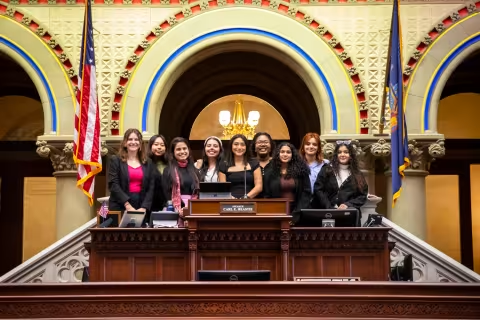
A group of students standing inside a chamber of the New York State Capitol Building.
experiential

Career Outlook


Demand for professionals with a bachelor’s in legal studies is expected to hold steady and even grow a bit over the next few years. The types of jobs and fields seeking professionals with legal expertise will continue to be varied and wide-ranging. With this degree, you will also be well prepared to go on to graduate school or law school and expand your law career options into academia and legal practice.

Potential job titles with a Legal Studies bachelor's degree include:

  • Legal Assistant
  • Law Clerk
  • Compliance Officer
  • Law Enforcement officer
  • Mediator
  • Legal Journalist
  • Policy Researcher
  • Human Resources Generalist
  • Teacher
  • Researcher
  • Non-Governmental Organization (NGO) Staff


A student standing on Albany's Empire State Plaza with the Capitol building in the background.
career
Student Learning Objectives


Learning objectives that UAlbany students are expected to attain through their course of study within their academic program.

Bachelor of Science
Bachelor of Science
  • 1. Approach issues in legal studies from multiple disciplinary perspectives by examining key themes within disciplinary frameworks.
  • 2. Demonstrate an understanding of primary and secondary legal-studies-related texts by writing about related topics using skills developed from each discipline:
    • 2a. Demonstrate an understanding of the key concepts from criminology and criminal justice by applying them to real problems. [Criminal Justice]
    • 2b. Demonstrate the ability to identify and assess evidence about what happened in the past by using historical evidence and writings about analogous cases to make persuasive arguments. [History]
    • 2c.1 Demonstrate an understanding of key concepts from competing philosophies of law. [Philosophy]
    • 2c.2 Demonstrate the ability to recognize both formal and informal logical analysis of legal concepts and arguments. [Philosophy]
    • 2d.1 Demonstrate an understanding of how the legal system is used to control and legitimate the state. [Political Science]
    • 2d.2 Demonstrate an understanding of the limitations of the legal system and how that system can be used to both constrain and empower marginalized groups. [Political Science] 

slo

What Makes The University at Albany Great

Student move-in day.

Living-Learning Communities

Live and take classes with other incoming freshmen who share your personal interests, passions or intended academic major.

A student abroad visiting a monument.

Study Abroad

Become a global citizen: international experience is crucial to success in business, education, research, and public policy.

A student conducting undergraduate research.

Undergraduate Research

Research, scholarship, and creative activities at the University at Albany is an option for all students, across all academic disciplines. You will be able to learn more about a specific academic field or career path all while building a long-lasting mentoring relationship with a faculty member or principal investigator.

Explore Minors

Build competency in a passion or strengthen your resume.

A minor consists of 18–24 graduation credits which must include a minimum of 9 graduation credits of advanced coursework at or above the 300 level. Most undergraduate degrees require completing a minor and it has to have a different title from your major.

Full List of Minors
Full List of Minors
  • Acting
  • Africana Studies
  • Anthropology
  • Art
  • Art History
  • Atmospheric Science
  • Bioethics
  • Biology
  • Broadcast Meteorology
  • Business
  • Chemistry
  • Chinese Studies
  • Cognitive Science
  • Communication (Fully Online Option)
  • Computer Science
  • Creative Writing
  • Criminal Justice Studies (Fully Online Option)
  • Cybersecurity (Fully Online Option)
  • Documentary Studies
  • East Asian Studies
  • Economics
  • Educational Studies
  • Electrical and Computer Engineering
  • Electronics
  • Film Studies
  • Emergency Preparedness, Homeland Security and Cybersecurity (Fully Online Option)
  • English
  • Forensic Science
  • French
  • Game Design and Development
  • Geographic Information Science
  • Geography
  • Globalization Studies
  • Hebrew
  • History (Fully Online Option)
  • Informatics (Fully Online Option)
  • Instrumental Performance
  • International Studies
  • Italian
  • Japanese Studies
  • Journalism (Fully Online Option)
  • Judaic Studies
  • Korean Studies
  • Latin American and Caribbean Studies
  • Law and Philosophy
  • Leadership
  • Legal Studies
  • LGBTQ Studies
  • Library and Information Science
  • Linguistics
  • Machine Learning
  • Mathematics
  • Medical Anthropology
  • Music
  • Musical Performance
  • Musical Theatre
  • Philosophy
  • Physics
  • Political Science
  • Portuguese
  • Pre-Education
  • Psychology (Fully Online Option)
  • Public Health
  • Public Policy
  • Religious Studies
  • Russian
  • Russian and Eastern European Studies
  • Social Welfare Studies
  • Sociology (Fully Online Option)
  • Spanish
  • Statistics
  • Sustainability
  • Theatre
  • Theatrical Design/Technology
  • Urban Studies and Planning
  • U.S. Latino Studies
  • Vocal Performance
  • Women's, Gender and Sexuality Studies