


AISS Newsletter: August 2025

Undergraduate Academic Policy Updates 2025
Undergraduate Course Repeat Policy
This fall semester, the revised Undergraduate Course Repeat Policy takes effect. This policy change means that students may retake a course two times (resulting in three attempts) and the transcript will show all attempts but only the credits earned in the course attempt with the highest grade will be counted towards the degree requirements and calculated in the student's GPA. Colleges, schools, and departments may have additional limitations on which courses or how many courses may be repeated in their respective programs and students should check with their
major department before repeating a course.
45 Upper-Division Credit Requirement
SED has a long-standing policy that requires students pursuing a baccalaureate degree to successfully complete at least 45 credit hours in upper division courses. In addition, SUNY requires all major programs must consist of no less than 24 upper- division credits in the major (courses at the 300-level and above). Beginning this fall semester, the UAlbany audits have been updated to account for and track this upper division credit requirement.
Change to Declaring a Major
As of August 1, 2025, all incoming and current students were declared into their major rather than being designated as "intended" within a major area. The "intended" major designation will remain active only for restricted majors (e.g., those that require separate admission criteria for degree progression). This change does not affect advising structures or responsibilities at present, but it represents an important improvement in how we track student progression through our Business Intelligence (BI) system and how we engage students with their academic departments earlier in their academic careers. By aligning students more directly with their declared programs, they will have stronger departmental connections, clearer pathways, and an enhanced sense of student belonging and academic identity.
For questions please contact [email protected].

Credit for Prior Learning Task Force Launching this Fall
Credit for Prior Learning or CPL is important because providing students with academic recognition and credit for their hard-earned work-related experiences and skills improves college access, increases the likelihood of degree completion, and in many instances reduces time to degree, thus saving students money. It is also important to note that although "prior learning" is the term that is widely used, students can also earn credit for learning that is concurrent with their program of study. This semester UGE will launch the CPL Task Force to assist in examining CPL practices at our peer institutions and to help outline the elements of a comprehensive CPL campus policy that will then proceed through the governance process.
Task Force Membership:
| Member | Title | College and/or Department Represented |
|---|---|---|
| Zakhar Berkovich | Director of Undergraduate Student Services and Past UAC Chair | Rockefeller's Office of Student Affairs |
| Kate Coddington | Associate Professor & Past Chair of University Senate | College of Arts & Sciences, Dept. of Geography, Planning & Sustainability |
| Sabrina Eames | Associate Director for Transition and Credit Preservation | AISS & Undergraduate Education |
| Susanna Fessler | Interim Dean of CIEGS & Professor | CIEGS and College of Arts & Sciences, Dept. of East Asian Studies |
| Lance Fraiser | Coordinator of Credit for Prior Learning | AISS & Undergraduate Education |
| Racheal French | Assistant Registrar | Office of the Registrar |
| Glyne Griffith | Interim Associate Dean for Undergraduate Education | AISS & Undergraduate Education |
| Cassandra Marshall | Director of Nursing | College of Integrated Health and Sciences, Dept. of Nursing |
| John McCluskey | Senior Director of the School of Criminal Justice and Professor | Rockefeller, School of Criminal Justice |
| Unal Tatar | Associate Professor | College of Emergency Preparedness, Homeland Security and Cybersecurity, Dept. of Cybersecurity |
Minerva Center for High Impact Practices
Turning Practice into Purpose.
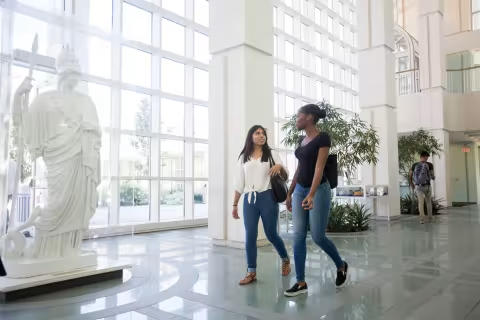
The Minerva Center for High-Impact Practices promotes meaningful connections that engage students in intentional academic experiences. Such experiences contribute to students' deeper learning and personal development. The Minerva Center is a reconfiguration of the former Center for Experiential Learning (CEE) and the Center for Undergraduate Research & Creative Engagement (CURCE) and promotes hands-on, real-world learning opportunities that support students' academic success.
Experiential Education
Earlier this year, SUNY increased funding for undergraduate internship and research opportunities and awarded UAlbany $320,000 to support paid undergraduate assistantships across the university. In spring 2025, the Minerva Center provided 106 paid research assistantships and helped with lab supplies and student research costs. The Center was also awarded another SUNY grant of $50,000 to participate in the "Grow with Google" experiential education initiative that partners with the National Association of Higher Education Systems (NASH) to increase degree completion, improve social mobility, and reduce student debt.
Huge Enrollment Increases to Online Programs
For Fall 2025, the following undergraduate programs are offered completely online:
- Communication BA
- Cybersecurity BS
- Game Design & Development BS
- Human Development BS
- Psychology BA
- Criminal Justice BA
- Emergency Management & Homeland Security BS
- History BA
- Informatics BS
- Sociology BA
In addition to programs, we offer more than 150 fully online courses throughout the year. This fall we welcomed more than 225 new online students who will join the over 499 UAlbany undergraduates pursuing academic success online. In 2024, we were named Best Online Programs by US News & World Report for bachelors programs.
WCI Programs Welcomes TESOL Lecturers

Isabelle Cavazos is a Mexican- American, first-generation educator who is passionate about uplifting multilingual learners as they navigate their higher education journeys. Originally from Central Florida, she has taught ESL, academic writing, and first-year experience courses across the country. Isabelle holds a masters of Arts in teaching English as a Second Language from the University of Illinois at Urbana-Champaign.

Dr. Riya Chakraborty is a social science researcher and educator with a Ph.D. in Curriculum and Instruction (ESOL/ Bilingual Education_ from the University of Florida. She is an experienced educator with International teaching experiences in India and Columbia. Her work as an educator includes justice- oriented teaching education, bilingual/ multilingual education, and linguistically and culturally responsive pedagogy.