





University Art Museum Kicks Off Fall Semester With Three New Exhibitions

By Bethany Bump
ALBANY, N.Y. (Aug. 8, 2023) — The University Art Museum is showing three new exhibitions this fall that explore themes dealing with the cosmos and creation myths, political and social issues in Latin America and the Caribbean, and Afro-Caribbean religious and spiritual heritage through the mediums of weaving, painting, bookmaking, film and dance.
The new exhibitions went on view Monday and can be seen during museum hours, Monday through Friday from 11 a.m. to 4 p.m. and select Saturdays — Sept. 23, Sept. 30, Oct. 14 and Oct. 21 — from 11 a.m. to 4 p.m.
They will remain up throughout the fall semester until Dec. 4, while Barrow Parke: Systems and Mythologies will reopen for the spring semester as well.
Barrow Parke: Systems and Mythologies
Aug. 7 - Dec. 4, 2023
Jan. 22 - April 3, 2024
1st Floor Main Gallery
Artists Mark Barrow and Sarah Parke have collaborated since 2008 under the joint artistic moniker “Barrow Parke” and use weaving and painting to explore visual systems at the intersection of art, craft and technology.
Their work covers topics from world creation myths to computer science to the cosmos, but always centers on the craft of weaving: its history, logic, mathematics and systems, and its intuitive, visual and tactile qualities.
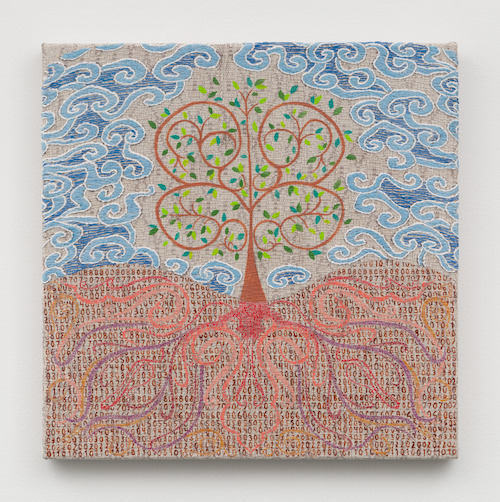
Systems and Mythologies features newly commissioned work such as The Universe (2023), which depicts fish from a Japanese Ainu creation myth swimming in a sea of patterns that include Zodiac motifs. In Shapes in Time (2022), woven and embroidered trees are juxtaposed with painted numbers appearing like computer code — conjuring associations between natural root systems, “root directories” in computer science, and the numbered shafts and pedals of the loom used to handweave the fabric itself.
The exhibition also features a newly commissioned piece that covers an entire arched bay of four floor-to-ceiling double windows and appears as a luminous translation of graph paper weaving drafts into a grid of translucent red, green, blue and black vinyl squares that read like stained glass. Together with computer-generated patterned wallpaper, the exhibition challenges the modernist aesthetics of the museum, which was designed in 1967 by Edward Durell Stone.
Libros/Arte: Handmade Books from Latin America & the Caribbean
Aug. 7 - Dec. 4, 2023
2nd Floor Main Gallery
This exhibition celebrates “Libro-arte,” a term used by many bookmakers from Latin America and the Caribbean to describe objects they make which blur the line between books and art.
More than 80 handmade books will be on display. These texts, which address a range of political, cultural and social themes, are made from a wide range of materials and typically published by small presses.
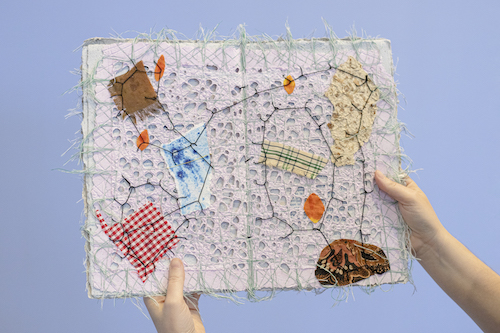
One book in the collection, Bestiarium, was made by layering paper pulped in a Soviet-era washing machine on a temporary cardboard web. Another, Yerbas Poderosas, incorporates plant matter, such as corn husks and rosemary, into pages during the pulping process.
In Migrar, about a family’s migration from Mexico to the U.S., a poem is illustrated in a single image that spans nine fan-fold pages in a pre-Columbian codex tradition. There is also a series of 20 cartonera books, a form of bookmaking featuring hand-painted, recycled cardboard covers, which originated in the streets of Buenos Aires, Argentina during economic crisis.
The exhibition has been in the works for three years, and drew on the expertise of faculty from UAlbany’s Department of Languages, Literatures, and Cultures, and Department of Latin American, Caribbean, and U.S. Latino Studies. It was organized in partnership with UAlbany’s M.E. Grenander Special Collections and Archives, which has been collecting the books since 2005.
Yelaine Rodriguez: EBBÓ
Aug. 7 - Dec. 4, 2023
Nancy Hyatt Liddle Gallery
Yelaine Rodriguez reinterprets Louis Aguirre’s 1998 Cuban chamber opera in the short film, EBBÓ (2021), which will appear as a wall-sized video installation and play continuously during museum hours.
A tragic story of devotion and defiance set among the shores and colonial ruins of the Dominican Republic, EBBÓ is loosely inspired by elements of the Afro-Caribbean religion and spiritual practice Regla de Ocha — sometimes called Santería — that originated in West Africa. Queen Apetebí is told by the Orisha, or spiritual being, Orula that the powerful deity Olofi has demanded she sacrifice her beloved pet Bird. The Queen refuses, instructs the Bird to hide and flees. But the Bird’s devotion becomes their undoing, as his need to sing for her draws the attention of the Iron King sent to destroy her and her kingdom for her defiance.
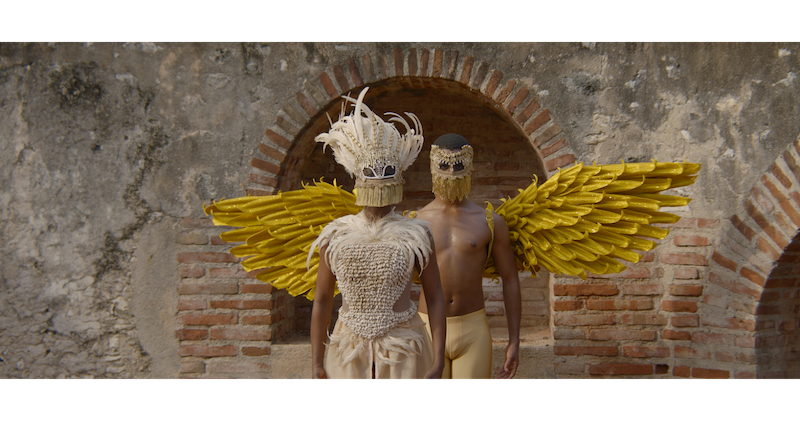
In the film, Afro-Dominican dancers Jeremy Antonio Caro and Rayser Rafelina Campusano Rosario perform in costumes Rodriguez designed, which feature sacred materials such as cowrie shells used in divination and rooster feathers used in rituals.
In EBBÓ, Rodriguez expands on Aguirre’s opera, which incorporates Afro-Cuban percussion and rhythms into a Western classical tradition. Rodriguez’s EBBÓ and her entire body of work are devoted to exploring Afro-Syncretism, or the blending and intersection of African, colonial and Indigenous legacies.