


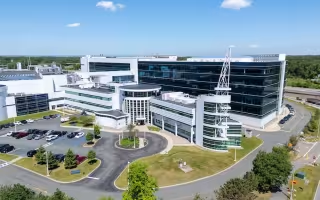
UAlbany-Led Research Team Achieves Rare Milestone in Ultra-High-Voltage Power Semiconductors
The fabrication and demonstration of the 15-kilovolt silicon carbide device helps establish a U.S. pipeline for next-generation power electronics.
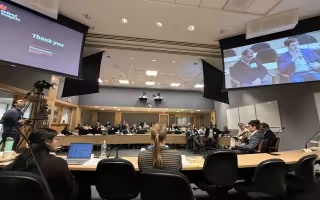
Mental Health Experts Navigate Responsible AI Innovation at Annual Summit
As demand for mental health care outpaces access to human providers, millions are turning to AI chatbots to get the support they need. Most of these tools were not designed for mental health support, and safety and equity standards are only beginning to take shape. These issues took center stage at the Global Center for AI in Mental Health’s fourth annual summit held in September at the SUNY Global Center in New York City.

UAlbany Launches Center for Low Atmosphere and Urban Weather
The boundary layer, the lowest part of the atmosphere where we experience daily weather, has long been the hardest part to predict.
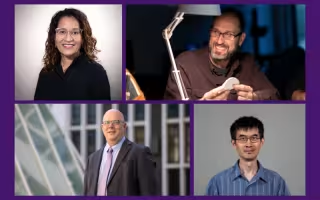
Public Impact Headlines UAlbany Research & Entrepreneurship Week 2026
Four faculty members with expertise ranging from wireless communication to the origins of complex human societies have been nominated by their colleagues to present this year’s Pathbreaking Research Talks on the third day of UAlbany's Research & Entrepreneurship Week. R&E Week 2026 runs Oct. 19-23.
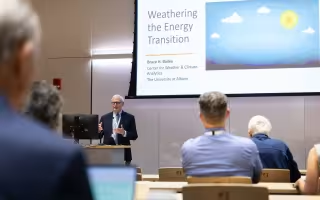
UAlbany to Convene New York Energy Leaders for 2026 Clean Energy Pathways Workshop
Hundreds of industry experts, researchers and policymakers will convene to examine the major decisions facing New York as it moves toward a cleaner energy economy.
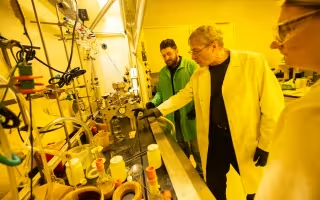
2026 Albany Nanotechnology Symposium at UAlbany Spotlights Metrology Advances
The 2026 Albany Nanotechnology Symposium returns to UAlbany’s ETEC Building on Oct. 22-23, with researchers, industry professionals and students from across the semiconductor, quantum and photonics fields expected to converge on Albany for two days of talks, posters and networking.
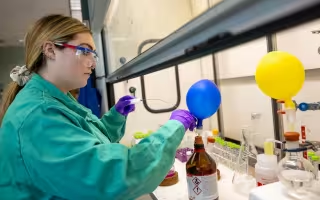
For Undergrad Researcher Christina Casey, Chemistry Always Clicked
UAlbany senior Christina Casey is a student researcher in the Royzen Lab at the RNA Institute. Casey's passion for chemistry blossomed young and at UAlbany, she's found a path to nurture that passion, learning skills and gaining hands-on experience to launch a career in STEM.