



UAlbany Study Finds Medicaid Expansion Boosted Coverage for Indigenous Communities
New research led by the University at Albany examines how different provisions of the Affordable Care Act affected insurance coverage among American Indian and Alaska Native people between 2011 and 2019.

UAlbany Receives $1.3M NSF Award to Establish Advanced Wireless Testbed
The University at Albany has received a $1.3 million award from the National Science Foundation to establish an advanced wireless testbed for cutting-edge research aimed at improving use of the electromagnetic spectrum, a vital national resource that is becoming increasingly crowded.

Report Shows Continued Healthcare Workforce Shortages Across New York State
According to a new report from the Center for Health Workforce Studies, New York State's healthcare workforce is growing, yet persistent workforce shortages and regional disparities remain.

CTG UAlbany, CDTA Explore AI Tools for Bus Shelter Maintenance
Researchers and students at CTG UAlbany are helping CDTA address that challenge using mobile sensors and artificial intelligence. Through an ongoing partnership, CTG UAlbany has adapted its Community Asset Tracker platform to identify maintenance conditions at bus shelters using AI-enabled camera sensors mounted on CDTA buses.

Landmark State Funding Boosts New York State Mesonet
The $2 million funding marks the first time the state has earmarked operating support for the network, which was built for New York State by UAlbany using federal disaster aid following Superstorm Sandy.

UAlbany Study Measures Impact of Regional Airline Exits on Travelers
New research co-authored by University at Albany economist Chun-Yu Ho and Tingting Peng, ’25, helps quantify that impact, using regional airline exits during the COVID-19 pandemic to measure what happened in affected U.S. markets after carriers ceased operations.
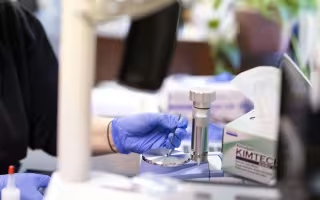
New Analysis Tracks Rise of Dangerous Drug Adulterant and Public Health Response in New York State
As medetomidine emerged and spread through New York's illicit drug supply, public health agencies executed a data-driven response to alert the public, make health practitioners aware of the emergent substance, distribute test strips and ultimately save lives. Their efforts were analyzed and documented in a new study published in the New England Journal of Medicine Evidence.