


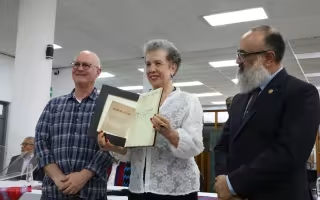
UAlbany Professor Helps Reconnect Guatemala with a Foundational Maya Text
UAlbany Professor Walter Little has helped to bring the Popol Wuj, which preserves the creation stories, sacred narratives and history of the K’iche’ Maya people to libraries in Guatamala.
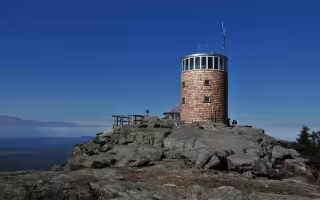
State Funding Keeps Decades of Whiteface Mountain Field Station Research Data Flowing
New funding from New York State will support cloud water chemistry, air quality and weather monitoring — at nearly 5,000 feet above sea level in the heart of the Adirondacks.
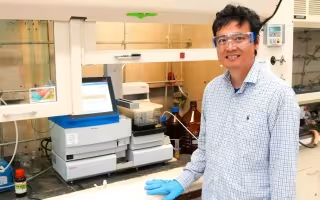
UAlbany Chemist Wins $2M to Build Protein Library, Target ‘Undruggable’ Cancer Protein
UAlbany's Qiang Zhang, associate professor in the Department of Chemistry at the College of Arts and Sciences, has secured $2 million from the National Institutes of Health to advance high-efficiency methods for building complex proteins. The work could illuminate rare brain diseases and open new paths for cancer treatment.
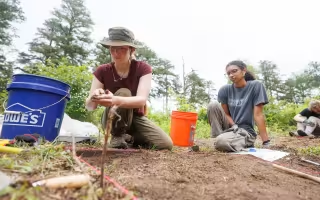
UAlbany Summer: Students Dig into Pine Bush History
This summer, 10 UAlbany undergraduate students, a graduate student and several volunteers participated in an archaeological field school led by Professor and Chair of Anthropology Sean Rafferty and Associate Professor of Anthropology Christopher Wolff. They worked at a site that was the former home a colonial tavern on what was once known as the King's Highway between Albany and Schenectady.

UAlbany Weather Experts Share Insight on Extreme Heat Wave Hitting Northeast
A dangerous heat wave will intensify across most of the central to eastern U.S. this week.
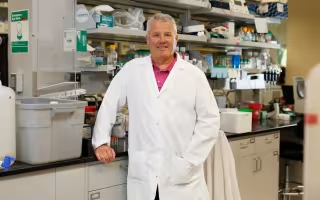
UAlbany Researcher Awarded $3.9M to Study Cell Response to Wood Smoke — With Implications for Firefighter Health
Distinguished Professor of Biological Sciences Tom Begley is among a team of investigators leading a five-year research project studying how cells respond to naphthalene, a harmful chemical found in wood smoke and other combustion products. Their findings will inform ways to protect firefighters from the harmful effects of smoke inhalation.
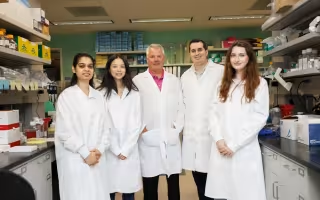
UAlbany Researcher Part of Team Awarded $3.4M to Study How DNA Damage Drives Aging and Cancer
Distinguished Professor of Biological Sciences Tom Begley is part of a multi-institution research team recently awarded $3.4 million from the National Institute on Aging to study how DNA damage accumulates with age and, when left unchecked, can contribute to cancer and other aging-related diseases.