


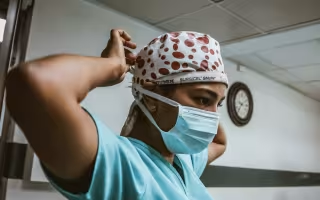
UAlbany Study Finds Significant Pay Gap Between Nurse Educators and Clinical Nurses
New research from the Center for Health Workforce Studies found that nurses working in education make considerably less than nurses working in clinical settings. This disparity in pay is a major contributor to the shortage of nursing educators and complicates efforts to build the health workforce pipeline.
UAlbany Researchers Launch Winter Storm Preparedness Tool for Erie County
The Erie County Winter Weather Storm Scale features a public website rich with weather information to help people make informed decisions and stay safe.
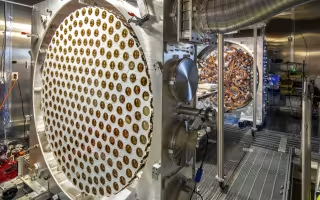
LZ Sets a World’s Best in the Hunt for Galactic Dark Matter
The latest results from the groundbreaking LUX-ZEPLIN (LZ) experiment have set a new world-leading standard for dark matter detection sensitivity. UAlbany researchers Cecilia Levy and Matthew Szydagis are part of a team of more than 250 scientists who collaborated on the latest findings, presented today in a scientific talk at the Sanford Underground Research Facility.
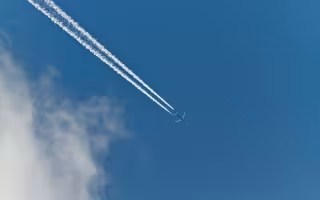
UAlbany Atmospheric Scientist Proposes Innovative Method to Reduce Aviation’s Climate Impact
ASRC's Fangqun Yu suggests that adding a tiny amount of ice-nucleating particles into aircraft engine exhaust could make contrails far less harmful by shortening their lifespan.
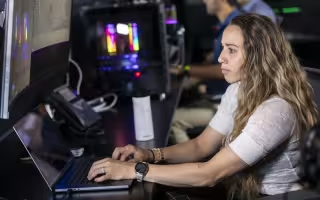
The Short Version: What AI can, and can't, tell us about the weather
Kara Sulia of UAlbany's Atmospheric Sciences Research Center talks about how artificial intelligence can help us see weather differently and what she doesn't yet trust it to understand about the complex physical forces driving the atmosphere.
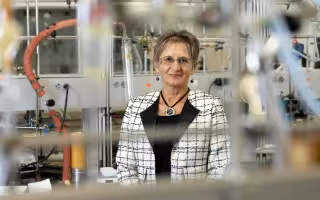
Chemistry Professor Honored with Prestigious American Chemical Society Award
UAlbany’s Marina A. Petrukhina has won the 2026 George A. Olah Award in Hydrocarbon or Petroleum Chemistry, an American Chemical Society award that recognizes outstanding research achievements and success in training the next generation of chemists.

Dozens of UAlbany Researchers Among World’s Top 2% of Scientists
The annual Stanford University report, published through Elsevier, creates a public database of top-cited researchers.