


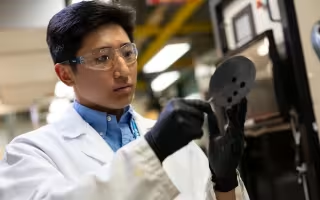
UAlbany PhD Student: My Journey from Game Boy to Nanoscale Engineering
Justin Nhan, a PhD student in nanoscale engineering at UAlbany’s College of Nanotechnology, Science, and Engineering, shares how his childhood passion for engineering inspired him to pursue research in the area of extreme ultraviolet lithography.
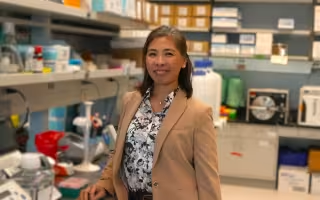
Study: Crosstalk Inside Cells Helps Pathogens Evade Drugs
New UAlbany research shows that tiny mobile structures inside pathogens "collaborate" in previously unknown ways; in so doing, the broader cell learns how to evade drugs designed to kill it. The work advances our understanding of antibiotic resistance and could someday inform the development of new treatments against disaeases like listeriosis.
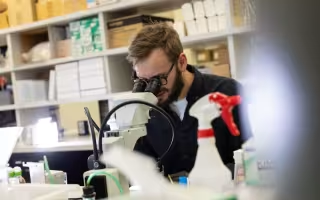
The Short Version Returns: In the Fly of the Beholder
With the assistance of a fly-sized movie theater and treadmill, of sorts, Assistant Professor Max Turner and his students track how neurons in the fly brain react to visual stimuli, how that translates to movement and what we can learn from fruit flies in the quest to better understand the human brain and how it's impacted by disease.
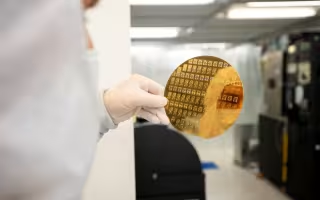
Engineering, Life Sciences Lead R&D Growth at UAlbany
UAlbany’s nearly $472M in 2024 R&D more than doubled the number the University reported in the NSF Higher Education Research and Development survey in 2023, driven largely by the return of the Department of Nanoscale Science & Engineering and its semiconductor industry R&D partnerships at the NY Creates Albany NanoTech Complex.
Exploring Homeowner Decisions After Disaster Strikes
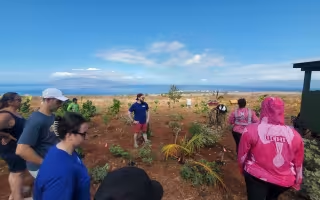
Alex Greer, an associate professor at the College of Emergency Preparedness, Homeland Security and Cybersecurity, has spent more than a decade studying hazard adjustments and relocation decisions in the wake of weather and climate disasters.
UAlbany Researcher Studying Impact of PFAS ‘Forever Chemicals’ on Edible Crops, Food Quality
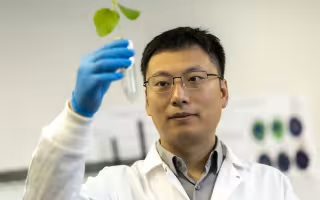
Weilan Zhang, an assistant professor in the University at Albany’s College of Nanotechnology, Science, and Engineering, was awarded nearly $420,000 from the National Science Foundation to study how the accumulation of toxic “forever chemicals” in edible plants impacts food quality and safety.
$380K in Bridge Funding Sustains Critical UAlbany Research
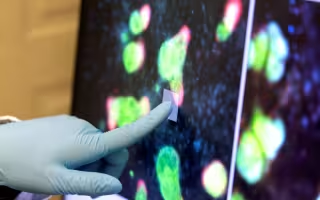
The bridge fund is awarding $381,435 to projects impacted by federal funding cuts or delays in areas ranging from extreme weather decision-making to RNA research and a critical analysis of how scientific data is misused to fuel conspiracy theories about demographic trends.