Robert Stone
1996



1996
PREVIOUS VISIT: NYS Writers Institute Reading - October 24, 1996
Air Date: WMHT, Channel 17, 6 p.m., February 20, 1999
Air Date: WMHQ, Channel 45, 9:30 p.m., February 24, 1999
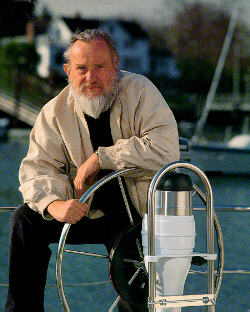
Robert Stone's novels often feature alienated protagonists who struggle to survive in a brutal world of violence, drugs, and alcohol. Commenting on his subject matter, Time reviewer Paul Gray said, "That Stone makes exciting fiction out of this depressing scenario is the hallmark of his mastery."
A Hall of Mirrors (1967), Stone's first novel, won the William Faulkner Award for best first novel and was also produced by Paramount as the movie WUSA in 1970. His second novel, Dog Soldiers (1974), won the National Book Award and was adapted into the film "Who'll Stop the Rain" in 1978.
Stone's other works include the novels A Flag for Sunrise (1981), which received the Los Angeles Times Book Prize, Children of Light (1986), and Outerbridge Reach (1992). He also edited the anthology The Best American Short Stories: 1992.
Stone has received Guggenheim and National Endowment for the Humanities fellowships, the five-year Mildred and Harold Strauss Living Award, the John Dos Passos Prize for Literature, and the American Academy and Institute of Arts and Letters Award. He currently teaches in the creative writing program at Yale University.
Robert Stone read at the New York State Writers Institute on October 24, 1996.
Previous Articles:
In 1962 Robert Stone went to Stanford and joined a group of Stegner Fellows in the Writing Program there who, with others just a couple of years before and after that time, have become the mainstay of contemporary American literature. Of the group and the measure of its selection Wallace Stegner later said, "they could be stubborn, mule-headed, selfish, intemperate, anything, so long as they could write." Among them were Ken Kesey, Larry McMurtry, Tillie Olsen, Ernest J. Gaines, Wendell Berry, Tom McGuane, Peter Beagle, and Judy Rascoe, among many others.
They were, as another student, Ed McClanahan, called them, "the nicest group of bad people I ever had the good fortune to fall in with." Many of those people migrated from Palo Alto to Perry Lane in Menlo Park, the quasi-left-bank of the peninsula. It was where Faye and Ken Kesey lived. Stone and his wife Janice, fresh from New York after a sojourn in New Orleans that provided the germ for Stone's first novel, A Hall of Mirrors, quickly joined what was to become a revolution of social and literary culture.
But this is prehistory to the times that have come in between then and now, times of political idealism and political assassinations, times of political and even cultural deceit, times of liberation and times of constraint, times which led to the cultures of Viet Nam, rock and roll, and apocalyptic visions. In his own estimations of such times, Robert Stone has gone incisively to the cultural core of our society. "He writes like an angel -- a fallen, hard-driving angel," one reviewer wrote of Stone's work, unnecessarily mixing awareness of Stone's craft with Stone's subjects.
Through works such as Dog Soldiers and A Flag for Sunrise, novels which are as politically and culturally astute as they are brilliant, to his bitter social satires Children of Light (about Hollywood) and Outerbridge Reach (about midlife crises, middle class values, and sailing), Stone proves his bond of fealty to the writers he respects the most: Dostoevski and Conrad, Hemingway, Dos Passos, and Graham Greene. A reader will find all of the big themes established by each in Stone's work, but they will be found in unique scale, uniquely Stone. He's an American master, of storytelling, of the novel, and of insight into our culture.
Donald W. Faulkner is the Associate Director of the New York State Writers Institute and teaches Contemporary Literature through the English Department.
New Orleans, Vietnam, Central America, California, the Middle East. Robert Stone's novels take him far afield both physically and imaginatively, even as his themes and concerns-what is happening in American today--remain steadfast.
Stone, the author of five novels, including A Hall of Mirrors, Dog Soldiers, A Flag for Sunrise and Children of Light, reads for the Writers Institute Thursday, October 24 at 8 p.m. in Assembly Hall of the Campus Center at the University at Albany's uptown campus.
Robert Stone was born in Brooklyn in 1937, to a family of Scottish Presbyterians and Irish Catholics who made their living as tugboat workers in New York harbor. He attended Catholic schools, which taught him how to read and write "thoroughly and grammatically," he has said. "Always kind of in love with language" he tried to put his experiences into narrative form early on to make sense out of them, and he won a short story contest for high school students.
He did not graduate from high school, however, for drinking too much beer and being "militantly atheistic." In 1955 Stone enlisted in the U.S. Navy and began to travel and, soon, to report on his travels.
Many years later, writing about Havana for Harper's in March 1992, Stone recalled, "Havana was my first liberty port, my first foreign city. It was 1955 and I was 17, a radio operator with an amphibious assault force in the U.S. Navy."
Eschewing their roles as "boozing, wenching buccaneers," Stone and a buddy set out to behave like "proper expatriates." They walked the city, they watched the people, they heard the music of conga bands and African flutes. They drank coffee slowly from small cups. "At the time," recalled Stone, "I was struck less by the frivolity of Havana than by its unashamed seriousness .... All this Spanish tragedy, leavened with Creole sensuality, made Havana irresistible. Whether or not I got it right, I have used the film of its memory ever since in turning real cities into imaginary ones." The film of its memory. Real cities made imagined ones.
Such is the written work of Robert Stone, whether he is recreating New Orleans as a metaphor for America or creating the county of Tecan in Central America, where pine trees grow on one side of a road, palm trees on the other.
After the Navy, Stone lived in New York City for a couple of years and then in New Orleans. In 1959 he married Janice Burr, and they have two children. Today the couple live in Connecticut. Mrs. Stone is a social worker.
But the road to a quiet life in New England was a long one. In 1962 Stone won a Stegner fellowship to the creative writing program at Stanford University.
Living in Menlo Park, California, he fell in with Ken Kesey's Merry Pranksters. He knew Neal Cassady, Jack Kerouac and Allen Ginsberg and he rode the Merry Pranksters bus across the U.S. in 1964 in the trip made famous by Tom Wolfe in The Electric Kool-Aid Acid Test (1968).
"Pleasant goofing" was how Stone described those days in an interview 20 years later. But through his experimentation with drugs in the early 1960s, he has said, he confronted a deep religious sensibility. "I discovered that my way of seeing the world was always going to be religious--not intellectual or political--viewing everything as a mystic process," he told Curt Suplee in the Washington Post in 1981. Hall of Mirrors was published in 1967, and Stone won the Faulkner Award for a "notable first novel". He wrote the screenplay for the film adaptation, titled USA and starring Paul Newman. Stone had no control over the final film, which despite his and Newman's best efforts, was not successful.
In 1971 Stone spent two months as a correspondent in Vietnam, and out of that experience grew Dog Soldiers, a novel not so much about the Vietnam war as about its corrupting influence on American life. Houghton published Dog Soldiers in 1974, and Stone won the National Book Award that year. Again he worked on the movie script, and again he was disappointed in the final product, a film titled "Who'll Stop the Rain" (he hated the title) co-starring Tuesday Weld and Nick Nolte.
A Flag for Sunrise (Knopf, 1981) grew in part from three trips Stone made to Central America in the 1970s. While some reviewers took Stone to task for his politics and philosophy, plenty of readers found the book a suspenseful thriller with an alarming theme.
By this time Stone's life was quieter and straighter. His characters served as his alternates, he told Newsweek in 1981. "They go through all that horrendous stuff so I don't have to." And feeling hung over or strung out would interfere with his creative process.
Children of Light (Knopf, 1986), in which Hollywood goes on location to Mexico, drew on Stone's observations of the film world. In 1992 Ticknor & Fields published Outerbridge Reach, in which the journey and the story take place at sea.
Now Stone has finished a short story collection--his first--the working title of which is Bear and His Daughter. He is back at Houghton Mifflin, which plans to publish the book in spring 1997. He is "trying to finish" a novel with a contemporary Middle Eastern setting, he said in July. It too will come out from Houghton, most likely in spring 1998. Stone likes giving readings, he said, because "writing is a lonely business. You're performing solo in an interior space. Externalizing the work and getting a human response is a refreshing change."
He gives "a fair number of readings each year, he said, and will even read from works in progress, which many writers will not. "You can learn about the effects of the work that way," he said. In general, then, giving a reading is a pleasant, productive experience for Stone--but not always. Asked what his worst reading experience was, he remembered immediately the time he read to the end of a story, only to find he did not have the last page. "I got to the end and it just wasn't there. I couldn't believe it--I was panic-stricken."
He made a stab at summarizing the last page, "but the whole point of the story was there, and it didn't go over," he said, still with a trace of sadness. But that was 10 or 12 years ago. "The wounds have healed," he said a moment later, a wink in his voice. The film of memory keeps running. Real cities are made imagined ones and the stories keep coming.
Debby Mayer is a freelance writer/editor and Weekend Editor for The Independent. She was previously the Publications Director for Poets & Writers, Inc.
Hear Robert Stone talk about his writing
For additional information, contact the Writers Institute at 518-442-5620 or online at https://www.albany.edu/writers-inst.