





School of Public Health Students Address Period Poverty in the Capital Region

By Erin Frick
ALBANY, N.Y. (May 16, 2024) — University at Albany’s Brynn Watkins and Claire Jennings, both Master of Public Health students at the School of Public Health, are the masterminds behind Capital Region Menstrual Health — an initiative that is expanding access to menstrual hygiene products and education around menstruation in the 518.
The idea for Capital Region Menstrual Health came about during Watkins’ work with the New York State Public Health Corps, where both she and Jennings have served for nearly two years. Upon joining the Corps as a Public Health Fellow, Watkins first began working with local health departments to bring condoms to partner organizations. Through these interactions, the need for menstrual health products was brought to her attention.
Partnering with Jennings and, later, UAlbany alum Annabelle Rieseler, the team formed Capital Region Menstrual Health to address the need for period products in communities throughout the Capital Region.
“One of the organizations said that they don’t need condoms — they always have them,” said Watkins. “But what they were desperate for was menstrual health products like pads and tampons, and it made me think ‘How can I help?’”
Fighting Period Poverty
Lacking access to period products can make it difficult or impossible for menstruating people to go to school and work or engage in social activities. Those who are forced to use items other than period products for menstrual care can face a heightened risk of infections and other ill health effects.
In New York, one in six women and girls between the ages of 12 and 44 live below the federal poverty line, making it difficult for them to afford menstrual hygiene products. According to “Women of Wearables,” the cost of a month’s supply of period products is more expensive in New York than in other states.
Capital Region Menstrual Health secured its first grant from “The Pad Project” in June 2022. Since then, the nonprofit has procured over $20,000 in financial support, plus in-kind donations from organizations and private contributors.
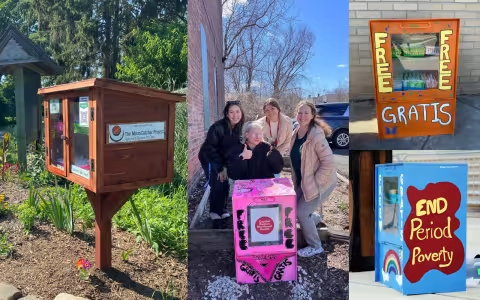
With these donations, the team delivers pads, tampons and moon/diva cups directly to under-resourced communities through partnerships with community organizations that steward “period pantries” — metal, weatherproof boxes that house period products that anyone can take at any time of day. They have now set up 10 period pantries in high-need areas across Albany, Schenectady, Troy and Cohoes.
To date, they have distributed over 180,000 period products to communities in need.
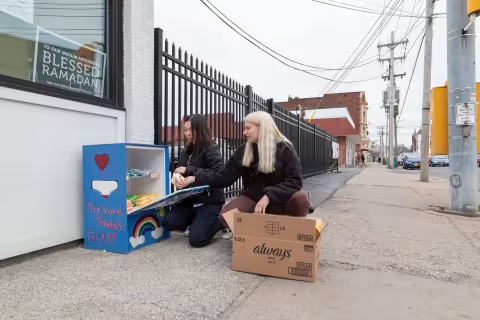
“Our initiative is the first of its kind in the Capital Region, and we’re fighting the stigma and educating people about having a period while increasing access to products,” Jennings says. “Two in five people in the U.S. experience period poverty, but this often isn’t talked about, even though having a period is a normal bodily function that over half of our population goes through.”
Watkins, Jennings and Rieseler coordinate with community organizations including food pantries, homeless shelters and domestic violence shelters, and use census data to determine where period pantries may be most in demand.
Now in its second year, Capital Region Menstrual Health is focusing on advocacy and education, and hosts educational sessions for children, teens and adults to provide information about menstruation, menstrual health and gender inclusive language. They present at community organizations, libraries, schools and community events like Albany’s Tulip Fest. They also maintain an active presence on social media to share information, resources and updates.

“There are people who want to talk about this — people come up to us and ask good questions and want to tell us stories,” said Watkins. “It’s been amazing to engage with the community and serve as the voice that says, ‘It’s not a bad thing to talk about your period’.”
Annabelle Rieseler graduated from UAlbany in 2022 with a major in human biology. Rieseler has also been serving as a New York State Public Health Fellow, which is how she connected with Watkins and Jennings to help expand their fight against period poverty from Schenectady into Albany.
“Outreach is a large part of what we do,” Rieseler said. “We go into places like schools and libraries to administer classes to students and adults about menstrual health, addressing questions like what is your period, what period products are available to you, and how do you use them? A major goal in our outreach work is reducing stigma around menstruation. We can’t fix things that we don’t talk about. We want to empower young menstruators to feel comfortable talking about menstrual health just as you would breathing or sleeping. We also want to instill that having a period is nothing to be ashamed of.”
Rieseler, who will be traveling to Morocco on assignment with the Peace Corps in September, explained that they also serve in a consulting capacity, working with area organizations to help them implement period equity into their services and programming.
Classroom Connections
Watkins and Jennings credit the Master of Public Health curriculum at UAlbany for helping them further Capital Region Menstrual Health’s mission and adapt their workflow based on the best practices they are learning in the classroom.
“At UAlbany, we’ve learned the importance of tracking the data, and it’s helped us to keep a very clear Excel sheet on what’s coming in and what’s going out for donations,” said Watkins, whose graduate studies at the School of Public Health are supported by UAlbany's Health Resources and Services Administration (HRSA)-funded Strengthening the Public Health Workforce Scholarship Program.
“We've also been able to come up with estimated costs for running the pantries, and then we’re able to use these numbers to make proposals to funders,” Jennings says. “It’s nice because from attending school while doing this project, it’s like we have mentorship for this every day as we apply what we’re learning about program implementation and evaluation in real time.”