Boivin Lab

Boivin Lab

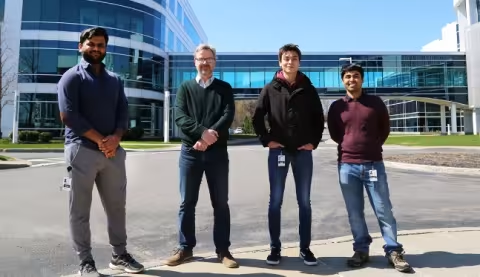
Ben Boivin Research Team


Laboratory of Redox Biology and Signal Transduction

Cells have evolved ways of responding to complex cues from their environment. My research group explores how these cues are integrated and controlled within cells. More precisely, our work focuses on how redox modification of proteins, in particular protein tyrosine phosphatases (PTPs), influence phosphorylation-dependent signal transduction in biology and pathologies. 

We tackle this fundamental aspect of cell signaling using complementary approaches that broadly fall into two categories. In our first approach, we employ animal and cellular models jointly with screening methods to gain knowledge from complex systems to identify components that are dysregulated in disease states. In our second approach, we build on knowledge acquired from both the literature and our own work to perform structure-function studies. 

Such studies help us understand how redox post-translational modifications of specific proteins cause structural changes that will in turn affect their enzymatic activity, protein-protein interactions and cellular function. Hence, while deciphering redox-regulated signaling networks and identifying unique signaling nodes is an important first step in understanding a disease state, our structure-function approach generates critical mechanistic insight that allows us to target signaling nodes in complex pathologies. 

Overall, we study how cellular oxidants regulate phosphorylation-dependent signaling in cancer and in cardiovascular pathologies with the ultimate goal of developing strategies and technologies to restore physiological response.


Research


“We want to understand the function and the regulation of the protein tyrosine phosphatase family members in diseases such as cardiac hypertrophy, diabetes and cancer with the ultimate goal of activating or inhibiting specific PTPs to prevent or cure these diseases.”

- Ben Boivin, Director of the Redox Biology and Signal Transduction Laboratory

Research projects:

  1. Understanding the oxidation mechanisms that control Protein Tyrosine Phosphatase activity in vivo
  2. Allosteric-site mediated activation of Protein Tyrosine Phosphatase
  3. Understanding the molecular function of PTP1B in cardiac hypertrophy
  4. Understanding the molecular function of PTPs in insulin resistance
  5. Understanding the function of cholesterol in redox signaling

People

Dr. Ben Boivin

Ben Boivin

Graduate Student
(Fall 2020 ~)
[email protected]

William Mudd received his BS degree in Biology at UAlbany in 2020 before pursing his PhD in Nanobioscience at SUNY Poly’s College of Nanoscale Science and Engineering. He joined the Boivin lab in 2020 and he has been the recipient of a Doctoral RNA Training Fellowship since 2021. His interests are to understand whether electron tunneling is occurring in protein tyrosine phosphatases and to develop methods to determine electron paths and to measure electron tunneling in proteins. Ultimately, his goal is to develop small molecules -- such as RNA aptamers -- to allow electron donors to activate protein tyrosine phosphatases in vivo.

Selected Publications

Coulis G, Londhe AD, Sagabala RS, Shi Y, Labbé DP, Bergeron A, Sahadevan P, Nawaito SA, Sahmi F, Josse M, Vinette V, Guertin MC, Karsenty G, Tremblay ML, Tardif JC, Allen BG, Boivin B. Protein tyrosine phosphatase 1B regulates miR-208b-argonaute 2 association and thyroid hormone responsiveness in cardiac hypertrophySci Signal. 2022;15(730):eabn6875.

Londhe AD, Bergeron A, Curley SM, Zhang F, Rivera KD, Kannan A, Coulis G, Rizvi SHM, Kim SJ, Pappin DJ, Tonks NK, Linhardt RJ, Boivin BRegulation of PTP1B activation through disruption of redox-complex formationNat Chem Biol. 2020;16(2):122-125.

Yang M, Haase AD, Huang FK, Coulis G, Rivera KD, Dickinson BC, Chang CJ, Pappin DJ, Neubert TA, Hannon GJ, Boivin B**, Tonks NK. Dephosphorylation of tyrosine 393 in argonaute 2 by protein tyrosine phosphatase 1B regulates gene silencing in oncogenic RAS-induced senescenceMol Cell. 2014;55(5):782-90. **Senior & Corresponding Author

Boivin B, Chaudhary F, Dickinson BC, Haque A, Pero SC, Chang CJ, Tonks NK. Receptor protein-tyrosine phosphatase α regulates focal adhesion kinase phosphorylation and ErbB2 oncoprotein-mediated mammary epithelial cell motilityJ Biol Chem. 2013;288(52):36926-35.

Boivin B, Yang M, Tonks NK. Targeting the reversibly oxidized protein tyrosine phosphatase superfamilySci Signal. 2010 Aug 31;3(137):pl2. Review.

Loh K, Deng H, Fukushima A, Cai X, Boivin B, Galic S, Bruce C, Shields BJ, Skiba B, Ooms LM, Stepto N, Wu B, Mitchell CA, Tonks NK, Watt MJ, Febbraio MA, Crack PJ, Andrikopoulos S, Tiganis T. Reactive oxygen species enhance insulin sensitivityCell Metab. 2009;10(4):260-72.

Boivin B, Zhang S, Arbiser JL, Zhang ZY, Tonks NK. A modified cysteinyl-labeling assay reveals reversible oxidation of protein tyrosine phosphatases in angiomyolipoma cellsProc Natl Acad Sci U S A. 2008;105(29):9959-64.

Complete List of Published Work in MyBibliography: https://www.ncbi.nlm.nih.gov/myncbi/1pkz7LaXyjq5c/bibliography/public/