



ALBANY, N.Y. (May 28, 2020) – Every year, millions of tons of sewage sludge and food waste are discarded in landfills where they cause serious environmental problems. Now, the University at Albany is leading a consortium of universities to dramatically alter the way this waste is handled. The goal is to develop economically viable methods to convert wet organic waste into high value products.
The U.S. Department of Energy has awarded the project $2.7 million. The consortium, which includes the University of Michigan, Argonne National Laboratory and Princeton University, is adding an additional $709,550 to bring the total budget to more than $3.4 million.
“Research and development of clean technologies is not only fundamental to reducing pollution and protecting our air, water and soil, it promotes innovation, supports good-paying jobs and boosts our economy,” Congressman Paul Tonko said. “Our local colleges and universities are a catalyst for cutting-edge technology innovation and discovery. Today’s announcement, led by the University at Albany, would literally turn waste into wealth by reimaging how waste is used and disposed. The impact on public health, sustainability and the economic well-being of our environment is obvious. I applaud UAlbany for their vital work and commitment to developing pioneering solutions to waste management.”
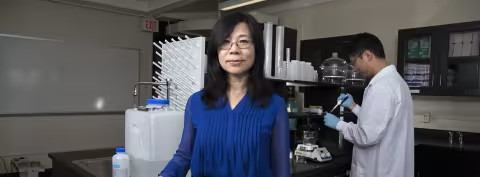
“Technologies developed through this project will bring revolutionary changes to how we perceive, handle, and use wet waste materials and help broaden the scope of the blooming bioeconomy,” said UAlbany professor of Environmental and Sustainable Engineering (ESE) and principal investigator Yanna Liang (pictured above).
According to the Environmental Protection Agency, Americans generate about 250 million tons of solid waste every year, of which about 15 percent is made up of food waste. These wastes can be anaerobically digested to produce biogas, but this conventional approach has many drawbacks. The bottlenecks can include low carbon conversion efficiency, inefficient product separation and CO2 emission.
“To address bottlenecks encountered in the field of converting wet organic wastes to commodities, we aim to develop a holistic approach by considering all steps involved in the conversion process,” said Liang, who serves as chair of ESE at UAlbany’s College of Engineering and Applied Sciences (CEAS).
“For UAlbany to lead a project of this magnitude with such implications for public health and economic well-being, with partner institutions of the stature of Michigan and Princeton, confirms Dr. Liang’s scientific and engineering leadership and offers a ringing endorsement of the vision we have set for the College of Engineering and Applied Sciences,” said CEAS Dean Kim L. Boyer. “Dr. Liang, ESE, and the objectives of this research exemplify our mission of ‘Science in Service to Society.’”
Specifically, the project will seek to identify the best pretreatment method, the optimal parameters for arrested methanogenesis, the optimal design of microbial electrosynthesis, and an innovative method for production extraction.
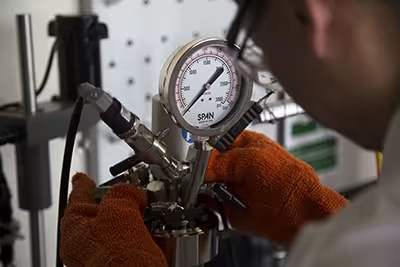
The researchers will evaluate every process in terms of economic viability and environmental impact through techno-economic analysis (TEA) and life cycle analysis (LCA). The overall process will be tested at a 5-liter and a 50-liter scale.
In addition to Liang, the project leaders include: Zhiyong (Jason) Ren, associate director for research, the Andlinger Center for Energy and the Environment at Princeton University; Anish Tuteja, associate professor of materials science and engineering and head of the Polymers, Surfaces, and Interfaces group at the University of Michigan; and Meltem Urgun Demirtas, group leader, Bioprocess and Reactive Separations at Argonne National Laboratory.
The researchers aim to develop a prototype where organic wastes can be pretreated efficiently, converted to target products with high rates in continuous operation, and where the desired compounds can be separated and recovered with high efficiency.
The project was featured in the June 2020 issue of the Coalition of Urban and Metropolitan Universities (CUMU) newsletter.
“Upon completion of the proposed project, new and fresh insight, innovative processes, and comprehensive process analyses will become available,” said Liang, who leads the Sustainable Design Research Laboratory at UAlbany. “All of these will contribute significantly to a circular economy where waste, especially organic waste, is treated and used as a resource rather than things that need to be disposed with a price tag.”
This press release was originally published on the University at Albany news feed. For more about Dr. Liang's research projects, please visit her research and faculty pages.