





Tracking the 2024 Total Solar Eclipse: A Q&A with Jeff Freedman

By Mike Nolan
ALBANY, N.Y. (April 2, 2024) — On April 8, a total solar eclipse will cross North America, passing over Mexico, the United States and Canada. A total solar eclipse occurs when the moon passes between Earth and the sun, completely blocking the sun’s face.
Those within the path of totality, which will stretch in the U.S. from Texas to Maine, will see a total eclipse. People outside the path of totality will still be able to see a partial solar eclipse, where the moon only blocks part of the sun’s face.
Jeff Freedman, a researcher at the University at Albany’s Atmospheric Sciences Research Center, will be among those sky-gazing in the path of totality. Freedman is one of four faculty mentors for a group of students in the Department of Atmospheric and Environmental Sciences who are participating in the 2023-24 Nationwide Eclipse Ballooning Project, sponsored by NASA.
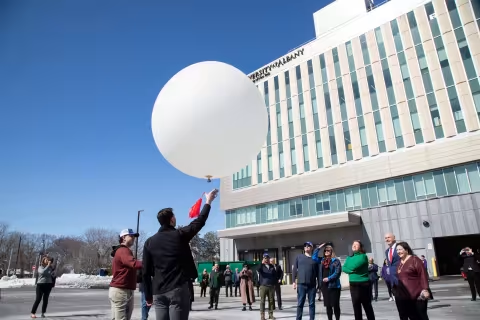
The student team will launch weather balloons from Fort Drum, N.Y. (near the center of the path of totality) for 30 consecutive hours around April’s total eclipse. They will be comparing atmospheric data from the balloon launches to real-time data from nearby New York State Mesonet sites, a statewide weather observation network operated by UAlbany.
We caught up with Freedman to learn more about the science behind a total eclipse and UAlbany’s involvement in the Nationwide Eclipse Ballooning Project.
What causes a total solar eclipse? How often does it happen?
A total solar eclipse occurs when the moon moves directly between the sun and the Earth. Some place on the Earth’s surface generally experiences a solar eclipse two or three times per year. Depending upon the distance of the moon from the Earth, this can be a total solar eclipse (where the moon completely covers the sun’s disc), to an annular eclipse, where the moon, being a bit further away, cannot completely obscure the sun’s disc and the result, at the time of maximum coverage, is a ring of light around the obscuring moon.
The last total solar eclipse to cross North America was in 2017. What makes this one different?
Because for this year’s eclipse the moon is a bit closer to Earth, the time of totality will be longer (3.5 to 4 minutes for 2024 versus 2.5 minutes for 2017), as well the width of the total eclipse shadow (about 110 miles versus an average of 65 miles for the 2017 event). Also, for 2024, many more people live within the path of totality (or within a couple of hundred miles of it) than the event in 2017. Finally, the path of totality will include the densest network of instrumentation ever to observe a total solar eclipse — the New York State Mesonet. In addition, NASA and other organizations will be deploying a variety of instruments to observe this eclipse.
What do we know about how a total solar eclipse impacts the atmosphere? What do we hope to learn through the Nationwide Eclipse Ballooning Project?
We know that the atmosphere and the Earth’s surface will experience cooling—on the order of five to 10 degrees Fahrenheit at the end of totality. Relative humidity, being a function of temperature, will increase. Boundary layer, or fair-weather cumulus clouds, those puffy clouds you see on a sunny afternoon (especially in the spring and summer), will also diminish, or completely disappear because they are directly rooted in thermals generated by the sun heating the Earth’s surface. And, of course, carbon uptake by vegetation via photosynthesis will diminish as we approach and experience totality.
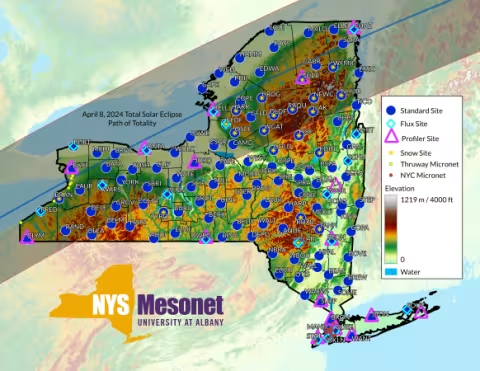
What’s opportunistic about this eclipse for us is that the path of totality will cross dozens of NYS Mesonet sites, including those with atmospheric wind, temperature, and humidity profilers, and surface flux stations measuring the exchange of heat, moisture, CO2, and momentum with the surface. This will provide further insight into how turning off the sun in the middle of the day affects surface-atmosphere exchange processes. Even beyond the path of totality, such as the rest of central, southern, and eastern New York, there will be measurable effects we can observe.
From recent solar eclipses, there is evidence of gravity waves in the stratosphere as it is cooling. Just like waves form in the ocean or a lake when water is disturbed, gravity waves form in the atmosphere when air is disturbed, impacting aviation and weather patterns. Can we detect such gravity waves in the lower parts of the atmosphere? This eclipse may help us answer that question. And since the Nationwide Eclipse Ballooning Project will have teams located from Texas to New England within the path of totality, we can compare our data with the other groups, confirming the impact of the eclipse on our atmosphere.
I should point out that historically, solar eclipses have been used to confirm a variety of scientific hypotheses, including Sir Arthur Eddington’s famous expedition in 1919 to test (and confirm) Albert Einstein’s theory of general relativity (in this case, the idea that large masses, such as the sun, can bend light). After April 8’s event, the UAlbany team will be looking for any new insights the eclipse may provide from the data we (along with the other NASA teams) have collected.
How did UAlbany get involved with this project? What type of data will our students be collecting?
June Wang, director of the New York State Mesonet, was involved with planning for the Nationwide Eclipse Ballooning Project from its inception. So, of course, given its large atmospheric sciences program, enthusiastic students, and the proximity of the April 8 eclipse to UAlbany, it was a natural fit for us to be involved. The students will be collecting data from the weather balloons they launch (profiles of temperature, moisture, winds and pressure), and a surface station they will set up (measuring temperature, humidity, solar irradiance, winds, pressure and any precipitation).
In addition, our students will also be observing atmospheric data from the National Science Foundation’s National Center for Atmospheric Research, which is deploying three MicroPulse DIAL (MPD) LiDARs at Mesonet profile network sites (Webster, Chazy and Albany) from April 1 to 30.
What advice do you have for people interested in viewing the total solar eclipse?
Beyond making sure you are taking the necessary steps to ensure eye safety (e.g., using the proper eclipse glasses), obeying traffic rules and using common sense, and hoping for good weather. Enjoy the experience, as the next chance you’ll get to view a total solar eclipse in New York will not be until 2079.