


|
College
of Arts and Sciences
•
Department of Biological Sciences
Biodiversity,
Conservation and Policy Program
One track in the program deals
with the relationships between urbanization and
conservation. Faculty (Drs. Margaret Stewart and
George Robinson) and students participate in conservation-oriented research in the Albany Pine Bush and in local
communities, including the Towns of Knox, Saugerties
and Tivoli (Dr. Gary Kleppel). Faculty members
sit on several NGO conservation boards, and serve
on Conservation Boards and as advisors to local
governments in the Towns of Knox and Guilderland.
They have provided technical assistance in such
areas as community definition of neighborhood
identity and comprehensive land use planning.
Contact: Dr. Gary S. Kleppel.
WAMC
Science Forum Radio Show
This program gives local 5th and 6th graders,
along with the general public, the opportunity
to ask a panel of scientists questions about science
to encourage scientific literacy. Comments by
panelists have been incorporated into a national
show, The Health Show. The show serves seven states
and has an estimated listening audience of 200,000.
Contacts: Drs. Helmut V. B. Hirsch and Helen Ghiradella.
•
Department of Earth and Atmospheric Sciences
Internships
and Other Student Learning Experiences
The department places interns with the National
Weather Service, local television, the Department
of Environmental Conservation, and other organizations.
For the National Weather Service student interns
conduct a range of activities from writing short
weather forecasts to running the Dobler radar
to recording data. Broadcast metrology majors
learn on air broadcasting through a partnership
with WXXA Fox 23. A course now in the planning
stages is on commercial metrology. It would train
students to forecast weather for weather dependent
companies. Contact: Michael Landin.
Meterology Broadcasting
The department places interns with a variety of organizations including local television. Contact: Chris Thorncroft
Research
Research in the department has an emphasis on weather forecasting and the measurement and prediction of extreme weather events. One project is exploring the land-ocean climate interactions of West Africa, with the long-term goal of improving climate prediction for West Africa.
Research
Collaboration with the National Weather Service
The National Weather Service is located on the
UAlbany campus. It performs research, often collaboratively,
with the University in order to improve forecasts
and public service. Contact: Vincent Idone
•
Department of Geography and Planning
Environmental
Monitoring
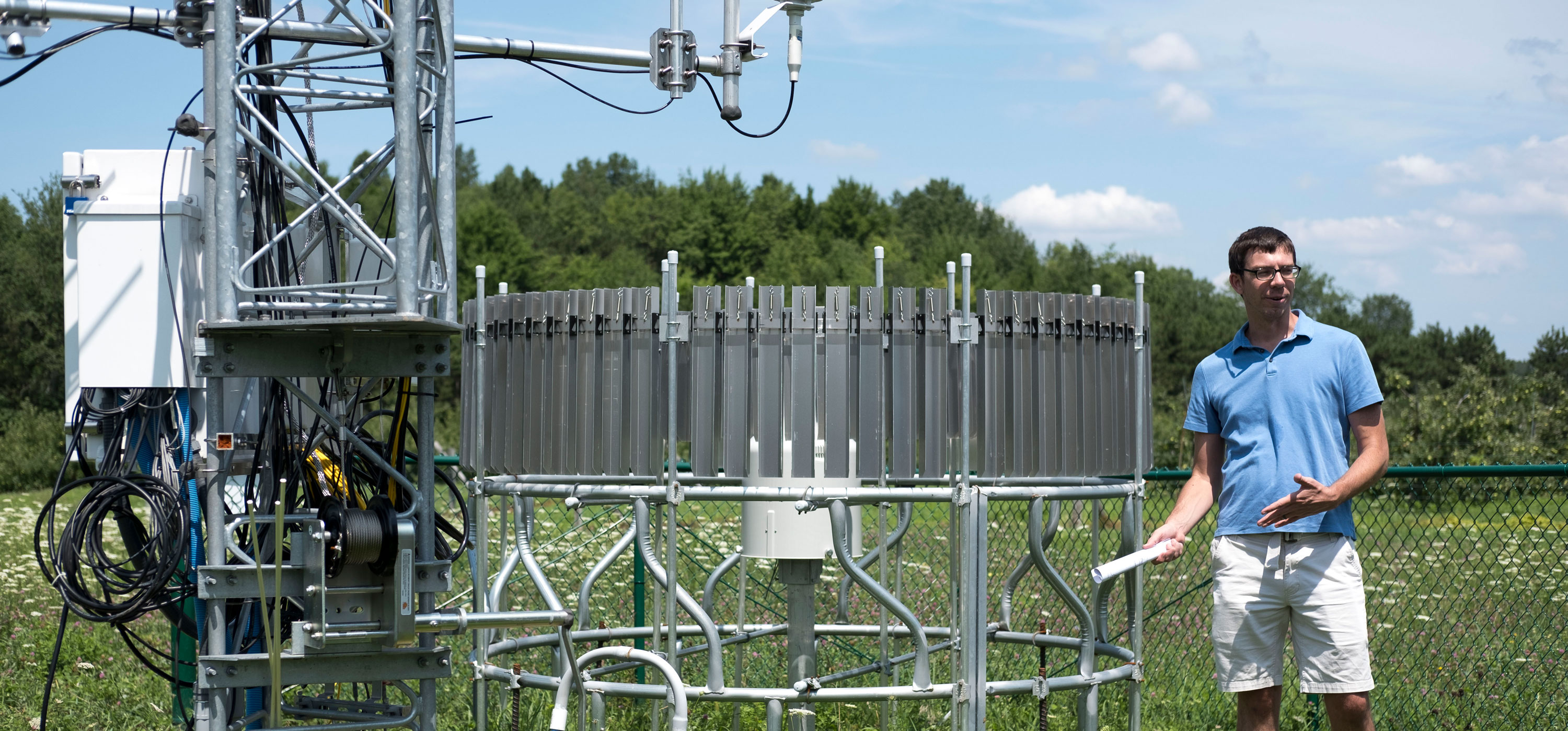
Dr. Andrei Lapenis trains undergraduate students
in field sampling and laboratory analysis of soil
and water contamination in his Environmental Analysis
course. Through the Mohawk Tower Observatory,
continuous live-time webcam images are available
of the University and Region. Contact: Dr. Andrei
Lapenis.
GIS
Internship Program
An extensive paid internship program offered in conjunction with the Department of Informatics in the College of Computing and Information, working
with most of New York's state agencies and a few
other organizations using Geographic Information
Systems (GIS). About 25 graduate and undergraduate
students who have done basic coursework in GIS
and Remote Sensing work on paid internships, typically
for 20 hours per week over most of the year. Contact:
Dr. Floyd Henderson.
National Transportation Information Systems Planning
Prof. Catherine Lawson is assisting the National Academy of Science's Transportation Research Board guide the development of intelligent transportation systems as chair of their Urban Transportation Data and Information Systems Committee. She also chairs their National Cooperative Freight Research Program Panel and is a panel member of the Hazardous Materials Cooperative Research Program. Contact: Catherine Lawson
Remote
Sensing
Through its GIS and Remote Sensing Laboratory,
directed by Dr. Floyd Henderson, the Department
of Geography and Planning, in conjunction with the Department of Informatics in the College of Computing and Information, does technical research,
mapping and digital image analysis for the NYS
Department of State, usually working on coastal
protection and flood hazard studies intended to
prevent tragedies and conserve natural resources.
Contact: Dr. Floyd Henderson.

College
of Computing and Information
• Department of Informatics
National Transportation Information Systems Planning
See description under the Department of Geography and Planning.

College of Nanoscale Science and Engineering
The College of Nanoscale Science and Engineering is the first college in the world dedicated to research, development, education, and deployment in the emerging disciplines of nanoscience, nanoengineering, nanobioscience, and nanoecomonics. CNSE's Albany NanoTech Complex is the most advanced research facility of its kind at any university in the world: a $4.2 billion, 450,000-square-foot complex that attracts corporate partners from around the world, and offers students a one-of-a-kind academic experience. For more information, visit http://cnse.albany.edu/ or contact Kristin Wolf.
Center for Sustainable Ecosystem Nanotechnologies
The Center for Sustainable Ecosystem Nanotechnologies provides critical design and analysis, pilot prototyping, and proof of concept to enable advanced systems and structures for integration within a host of renewable energy technologies, including fuel cells, solar energy, hydrogen, biofuels, wind, and hydropower. The research complements the applications-based programs of the College of Nanoscale Science and Engineering's Energy and Environmental Technology Applications Center ("E2TAC"), providing additional capabilities and expertise to accelerate the path to commercialization for next-generation alternative energy technologies. For more information, visit http://cnse.albany.edu/ or contact Kristin Wolf.
Energy and Environmental Technology Applications
Center (E2TAC)
The Energy and Environmental Technology Applications Center (E2TAC) addresses the needs of advanced energy and environmental applications by leveraging the intellectual power base and state-of-the-art infrastructure at the College of Nanoscale Science and Engineering (CNSE) and making use of its extensive capabilities in nanoelectronics and nanotechnology. Working with a growing list of collaborators, E2TAC is also at the forefront in business acceleration, education and outreach activities in the increasingly important areas of renewable energy and energy efficiency. For more information, visit http://www.e2tac.org/ or contact Kristin Wolf
Global Education and Training for Nanotechnology (GetNANO)
The College of Nanoscale Science and Engineering and Hudson Valley Community College joined with Einhorn Yaffee Prescott ("EYP") Architecture & Engineering PC of Albany to develop the Global Education and Training for Nanotechnology ("GetNANO") program. The GetNANO initiative is designed to ensure the development of the highly skilled workforce necessary for the design and efficient operation of state-of-the-art nanoelectronics research, development and manufacturing facilities. This initiative includes the creation of a collaborative program that trains architects and engineers to design high-tech buildings and facilities with sustainability and zero energy, focusing on areas such as building information modeling, energy simulation, and system monitoring and control. Contact: Kristin Wolf
National Institute for Sustainable Energy (NISE)
The College of Nanoscale Science and Engineering and Einhorn Yaffee Prescott (“EYP”) Architecture and Engineering PC of Albany have created a world-class center for zero energy and sustainability that serves as both a catalyst for energy technology innovations and as a magnet for the attraction of clean energy businesses and industries to the Capital Region and New York State. EYP's business group, EYP/energy – including 15 EYP executives, managers, architects, designers and engineers – is located at CNSE’s Albany NanoTech complex as part of the $3.5 million National Institute for Sustainable Energy (“NISE”), a leading-edge center for zero energy and sustainability research and development, business advancement, commercialization and workforce training. Through NISE, personnel from EYP and CNSE collaborate to convert zero energy concepts and innovations into actual business opportunities and revenue generating initiatives in established markets, including integrated building modeling and energy simulation, energy efficiency, new energy technology, and monitoring and control. In addition, programs in education, workforce training and development, and public policy have been established. Contact: Kristin Wolf

Atmospheric
Sciences Research Center
The Atmospheric Sciences Research Center performs world-class research to study the physical and chemical nature of the atmosphere and to apply that knowledge to study the interaction of various processes that have an impact on our environment. The Center’s work thus enhances the state and nation’s scientific capacity and infrastructure. Through technology transfer and collaboration with state, federal and industrial partners, ASRC also helps advance citizens’ well being. A recent project is focusing on the East Asia summer monsoon and the Northeastern winter climate. It will increase the reliability of general circulation models in predicting future regional climate changes over the U.S. in a global warming situation. For more information: http://www.asrc.albany.edu.

Environmental Sustainability Task Force
The Environmental Sustainability Task Force was formed in 2005 to provide leadership in demonstrating the University's responsibility towards environmental stewardship. Several initiatives have been developed including: energy conservation campaigns, recycling contests and farmer's markets. Most recently, a Director of Environmental Sustainability and Energy Manager have been hired to coordinate efforts and further propel the University as a role model in this field. With the signing of the American College and University Presidents' Climate Commitment, a comprehensive assessment of our greenhouse gas emissions and the development of a carbon neutral action plan will be undertaken in addition to our established programs and policies. Contact: Mary Ellen Mallia

Institute for Health and the Environment
The Institute was created to promote interdisciplinary research and grants in the broad area of health and the environment. Faculty in the Institute are drawn from several schools and colleges of the University, and other local universities and medical centers. The Institute promotes linkages between community grassroots organizations and leaders and researchers by establishing partnerships with communities on issues related to the environment and health. The Institute’s External Advisory Board, consisting of prominent community leaders and grassroots community organizations, supports these partnerships. In order to promote interdisciplinary research, the Institute sponsors a regular seminar series so that members of the Institute can become acquainted with and knowledgeable of each other's research expertise. The Institute also organizes and sponsors symposia and conferences and provides resources to its members for grant-related activities. Contact: David Carpenter

|