Part 4: Investigations Outside of the City Wall
of Mayapán: Survey,
Mapping, and Test Pits
We initiated a project of settlement survey during the 2002 field season. The goal of this work is to investigate settlement patterning, settlement history, and urban function in previously uninvestigated portions of the Postclassic Maya city of Mayapán. Our focus was on a study area defined as all area within 1km of the city’s walls. Previous work by the Carnegie Foundation focused on areas contained within the over 9km long city wall that surrounds a large portion of the site. Work by Dr. Timothy Hare focused on mapping cleared fields both within and outside of the wall. This new work focuses exclusively on settlement patterning outside of the large city wall and provides valuable information on the distribution of architecture types, the chronology and function of those structures and the location of various productive activities.
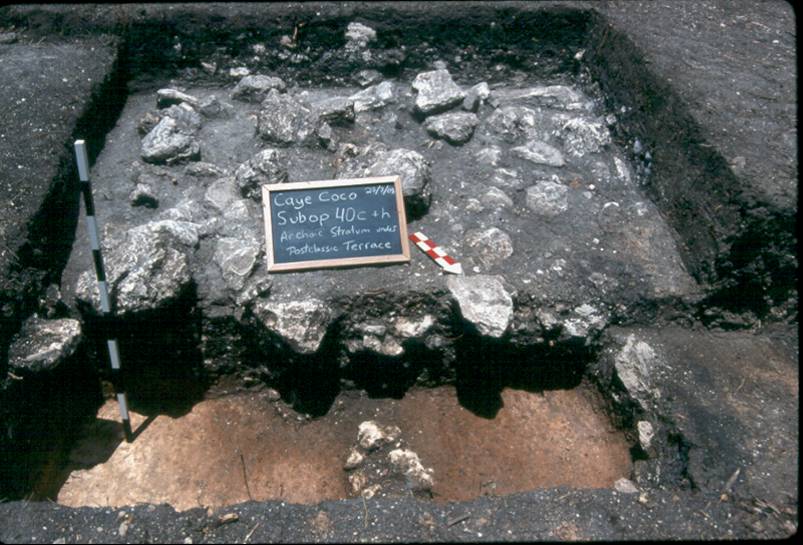
The research took place in phases. The first phase involved detailed mapping of all architecture encountered along eight 250m x 1000m transects (Figures 16, 17, 18, 19, 20). These transects were placed in a combination of intentionally and randomly chosen locations. Based on this phase of the research a typology of the architecture was devised and used as a basis of a stratified sampling program (Phase Two) in which examples of each structure type were subsurface tested in 1X1m excavation units (Figure 14). Artifact analysis has been completed, and we are currently in the process of analyzing the distribution patterns of features and associated materials.
Transects for survey were chosen through a combination of judgmental and random methods. Five transects were selected judgmentally to extend north, south, east and west from five of the city’s major gates. One each of these extends east, west and north and two extend to the south. One of two transects selected along south side was not surveyed due to hurricane damage that made the forest impassable and ground cover extremely heavy. One random transect was also selected in each cardinal direction. To select these random samples, we entered a list of all possible 250m wide by 1000 long transects extending in the four cardinal directions from into an Excel spreadsheet, and this program was used to randomly select one transect from each of the four directions. Our final sample thus consists four random and four non-random transects in the sample. The total area surveyed for all transects is 2 square kilometers, an area that is equivalent to just under half of the total area contained within the city walls.
With one exception, the Phase I survey was conducted by teams of four to seven people walking transect lines spaced at 15m intervals. The dense ground cover encountered along Transect 4 reduced visibility significantly. In this case, we reduced the line spacing to 7.5m intervals in order to improve our coverage of the area. Magellan Map 330 GPS units were used to navigate straight lines in the dense overgrowth of the transects, to map large scale features such as the dry laid, low, stone walls or albarradas, and to record the location of architectural clusters. Frequently, structure clusters are defined by inclusion within an albarrada wall enclosure. However, sometimes they are set apart only by a zone of relatively empty space that separates them from other adjacent clusters. For consistency of preliminary recording, single isolated structures were also assigned cluster numbers. The structure cluster numbers assigned this during the 2002 and 2003 seasons were preliminary and have been converted to the alphabetical system established by the Carnegie project (based on the new extended alpha-numeric grid applied to the site by Timothy Hare).
All architectural clusters encountered were cleared of vegetation and mapped using the traditional tape and compass method. As mentioned above, the location of each of the clusters was recorded using the Magellan GPS equipment. These architectural maps were digitized and combined with the GPS data using ArcGIS 8.3 software. In addition to mapping the settlement distribution, we collected GPS points for cenotes, sascaberas, chultuns, and cave entrances. We also mapped a number of modern and historic features such as paths, roads, walls, fences, INAH datum markers, and the transvia, a small railroad used to transport henequen from Xkanchakan to Rancho San Joaquin near the site core around the turn of the last century.
In the second phase of research, a typology of eleven architectural types was devised based on the results of the first phase (Figure 21). We excavated a total of 53 1X1m test pits along Transects 1 through 5 (Figure 14) to test a sample of each structure type. Units were placed in close proximity to key architectural types within teach transect, including: one and two-room structures/dwellings, stone platforms, round structures, elliptical structures, circular alignments, spiral alignments, and shrines. The choice of individual structures to be tested was determined by the preservation of the structures, logistical concerns such as accessibility a desire to test examples of all types encountered and a desire to achieve the maximum spread of excavation units across the transect space. Proximity of the excavations to the structures was often determined by availability of soil. As the majority of these architectural clusters are located on altillos with little or no soil cover, the area surrounding the structure was re-cleared and examined for testable pockets of soil. The unit was placed as close as possible to the structure in an area containing the deepest soil possible. In cases where there was adequate soil cover all around, the unit was located directly behind the structure being tested in hopes of encountering midden deposits. In general, we tested one or two examples of each of the structure types documented for each transect. In a few cases, additional test units were placed near the same structure in order to expand the sample of material from structures when the first unit contained little or nothing.
All excavation units were oriented to the cardinal directions. Units were excavated in arbitrary 10cm levels (and materials collected in ¼” screens); each level and feature was assigned a unique lot number. Excavations were conducted using small hand picks, trowels, and brushes. GPS points were taken for all test excavation units. These readings were used to plot test units on our transect maps in ArcView 8.3.
Phase I of this research, survey and mapping, was completed during the 2002 and 2003 field seasons. In this time, we compiled detailed maps of eight 250 meter by 1000 meter transects. In total, 347 structures in 173 clusters were documented in the study area. A small number of these are included in the margins of the Carnegie map (Jones 1962). However, the vast number of the structures are newly recorded. This count of 347 structures can be compared with the density of structures within the wall which is far greater. In the roughly 9 sq km area contained within the wall there are approximately 4,000 structures. The density outside the wall is predictably lower than within the walls. Projecting that sample out over the entire 1km parameter of Mayapán suggests that there may be roughly 1,700 structures located within 1km of the city wall. That represents a roughly 40 percent increase in the potential number of settlement features around the city, although all of these features are not contemporary with Mayapán.
Eleven general structure types were defined. Table 3 shows the number of each structure types found in each transect. A total of 128 single room structures were recorded, making this the most common structure type documented. These structures are defined by a wall line and may or may not be confined to a basal platform. The form of these structures is variable. Some are simple rectangular wall lines lacking internal features. Many others contain double walls and/or bench features suggesting that they many have functioned as dwellings.
Platforms were the second most common type encountered with 107 examples recorded. There is a great deal of variability within this category. They vary both on shape and size. Typically they are rectangular, square or round. On occasion they are irregular in shape. The smallest of these structures is less than one meter across. These may have served as altars, storage platforms, or features of perishable structures, such as kitchens. Other platforms are up to twenty meters across and probably served as foundations for one or more perishable structures. The common feature of shared structures is that they are elevated platforms constructed of large cobbles and having a flat upper surface. Platform domestic architecture deviates from typical Mayapán style housing, and is likely earlier in date.
The third most common type was the round structure. A total of 57 round structures of various types were recorded. These structures are defined by the presence of round wall lines. Note that in this preliminary tabulation, all round platforms lacking wall lines are grouped with platforms rather than with round structures. The majority of round structures were defined by a single course stone wall line, although occasional double wall lines were observed. Some have clear entrances. There is a wide range in size among these structures. Transect 2 contained several large round structures measuring between five and seven meters in diameter. Testing revealed large quantities of burned wood that suggests that these features served as lime kilns to make the large quantities of plaster used throughout the city. Other structures in this cluster may have served as dwellings, granaries, field outbuildings, or for other purposes. Additional testing is required to more fully understand the function of the structures in this classification.
Another common class of structure is the two-room structure. As suggested by the name, these structures defined by wall lines and are clearly partitioned into two distinct spaces. The majority of this class consists of typical Mayapán style commoner dwelling as defined by Smith (1962). Most of these structures sit on rectangular basal platforms and have clearly identifiable double walls and bench features.
Several other classes of structure are far less common. A form termed the open spiral was represented by two examples in cluster in Transect 5, Cluster 7Q-1. Both of these structures were spiral shaped wall lines open to the center and both were located on low platforms built along the side of an altillo. One of these was a single course wall the other was a double wall. The example with the double wall also contained a wedge shaped bench. These were constructed of large rough cobbles and were located nearly 1000 meters north of the city wall. Preliminary analysis suggests that this architectural form predates the Late Postclassic Period.
Three room structures were represented by two examples. Four room structures, elliptical structures, range structures, rectangular pyramids and round pyramids were represented by one example each. Three and four room structures are defined by wall lines and were partitioned into distinct rooms. A single range structure was also found. It was a long, tall, rectangular platform mound. The single elliptical structure was defined by a stone alignment. This type may have been a variant of single walled round structure, serving a similar function as it is similar in size to other examples that may represent dwellings predating the Mayapán occupation. Rectangular and round pyramids are tall structures rising sharply to a near point. Both examples from the study area have small flat tops that may have supported perishable structures.
Phase II of the research involved excavating a series of 1m x 1m test pits (in 10cm arbitrary levels) to recover a sample of the artifacts associated with the occupation of the structure (Russell 2004b). More specifically, we were looking for data that would provide information on the chronology and function of the structures in question. As noted above, these units were placed as close to the architecture as possible without penetrating it, due to INAH regulations. The extremely limited soil coverage in the area largely dictated the placement of these units in relation to the architectural features. In the event that no artifacts were recovered in the initial unit, a second unit was placed. In total 52 units were excavated along five of the eight transects. The analysis of the materials recovered continues.
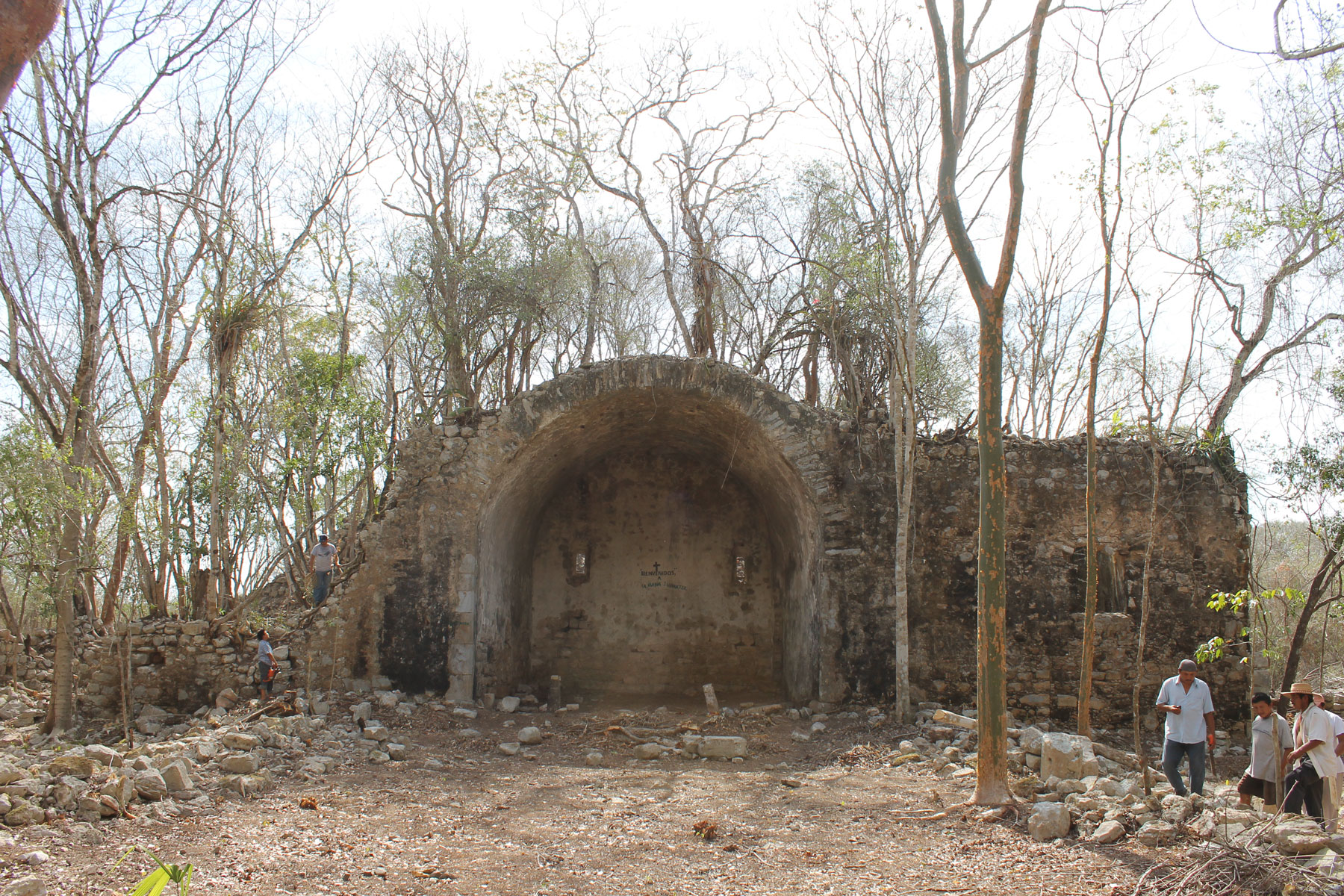
Following the completion of the test-pitting program, we mapped a cluster (18O-1) located just outside the major gate, Gate “G”, at the northeast point of the city wall (Figure 22). These structures were first encountered just outside of our transect during the first season of mapping. The group stood out for its size and the large number of column drum stones scattered about. The cluster consisted of four structures that match Proskouriakoff’s (1962:89-90) description of the “basic ceremonial group”. Typically these are defined by the presence of a colonnaded hall, a raised shrine and an oratory. When the cluster was cleared, it became evident that the main structure of the group was a colonnaded hall. Proskouriakoff suggested two interpretations of the function of these structures, men’s houses and administrative features for specific lineages. Today, the latter interpretation is preferred by most scholars.
The location of this hall was very surprising because the distribution of these structures is extremely limited within the site. Of the 26 previously recorded colonnades at Mayapán, 22 are located in the ceremonial center in Square Q, three at the Itzmal Ch’en temple-cenote group, and one is present in Square J. This is the first found outside of the walls. The location of this cluster, just outside this major gate is very interesting. It is stated in Smith’s (1962:79) discussion of the ethnohistoric sources about Mayapán that each of the four cardinal gates was controlled by a different lineage at the site. Specifically he indicates that the east gate of the city was controlled by the “Couoh” (now spelled Kowoj). If indeed colonnaded halls are lineage houses, this may be the home of the Kowoj lineage or at least those members involved in controlling the east gate to the city.
Preliminary artifact and architectural form analysis suggests that the vast majority of the structures mapped are contemporaneous with the occupation of Mayapán. Two pockets of settlement, Dzan Tun Ch’en along south Transect 4 and occupation at the north end of Transect 6 appear to predate the main site settlement (Figure 23). The pocket of pre-Mayapán settlement at the end of Transect 6 seems to be associated with the Classic Period site of Telchaquillo. The general direction of the structures appears oriented toward the cenote that makes up the center of that settlement. Most striking is the orientation of a large temple pyramid (14P-8) located along the transect. A straight line drawn down the front stairs of the temple virtually crosses right over the cenote, which is located about 1km northwest of the structure.
The Dzan Tun Ch’en settlement pocket appears to have been a solitary cluster site that may have been occupied from the Late Classic to the Postclassic Period. It appears centered on water bearing Cenote Madera, located just to the east of Transect 4. The composition of this settlement pocket suggests that we crossed the site center in our transect. We documented three specific structural groups. Cluster 14J-4 consists of seven structures, one very large domestic structure and six platforms that likely served for storage. Located adjacent to this large group are two examples of large public architecture. These structures were accessible from all sides and were not closed off by albarrada walls. Cluster 14J-5 is a large multi room structure consisting of two large rectangular wall lines connected to an open round structure (accessed from inside of the main structure). The largest and main rectangular alignment has small semi-circular bench features on all four sides. Russell argues that this cluster represents a center for small scale market transactions for the Dzan Tun Ch’en settlement, as the small benches could have served as market stalls. The majority of the material collected here indicates a Late Classic date. Russell is awaiting the results of phosphate tests conducted on the soil inside of the structure to further consider this hypothesis. He suspects that the numerous platforms associated with cluster 14J-4 served as storage for goods being exchanged at the adjacent market stall facility. Finally, cluster 14J-6 is a large flat altillo that was leveled and extended to form a large platform. There is an entrance facing the proposed market a short distance away. There is a small rectangular cobble platform located along the east side of the platform and the south end of the platform is an area defined by large stone slab walls that is reminiscent of some sort of performance platform.
The research outside of the city wall was undertaken to examine the settlement zones lying outside of Mayapán. In the study area we located 347 structures, a density far lower than within the walls. The vast majority of the structures recorded are contemporaneous with the main Mayapán occupation see. We have demonstrated that settlement continues directly outside of the wall, that it extends several hundred meters in each direction. At a greater distance from the city wall, there are discontinuous outlying pockets of settlement such as the Dzan Tun Ch’en Cluster in Transect 4. Second, there appears to be a reasonably clear difference between structures located near the city wall and those found at a greater distance. The majority of the structures were encountered within 400m of the city wall. In this zone, residential groups predominate. Beyond this point, settlement is lighter and the structures seem to be primarily non-residential in nature (Figure 24). Most of the residential groups are located on altillos and are at least partially ringed by dry laid albarrada walls. The general pattern seems to be that residents were living close to the wall and walking out to tend agricultural fields and engage in other productive activities.
Along the east side transects (Transects 1, 3 and 8), there were many isolated, low platforms found beyond 400 m from the city wall that appear related to agricultural production, serving as granaries and field outbuildings. These are known locally today as paseles. These structures are primarily located in the low areas between altillos. They are not enclosed by walls.
In addition to providing information on food production, the research produced useful information about non-agricultural production activities. In particular, seven large (5-7m in diameter) round structures located in the far end of west side Transect 4 were tested and appear to have been lime kilns for the production of plaster. They contain large quantities of carbonized wood and blackened limestone. These features are located close to several large stone quarries known locally as sascaberas. Radiocarbon dating of these features indicates that they are contemporaneous with the latter part of the Mayapán settlement. It has been speculated that the city wall itself is a late feature at the site. If correct, these features may be related to the construction of the wall. However, the destined use of this lime is difficult to determine as lime was a widely utilized material at this site for construction as well as for the preparation of maize.
Access to water bearing cenotes seems to have been a major factor in the distribution of residential architecture. Two areas demonstrate this pattern clearly. The previously mentioned pocket of settlement (Dzan Tun Ch’en) located about 700 meters from the city wall along Transect 4 is one example. It appears to cluster around Cenote Madero which is located about 20 meters to the east of the transect. The dense cluster of settlement recorded this year along Transect 7 lies just on the other side of the city wall from several large cenotes located in Quadrant AA. In addition, local informants tell me that there are additional cenotes lying just a short distance to the south of this transect. The transects vary in their density having a range of 11 to 62 structures per transect . Interestingly, Transect 2, which has only 11 structures, was located just 250 meters north of Transect 7, which has 59 structures. A similar drop in density is evident for the settlement inside of the wall as well. The reason for this sudden change is not yet entirely clear. However, it is also likely a reflection of the distribution of water in the area. There are far fewer cenotes as one moves north along the west side of the settlement.
Return to The Economic Foundations of Mayapán
Table of Contents
Return to the Main Page
© 2006 Institute for Mesoamerican Studies
Updated February 8, 2006