| From
skateboards to nanotechnology �
a UAlbany student�s journey to his future
 |
| Jonathan
Rullan |
When he arrived at UAlbany at age 17, Jonathan
Rullan was �still influenced by skateboarding
and all of the adolescent style that came with
it: big jeans, tongue piercing, bleached hair.�
In the six years since, he has traded in his
skateboard, piercing, and bleach for an atomic
force microscope (AFM), a scanning electron
microscope (SEM) � and a future in the nanotechnology
field.
Now 24, the New York City native �really had
no idea what I wanted to be� when he enrolled
in 1998. �All I knew was that I wanted to do
something in science, and when I was trying
to think what I could do with science, I really
wasn�t sure. So I took one step at a time, taking
the courses I liked.�
Jonathan became interested in nanotechnology
� the science of manipulating matter on the
atomic scale � and the College of Nanoscale
Science and Engineering (CNSE) �before the school
was even up and running. In my senior year,
doing independent research at Albany NanoTech,
I was exposed to something I didn�t even know
existed and decided to pursue it.�
After earning his B.S. in physics in 2002,
Jonathan studied in UAlbany�s physics graduate
program for about a year and half. He �switched
over to CNSE� last spring. Now working toward
his master�s in nanoscience and nanoengineering,
he is considering the idea of earning a doctorate
in the same field. �I�m studying the surface
morphology of copper interconnect wires as a
function of time and heat. It�s important to
understand the stresses induced on a copper
wire � all the different material being applied
on top of the copper, which requires different
heat processes.�
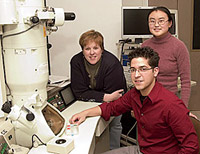 |
| Left to
right: Assistant Professor of Nanoscale
Science and Engineering Kathleen Dunn, Jonathan
Rullan, and graduate student Susan Huang,
who also does research at CNSE. |
Jonathan works closely with his faculty mentor,
Assistant Professor of Nanoscale Science and
Engineering Kathleen Dunn. �She lets me do work
I�m interested in, but leads me in the right
direction. I look up to her.�
�Mentoring is a vital part of the faculty-student
relationship,� says Professor Dunn. �Classroom
teaching can only go so far; most students learn
better from watching and doing.�
The mentoring relationship, she adds, benefits
faculty, too: �It keeps us young. The students
are a constant source of new energy and new
ideas that catalyze our own research interests.
It�s very fulfilling to watch the evolution
of a student as we nurture his creativity and
equip him with the critical analysis skills
required to tackle the problems presented to
him. In Jon�s case, particularly, it has been
rewarding to see him learn to focus his tremendous
energy and to see him develop the analytical
skills to complement his innate enthusiasm and
abilities.�
Related Links:
Albany
NanoTech
College
of Nanoscale Science and Engineering |