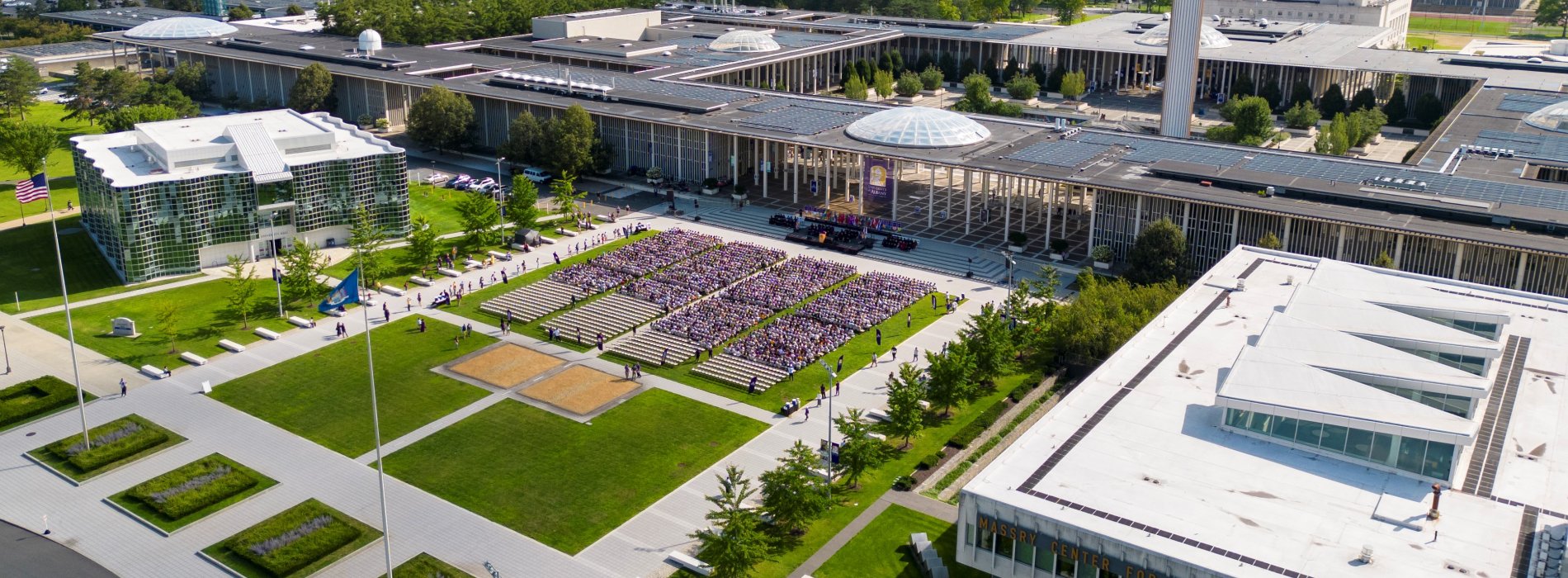
Campus University at Albany-SUNY_____________________ Date November 25, 2002
Proposed Program Title NanoSciences & NanoEngineering
Proposed Degree/Certificate Doctor of Philosophy (Ph.D.) and Masters of Science (M.S.)
HEGIS Classification and Number Engineering 0915
Academic Unit to Offer Program School of NanoSciences & NanoEngineering
Proposed First Enrollment Date Fall 2003 _______
A. Executive Summary
The School of Nanosciences and NanoEngineering (SNN) of the University at Albany-SUNY proposes the establishment of the degrees of Doctor of Philosophy (Ph.D.) and Masters of Sciences (M.S.) in the emerging interdisciplinary fields of NanoSciences and NanoEngineering. The first curriculum proposed offers Ph.D. and Masters degrees in selected science and engineering tracks pertaining to the nanoelectronic, optoelectronic, optical, nano/micro-electro-mechanical, nano/micro-opto-electro-mechanical, energy, and nanobiological fields. Multiple student entry channels are designed to accommodate students from undergraduate and graduate educational background in Physics, Chemistry, Biology, Computer Science, and Electrical, Mechanical, Chemical, and Biochemical Engineering.
Specific thesis pathways include: Molecular Materials and Architectures; Optoelectronic Materials, Architectures, and Devices; NanoSystems Sciences and Technologies; Thin Film Single and Multilayered Material Structures: Nanomaterials for Nanotechnology: and Nanoscale Materials Characterization, Modeling, Analysis, and Metrology.
The cross-disciplinary Ph.D. and M.S. curriculum proposed integrates the fundamental science principles of physics, chemistry, computer science, and biology with the cross cutting fields of nanosciences, nanoengineering, and nanotechnology. The underlying graduate course instructional strategy supports this multidisciplinary approach. A comprehensive portfolio of courses provides fundamental knowledge in the basic science and engineering of design, growth, and properties of nanomaterials, including metals, semiconductors, polymers, and chemical and biological materials; to the integration, processing, testing and qualification of these materials in integrated nanocircuitry, micro- and nano-systems and sensors, and integrated optics. Significant emphasis within each discipline is placed upon the science and technology know-how for atomic scale material modeling, characterization, and metrology to develop the fundamental skills necessary for independent and original research.
The interdisciplinary environment for the proposed graduate program is essential to its effectiveness. It is made possible by building on pertinent components of the physics, chemistry, computer science, and biology curricula. Given the potentially diverse nature of entering students, carefully tailored academic tracks are designed to tap into existing course offerings in UAlbany's core science departments to accommodate individual student background and interests, while ensuring a comprehensive and sound education. To ensure success, a close working relationship was established with existing academic units for the implementation of highly synergistic partnerships where the sum is significantly greater than its parts and which are appreciably more beneficial to the University's faculty and students.
The collaborative, cross-discipline nature of the program is fostered by the participation of faculty from Physics and Chemistry, and other departments in the future, typically through joint appointments or adjunct professorships in the SNN. It is also enhanced by the recruitment of a number of highly qualified senior scientists and researchers from the UAlbany Institute for Materials (UAIM) to join the school, and the initiation of externally-funded national searches to attract world-renowned experts in key fields of nanosciences to UAlbany.
A.I. Estimated Student Headcount Enrollment/Projected Faculty and Staff Numbers
|
|
YearI |
Year II |
YearIII |
YearIV |
Year V |
|
Projected Number of Students (Headcount) |
|
||||
|
Full-Time (M.S.) |
6 |
10 |
13 |
20 |
25 |
|
Part-Time (M.S.) |
1 |
3 |
7 |
12 |
25 |
|
Full-Time (Ph.D.) |
5 |
16 |
38 |
55 |
85 |
|
Part-Time (Ph.D.) |
0 |
4 |
7 |
10 |
15 |
|
Projected Number of New Faculty |
|
||||
Full-Time |
2 |
3 |
2 |
3 |
3 |
|
Part-Time (includes adjuncts, joint, etc.) |
2 |
3 |
4 |
4 |
5 |
|
Projected Number of New Support Staff |
|
||||
Full-Time |
2 |
1 |
- |
1 |
2 |
|
Part-Time |
3 |
2 |
3 |
4 |
2 |
A.II. Number of Existing Faculty Who Will Participate in Program in Year I
|
|
Full-Time |
Part- Time |
Adjunct |
Regular (Tenured) |
Regular (Untenured) |
|
Professor |
6 |
1 |
1 |
3 |
5 (4 tenure track) |
|
Associate |
1 |
2 |
--- |
2 |
1 (tenure track) |
|
Assistant Professor |
10 |
--- |
--- |
--- |
10 (tenure track) |
|
Instructor |
--- |
6 |
--- |
--- |
6 |
B. Overarching Goal of Graduate Program
The purpose of the graduate academic program proposed is to provide a comprehensive education of the highest quality at the M.S. and Ph.D. level with regards to the discovery and dissemination of fundamental knowledge concepts and new frontier scientific principles in the emerging interdisciplinary science and technology fields of nanosciences and nanoengineering.
The fields of nanosciences and nanoengineering aim to advance the knowledge base for controlling the growth of the basic building blocks of physical, chemical, and biological systems at the molecular level, atom by atom, leading to the formation of macroscale structures and systems with novel properties, unique performance, and innovative functions.1,2 The resulting fundamental knowledge base will help advance new scientific disciplines, including nanomaterials, nanobioinformatics, nanoelectronics, and quantum computing. It will also offer students an excellent opportunity to assume advanced coursework studies and undergo original research work in one of the most enabling fields of the 21st century, namely, nanotechnology. As described in the report by the National Science and Technology Council on the National Nanotechnology Initiative, the field of nanotechnology is "leading to the next industrial revolution.1"
The graduate academic program proposed represents the first educational curriculum of the recently established School of NanoSciences and NanoEngineering. The creation of the school signified a critical enabling step in the implementation of the strategic development plan of the University at Albany-SUNY (UAlbany), as embodied by its mission statement. The statement called for building and expanding on existing academic and educational strengths to become a top, world-renowned research university with Carnegie I designation. As part of achieving this goal, the university created, under the umbrella organization Albany NanoTech, two synergistic university organizations in nanosciences and nanoengineering: The UAlbany Institute for Materials (UAIM) and the SNN.
UAIM serves as a fully-integrated research, development, prototyping, and technology deployment resource that manages a strategic portfolio of focus centers that are collectively
_______________________________________
Nanotechnology Technology Initiative: Leading to the Next Industrial Revolution (National Science and Technology Council, Maryland, September 1999).
J. Jasinski and P. Petroff, in Nanotechnology Research Directions: IWGN Workshop Report, eds. M.C. Roco, S. Williams, and P. Alivisatos (National Science and Technology Council, Maryland, February 2000), pp. 77-96.
increasing the relevance of university research to the more immediate needs of industry and society. These centers encompass nanoelectronics, micro- and nano-mechanical systems, bioelectronics, telecommunications, wireless communications, optical devices and components, leading edge metrology, and sensor-on-a-chip devices for energy, environment, and defense applications. All are fields that figure prominently in the global economy of the 21st century.
In 2000-01, UAIM received more than $165 million in support from governmental and corporate partners. This includes $150 million in funding from IBM and New York State in support of the creation of the Center of Excellence in Nanoelectronics, which will house the only university- based 300-mm wafer research and development, prototyping and workforce training facility in based 300-mm wafer research and development, prototyping and workforce training facility in the world. UAIM currently maintains a $125M state-of-the-art infrastructure, including state-of-the-art laboratory, prototyping, and cleanroom facilities, thereby offering students and faculty the most advanced facilities and equipment available today. SNN complements UAIM in terms of providing the critical mass of intellectual know-how and state-of-the-art instructional facilities to ensure the proper dissemination of fundamental knowledge concepts and new frontier scientific innovations in nanosciences and nanoengineering, from theoretical principles to experimental demonstrations and practical applications. While being committed to the time tested traditional goals of freedom of thought and excellence in academic research and education in its specialty fields, SNN is equally dedicated to the 21st century goal of harmonizing and integrating the work product of the University with the broad emerging societal, intellectual, and economic needs of the state and nation.
C. Structure and Content of Program
As stated earlier, the first curriculum proposed under the School of Nanosciences and Nanoengineering offers programs leading to the degrees of Doctor of Philosophy (Ph.D.) and Masters of Science (M.S.) in nanosciences and nanoengineering in pertinent concentration areas that include:
Molecular
Materials and Architectures: Material properties of molecular dots, wires,
and crystals, quantum confinement and ballistic transport based device structures,
and the integration of molecular/electronic materials in nanodevice geometries.
Optoelectronic Materials, Architectures, and Devices: Compound semiconductor material properties, quantum confinement-based nanodevice structures, and integration of optoelectronic/electronic materials in emerging "XYZ-on-a-chip" or "system-on-a-chip" (SOC) architectures and systems.
NanoSystems Sciences and Technologies: Design, fabrication, integration, and testing of nano/microelectrical and nano/micro-optoelectrical mechanical systems for incorporation in SOC architectures and systems.
Thin Film Single and Multilayered Material Structures: Self-assembly, deposition, modification, and integration of single and multilayered thin film materials.
Nanomaterials for Nanotechnology: Design, deposition, and integration of atomic and molecular-level nanoengineered materials for nanotechnology based applications.
Nanoscale Materials Modeling, Characterization, Analysis, and Metrology: Advanced x-ray, ion, and electron based microscopic and spectroscopic analytical techniques and process metrologies for atomic and molecular-level material properties of thin films, nanomaterials and nano/micro-scale devices. Advanced Theory and Simulation of optical, electronic, elastic, and thermodynamic properties utilizing state of the art electronic structure methods (Density Functional Theory, Hartree-Fock/Configuration Interaction, Quantum Monte Carlo, Quantum/Classical Molecular Dynamics, etc.)
The SNN graduate course curriculum supporting the thesis pathways outlined above maintains a cross disciplinary approach proposed integrates the fundamental science principles of physics, chemistry, computer science, and biology with the cross cutting fields of nanosciences, nanoengineering, and nanotechnology. The underlying graduate course instructional strategy supports this multidisciplinary approach. A comprehensive portfolio of courses provides fundamental knowledge in the basic science and engineering of design, growth, and properties of nanomaterials, including metals, semiconductors, polymers, and chemical and biological materials; to the integration, processing, testing and qualification of these materials in integrated nanocircuitry, micro- and nano-systems and sensors, and integrated optics. Significant emphasis within each discipline is placed upon the science and technology know-how for atomic scale material modeling, characterization, and metrology to develop the fundamental skills necessary for independent and original research in nanosciences and nanoengineering.
The interdisciplinary environment for the proposed graduate program is essential to its effectiveness. It is made possible by building on pertinent components of the physics, chemistry, computer science, and biology curricula. Given the potentially diverse nature of entering students, carefully tailored academic tracks are designed to tap into existing course offerings in UAlbany's core science departments to accommodate individual student background and interests, while ensuring a comprehensive and sound education. To ensure success, a close working relationship was established with existing academic units, particularly the College of Arts and Sciences and the School of Business, to implement highly synergistic partnerships where the sum is significantly greater than its parts and which are appreciably more beneficial to the University's faculty and students.
The collaborative, cross-disciplinary nature of the program is fostered by the participation of faculty from the academic departments listed above (and other departments in the future), typically through joint appointments or adjunct professorships in the SNN. It is also enhanced by the recruitment of a number of highly qualified senior scientists and researchers from the UAlbany Institute for Materials (UAIM) to join the school, and the initiation of externally-funded national searches to attract world-renowned experts in nanotechnology and nanosciences to UAlbany.
It should be noted that the first set of courses proposed under the curriculum place particular emphasis on students with background in the hard sciences and engineering, particularly physics, chemistry, electrical engineering, and chemical engineering. For this reason, entering doctoral students are required to complete a seven core-course sequence consisting of an appropriate subset of the following courses: CHM 520A, CHM 520B, CHM 525A, CHM 525B, CHM 526, CHM 535A, and CHM 561; or PHY 510A, PHY 510B, PHY 519, PHY 532, PHY 560, PHY 562, and PHY 563; or SNN 501, SNN 511, SNN 512, SNN 519, SNN 525, SNN 528 and SNN 541. Similarly, entering M.S. students are required to complete a three core-course subset from the same course portfolio.
The selection of an appropriate core-course sequence is designed to accommodate multiple nanosciences student specialization channels, including Physics and Chemistry. This approach also allows leveraging of inter-departmental instructional resources, and positions SNN faculty to provide critical capabilities to support the teachings loads in physics and chemistry, and vice versa.
To be fully comprehensive,
the curriculum will evolve over the next few years to include additional general
and specialized courses to support the admission of students with backgrounds
in computer science and life sciences. Naturally, these additions will be performed
in close collaboration and active consulting with the departments of computer
sciences and biology.
C.1.
Prospective SNN Course Offerings. General Courses
SNN 505--Crystallinity and Structure of Nanomaterials (3 Cr). Topics in nanostructure determination: structure factors, integrated intensities, data collection, diffuse scattering and effects of atomic scale defects on structural analysis. Theory and application of synchrotron x-rays, neutron diffraction, electron diffraction, atomic force microscopy, scanning tunneling microscopy, and emerging nanoscale electron, ion, and x-ray methodology to the nanostructure of crystalline, polycrystalline, and amorphous materials.
C.2. Prospective
SNN Course Offerings. Concentration Courses Specific to Thin
Film Single and Multilayered Material Structures
SNN 625--Macroscopic Quantum Phenomena and Nanostructures (3 Cr). Nanostructures and low-dimension systems, strongly interacting systems, excitations. Optical properties of semiconductor nanostructures. Transport properties in mesoscopic systems, electron optics vs. photon optics, weak localization, Landauer-Büttiker formalism, quantum entanglement, Coulomb blockade, single electron devices, spin dynamics in semiconductor quantum dots.
C.5. Prospective
SNN Course Offerings. Concentration Courses Specific to Nanomaterials
for Nanotechnology
SNN 671--Advanced Methods for Structure Determination: (3 Cr + 1 Cr for Laboratory Work). Advanced transmission electron microscopy techniques: high-resolution lattice imaging and image simulation for analysis of structural defects and interfaces, z-contrast. Convergent beam electron diffraction as method of nano-scale structural characterization of materials. High-resolution X-ray diffraction technique, application to studies of quantum dots and quantum well structures. Labs –2 hours/2weeks per group, alternating weeks for different groups (max number of students in an individual group not to exceed 5).
C.7. Prospective SNN Course Offerings. Concentration Courses Specific to
Molecular Materials and Architectures
Students accepted into the SNN Ph.D. program are required to construct a preliminary program of graduate study with the assistance of their academic advisor at the completion of the first year of study. This preliminary program will consist of the student's choice of concentration (specialization) and a tentative concentration course curriculum.
Students admitted with an appropriate Masters of Science degree shall complete 36 credit hours of academic coursework in partial fulfillment of the Ph.D. degree requirements:
Admission to the SNN Ph.D. program requires successful completion of a qualifying written examination which will be offered twice yearly (at the beginning of the Fall and Spring semesters). It will consist of multiple sections covering materials nanoscience, nanoengineering and basic nanoscience applications. The exam must be taken and passed within 4 semesters of the student's matriculation date to maintain good academic standing in the SNN Ph.D. program.
Within 3 semesters of passing the qualifying written examination, students in the SNN Ph.D. program must take and pass a preliminary oral examination. The preliminary oral examination will consist of an oral presentation on a research topic relevant to a SNN area of concentration but exclusive of the likely Ph. D. Dissertation topic. Successful completion of the preliminary oral examination will be judged on: (a) the student's ability to completely and thoroughly research the chosen topic; (b) the effectiveness and clarity of the student's presentation; and (c) the ability of the student to articulate and defend the scientific foundations of their topic research.
Successful completion of
the preliminary oral examination is determined by a five-member oral examination
committee. This committee consists of at least three members of the SNN faculty
(including the student's advisor) and at least one outside member (University
at Albany faculty outside SNN, or SNN research partner). Upon passing this examination
the student advances to candidacy for the Ph.D.
D.4.
Ph. D. Dissertation Proposal
Within one semester of passing the preliminary oral examination the candidate must submit to a Ph.D. dissertation committee a proposal outlining an original research project constituting a Ph.D. dissertation. The candidate must describe the motivation and background for the dissertation; the critical milestones for completing relevant research tasks; and a statement of work outlining a specific research plan. The five-person Ph.D. dissertation committee consists of at least three members of the SNN faculty (including the candidate's advisor) and at least one outside member (University at Albany faculty outside the SNN, or a SNN research partner). The role of the committee is to ensure that the proposal outlines a scope of work capable of achieving a significant, original contribution to the to the candidate's concentration area.
D.5. Ph. D. Degree
Research Support
The research and academic obligations for any funded SNN Ph.D. students, i.e., students who are funded by government, industrial or private fellowships, scholarships, research assistantships through sponsored research projects, etc... must be related directly to their research projects or to the development of the critical research skill set necessary to carry out their research project. As such, the intent of this financial support is to provide resources to assist in their educational and professional development, and cannot be used to require students to perform tasks that are unrelated to their research and academic obligations.
D.6.
Ph. D. Dissertation and Public Dissertation Defense
Upon timely completion of the Ph.D. dissertation research project the candidate prepares a dissertation and submits the final draft to the dissertation committee. The committee ascertains the suitability of the draft and recommends amendments which the candidate must complete before the final defense is scheduled. Once approved by the committee, permission is granted for the candidate to present and defend his dissertation in a public seminar.
D.7.
Ph. D. Publication Requirement
For successful completion of the Ph.D. degree requirements, students are also required to be the first author on a minimum of two scientific publications that have already been accepted for publication in recognized peer-reviewed technical journals that are related to the their concentration area.
E. SNN
Program Requirements for M.S. Degree Admission and Completion
Students accepted into
SNN Masters program are required to construct a preliminary program of graduate
study with the assistance of their academic advisor at the completion of the
first year of study. This preliminary program will consist of the student's
choice of concentration and a tentative concentration course curriculum.
E.1. M.S. Course Requirements
Students admitted with an appropriate Bachelor's degree shall complete 30 credit hours of academic coursework in partial fulfillment of the M.S. degree requirements:
12 credit hours of M.S. thesis research.
Students admitted into the SNN M.S. Program are required to undertake an original research project that represents a significant scientific contribution to one of the appropriate concentration areas. Completion of the M.S. research requirement could follow one of two potential pathways: (1) submission and successful defense of a formal Masters Thesis or (2) submission of a detailed written research report combined with the successful completion of a portion of the Ph.D. written qualifying examination.
E.3. M.S. Research Support
The research and academic obligations for any funded SNN M.S. students, i.e., students who are funded by government, industrial or private fellowships, scholarships, research assistantships through sponsored research projects, etc... must be related directly to their research projects or to the development of the critical research skill set necessary to carry out their research project. As such, the intent of this financial support is to provide resources to assist in their educational and professional development, and cannot be used to require students to perform tasks that are unrelated to their research and academic obligations.
E.4.
Thesis Route for the M. S. Degree: Thesis Proposal
Within two semesters of his or her matriculation, a student electing to follow the formal thesis route for the M.S. research requirement must submit to a Masters Thesis committee a proposal outlining an original research project constituting a Masters Thesis. The candidate must describe the motivation and background for the thesis; the critical milestones for completing his/her research, and a statement of work outlining a specific research plan.
The five-person M.S. thesis committee consists of at least three members of the SNN faculty (including the candidate's advisor) and at least one outside member (University at Albany faculty outside SNN or SNN research partner). The committee's role includes ensuring that the proposal outlines a scope of work capable of achieving a significant and original contribution to the candidate's concentration area.
Upon timely completion of the Masters Thesis research project, the candidate prepares a thesis and submits the final draft to the thesis committee. The committee ascertains the suitability of the draft and recommends amendments which the candidate must complete before the final defense is scheduled. Once approved by the committee, permission is granted for the candidate to present and defend his or her thesis in a public seminar.
E.5.
Non-Thesis Route for the M. S. Degree: Project Proposal
Within two semesters of his or her matriculation, a student electing to follow the non-thesis route for the M.S. research requirement must submit to his or her research advisor a proposal outlining an original research project to be undertaken.
The candidate must describe the motivation and background for the proposal; the critical milestones for completing his/her research, and a statement of work outlining a specific research plan. The role of the advisor includes ensuring that the proposal outlines a scope of work capable of achieving a significant and original contribution to the candidate's concentration area.
Upon timely completion
of the Masters Research project, the candidate prepares a detailed written research
report and submits the final draft to the research advisor. The advisor ascertains
the suitability of the draft and recommends amendments which the candidate must
complete before being recommended for the Masters degree.
A bachelor's degree or equivalent in the physical sciences, engineering, or mathematics is required for admission to SNN graduate programs. A minimum GPA of 3.0 (out of a maximum of 4.0) is strongly recommended in addition to strong letters of recommendation from past academic/professional instructors, mentors, advisors, or managers who can evaluate the applicant's potential for graduate education and research.
Upper level undergraduate coursework in one or more of the following areas is strongly recommended, depending on the individual student background and interests:
Mathematics: 21 credit hours in multivariable vector calculus, linear algebra, differential equations, and complex analysis;
Physics/engineering: 24 credit hours in basic mechanics, thermodynamics, electromagnetism, electronics, and advanced mechanics;
Chemistry: 12 credit hours in physical and organic chemistry;
Computer Sciences: 9 credit hours of theoretical and practical computer sciences courses;
Biology: 12 credit hours in advanced biological sciences.
Incoming students with less than the recommended level of mathematics, physics, chemistry, biology, or computer sciences may be able to remedy the deficiencies by taking various upper-division undergraduate courses in their first year of graduate study at the discretion of the student's academic advisor at the SNN.
SNN gives admission priority
to qualified students who are interested in high-quality academic research in
its areas of specialization in nanosciences and nanoengineering. All applicants
into the program must have satisfactory performance in the verbal, quantitative,
and analytical sections of the Graduate Record Examination (GRE). Minimum TOEFL
scores of 250 under the recently revised grading scale (equivalent of 600 under
the old grading system) are required for entrants whose native language is not
English. For foreign nationals applying to the SNN program, proof of financial
support is required prior to UAlbany issues the appropriate certificate of eligibility
for receipt of a visa. Further information can be obtained directly from the
university.
Current SNN Faculty and Staff Engaged in Proposed Educational Curriculum
Name |
Rank |
Status |
Course Load |
|
Hassaram Bakhru |
Professor |
Part Time |
SNN667 |
|
Michael Carpenter |
Assistant Professor |
Full Time |
SNN610, SNN679 |
|
James Castracane |
Professor |
Full Time |
SNN 631, SNN632, SNN635 |
|
Katharine Dovidenko |
Assistant Professor |
Full Time |
SNN505, SNN670 |
|
Kathleen Dunn |
Instructor |
Part Time |
SNN665A, SNN665B |
|
Eric Eisenbraun |
Assistant Professor |
Full Time |
SNN601, SNN602 |
|
Harry Efstathiadis |
Instructor |
Part Time |
SNN531, SNN541 |
|
Michael Fancher |
Instructor |
Part Time |
SNN555, SNN560 |
|
JoAnne Feeney |
Assistant Professor |
Full Time |
SNN555, SNN560, SNN565 |
|
Robert Geer |
Associate Professor |
Part Time |
SNN501, SNN516 |
|
Pradeep Haldar |
Professor |
Full Time |
SNN614, SNN565 |
|
John Hartley |
Professor |
Full Time |
SNN525, TBD |
|
Mengbing Huang |
Assistant Professor |
Part Time |
SNN512 |
|
Alain E. Kaloyeros |
Professor |
Full Time
|
TBD
|
|
Vincent Labella |
Assistant Professor |
Full Time |
SNN511, SNN512, TBD |
|
Ernest Levine |
Professor |
Full Time |
SNN519, SNN605, SNN606 |
|
Eric Lifshin |
Professor |
Full Time |
SNN532, SNN665A/665B, SNN670 |
|
Richard Moore |
Instructor |
Part Time |
SNN532 |
|
Serge Oktyabrsky |
Associate Professor |
Full Time |
SNN517, SNN620 |
|
James Raynolds |
Assistant Professor |
Full Time |
SNN502, SNN650, TBD |
|
Fatemah Shahedipour |
Assistant Professor |
Full Time |
SNN511, SNN541 |
|
Timothy Stoner |
Assistant Professor |
Full Time |
SNN525, TBD |
|
Vadim Tokranov |
Instructor |
Part Time |
SNN615 |
|
Paul Toscano |
Adjunct Professor |
Part Time |
TBD |
|
Bai Xu |
Assistant Professor |
Full Time |
SNN 528, SNN636, SNN645 |
|
John Welch |
Adjunct Professor |
Part Time |
TBD |
|
Di Wu |
Instructor |
Part Time |
SNN531, SNN532, SNN541 |
H. Criteria and Procedures for Admission to the Proposed Program
Prospective degree students with a bachelor's degree or equivalent in physical sciences and engineering from a college or university of recognized standing are encouraged to apply for admission to the School of NanoSciences and NanoEngineering. Their academic record must be a B or better in pertinent preparatory course work. Applicants must first satisfy the general admission requirement outlined in the UAlbany Graduate Bulletin. Requirements include the submission of a formal application for admission to the university before being considered for acceptance at SNN
Official transcripts for all prior college work.
An SNN graduate admissions committee will assess applications and supporting credentials and provide a recommendation to the UAlbany Office for Graduate Studies. In addition to academic qualifications, the SNN admissions committee will evaluate the applicants qualities and potential for engaging in independent research. Previous experiences and accomplishments in research will be considered as an important factor for potential admission to the program. Standardized tests such as the Graduate Record Examination (GRE) are required, and will serve as a critical component in the review process. Applicants whose native language is not English are additionally required to submit a score of the Test of English as a Foreign Language (TOEFL). The minimum acceptable TOEFL score is 250 under the recently revised grading scale (equivalent of 600 under the old grading system).
On recommendation of the SNN admissions committee, students admitted to graduate study are assigned a faculty advisor by the SNN dean. Admission to graduate study does not necessarily imply admission to candidacy for a degree. Students admitted in graduate programs are assessed later for admission to degree candidacy,
I. Student Body to Be Served
Due to its interdisciplinary nature, the curriculum proposed targets students from diverse educational backgrounds, including physics, chemistry, biology, computer science, materials science and engineering, electrical engineering, and chemical engineering. As such, the SNN curriculum builds on UAIM's already established track record of attraction and retention of students from most core science disciplines at the university, including physics, chemistry, biology, computer science, and materials science and engineering (with the largest contribution to-date being from physics). These students are conducting leading edge M.S. and Ph.D. research work in pertinent fields of nanosciences and nanoengineering within the externally sponsored programs of UAIM. In this respect, it is expected that an increasingly larger percentage of students entering the SNN will possess engineering, biology, and computer science backgrounds, in view of interdisciplinary nature of the SNN educational programs.
In terms of geographic origins, it is projected that the curriculum proposed will attract and retain a large number of qualified graduate students who are interested in advanced careers in nanosciences and nanoengineering from a state-wide, as well as national and international pool of likely candidates. This assessment is based on the fact that the program proposed is one of the first in the nation to offer advanced degrees in the emerging fields of nanosciences and nanoengineering and therefore is inherently attractive to an international student base. The world wide character of the SNN student clientele is also mandated by the global nature of a large proportion of the eventual employers of its graduates, including the nanoelectronics, bioelectronics, telecommunications, and optoelectronics industrial and academic communities. The school has already established long-term relationships with premier academic institutions in various countries of Asia and Europe that will provide a continuous pipeline of qualified candidates, including the Netherlands, Greece, Germany, Russia, China, and India.
In this respect, the close relevance of the new curriculum to the educational needs within the SUNY system and the research and education agendas of the state and nation (see Section B.7.) denotes that a high percentage of the student body to be served will originate from within the U.S., particularly New York State. It is worth noting that since the inception of the school, over 65% of applicants who expressed interest in potentially joining the SNN are U.S. citizens, particularly from the Northeast and New York State. Additionally, the number of domestic undergraduate students who participate as summer fellows and scholars in the research programs of the UAIM has risen significantly over the last two years, driven largely by a deep interest in eventually joining the SNN educational programs as M.S. and Ph.D. students. This trend builds on the track record of UAIM, whose portfolio of Ph.D. graduates consists of over 50% U.S. citizens, a percentage that is more than twice the national average. As such, the instructional program proposed is designed to transform qualified citizens from the state and the nation into competent scientists, engineers, researchers, and educators who can succeed effectively in the global nanotechnology driven economy of the 21st century.
As discussed earlier, the SNN proposed curriculum is also designed to tap into the large network of two-year colleges in the state to develop joint workforce training and retraining opportunities that would uniquely position the state's citizens for the high technology manufacturing and professional jobs of the 21st century. The main objective is to create unique real-time, hands-on educational programs within a state-of-the-art development and prototyping infrastructure to improve the technical vitality of the state's current high technology workforce, and ensure significant reduction in the cost and time of workforce training for the targeted industries. These partnerships should provide an enabling incentive in New York's ongoing efforts to attract and retain high technology industrial clusters.
In accordance with UAlbany's strategy and drive to ensure continued diversity in the attraction and retention of students from all ethnic and social backgrounds, the SNN admissions committees will pay special attention to the consideration of applications from under-represented social and ethnic groups in sciences and engineering. This careful review process will be coupled to a proactive recruitment process and targeted outreach strategy to ensure successful admission of women and minority group candidates to the school's M.S. and Ph.D. programs. To ensure success, prestigious national research assistantships, fellowships, and scholarships will be pursued to assist in the attraction of women and minority students to the SNN. This approach builds on the extensive experience and established track record of UAIM, whose ranks of Ph.D. graduates includes over 40% women, a percentage that is approximately four times the national average. Many of them were recipients of the highly competitive Claire Booth Luce Foundation Women in Science Fellowship and the Semiconductor Research Corporation Fellowship.
J. Types and Amounts of Financial Support Anticipated
The School will provide various types of flexible and customized financial support to qualified students. All entering students will be offered either Teaching Assistantships (TAs) or Research Assistantships (RAs) ranging from $12,500-$15,200, depending on qualifications, for the 9-month academic year. In either case, additional financial support for the 3-month summer period will be obtained through participation in relevant research projects in the School. Students admitted with TAs or RAs are also eligible for a tuition scholarship. As students progress in their education and demonstrate improved proficiency in their thesis research work through successful completion of the written qualifying and preliminary oral examination, the level of financial support will be increased accordingly. Corresponding annual salary will range from $20,800 to $26,000, depending on academic standing and thesis research achievements.
Many internally and externally sponsored fellowships and scholarships will also be available to honor students with outstanding achievements in thesis research work. These awards will be provided through University at Albany Presidential Fellowships, Clare Boothe Luce Women in Science Fellowships, Semiconductor Research Corporation (SRC) Graduate Fellowships, IBM, NSF, and NIH Graduate Scholarships, Albany Valve and Fittings Scholarships, John J. Sullivan Endowed Fellowships, and other federal and industrial assistantships. It is anticipated that most of the SNN students will be supported from externally funded fellowships/scholarships.