


By Vinny Reda
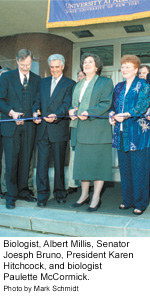
One of the brightest chapters in a series of success stories for the University�s four-year-old East Campus in Rensselaer County - its year-old Center for Comparative Functional Genomics (CCFG) - had its official grand opening celebration last Thursday, accompanied by a major announcement from the man who did the most to give the East Cam-pus and CCFG their starts, Senate Majority Leader Joseph L. Bruno.
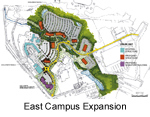
Bruno (R-Bruns-wick) announced $1.3 million in state funding to purchase an additional 29 acres of land for the campus, increasing its overall size from 58 to 87 acres. A preliminary study conducted by the University indicates that this will add at least seven potential building sites to facilities that are now near 100 percent capacity.
�This East Campus facility, which is designed for biotechnology research and health education, has been extremely successful and is bursting at the seams,� Senator Bruno said. �The additional land will increase the East Campus property by 50 percent and provide more room to grow.�
The existing facilities at the campus comprise 365,000 square feet of laboratory and office space. It was purchased by the University at Albany Foundation in 1996 from the Sterling Winthrop Company through a $5 million state grant made possible by Bruno.
In fewer than five years, the complex has been transformed into a hub of high tech research and economic development, which by January 2001 will house more than 600 jobs. In addition to CCFG, the East Campus is home to the University�s School of Public Health and ten private sector companies, six of which are focused on biotechnology and pharmaceutical-related fields.
Particular attention was paid on Thursday to CCFG, created in 1999 through a $5 million legislative initiative sponsored by Bruno, and now a partner (with anchor campus tenant, Taconic Biotechnology, Inc.) in a $4.5 million National Institutes of Health research initiative creating a Mutant Mouse Resource Center.
That grant was a direct result of the state�s investment, pointed out CCFG directors and UAlbany biologists Paulette McCormick and Albert Millis. The $5 million in state funds consisted of $2.8 million to equip the site, which comprises core research facilities for transgenics, imaging and microscopy, bioinformatics, molecular biology, and biochemistry, and $2.2 million to service a revolving loan program - called EC� (East Campus Equipment and Capital) - for enticing genomics-related incubator firms.
The strength of CCFG�s facilities was a large factor in its becoming one of the NIH�s four Mutant Mouse Resource Centers nationally - and the only one that is a partner between higher education and industry. CCFG�s strengths and EC� were also the main reasons that President Hitchcock was able to announce that AVAX Technologies, a Kansas City firm that develops innovative therapies for cancer treatment, has now established its research and development operations on the East Campus.
�This is a classic example of how university, industry and government partnerships can be used to advance science and leverage resources that produce economic development,� said Hitchcock.
�Today is therefore another special milestone in the life of the University, and indeed the Capital Region. The visionary leadership of Senator Bruno has made all of these wonderful accomplishments possible by providing a cutting edge research facility where our University scientists can work side by side with industry scientists, thus accelerating the time-to-market for the new products arising from such research collaboration.�
Other tenants now doing cooperative research with CCFG include VEC Technologies, Inc., producers of endotheliel cells for use in research, and Triage Venture, developer of products to treat vascular diseases.
IBM's New $2.5 Biliion
Computer Chip Plant to Enhance UAlbany-Industry Relationship
By Vinny Reda
When Governor George Pataki, Senate Majority Leader Joseph
L. Bruno and Speaker Sheldon Silver jointly announced plans last February
for the University�s construction of phase II of the CESTM complex - one
fully dedicated to the creation of a $55 million, 300-millimeter wafer
prototyping and workforce training facility - top officials from International
Business Machines (IBM) Corporation were on hand, applauding the project.
�We at IBM are excited about your progress in securing this proposed new 300mm facility,� said John Kelly III, senior vice president and technology group executive. �This cleanroom business incubator facility should prove to be another powerful New York State economic development resource.�
No wonder then that on Oct. 10 in New York City, when IBM announced the largest private investment in the history of New York State - a $2.5 billion 300-millimeter (or 12-inch) wafer production facility in East Fishkill - one of only three external invitees to the event was University physicist Alain Kaloyeros, director of the UAlbany Institute for Materials (UAIM).
Kaloyeros likened the potential relationship between IBM and UAlbany to that of Samsung Corporation and the University of Texas in Austin, in which the company has provided more than $100 million to that university for use of its basic research facilities and its capacity to train workers.
IBM has already invested some $20 million in the UAIM facilities in the last five years. The reason is that, of the approximately 800 chip-wafer plants worldwide, fewer than 125 are equipped for prototyping the current industry standard in computer chip design - the 200 millimeter, or 8-inch, wafer. Of these, fewer than 50 are in the U.S., and only one is located at a U.S. university - the UAlbany Institute for Materials.
Now, the semiconductor industry is moving to the next, larger generation, 300-millimeter wafer platform for greater capacity and higher performance. Semiconductor industry analysts predict that 50 percent of wafers manufactured by 2005 will be 300-millimeter- (or comparably 12-inch) platformed - and UAlbany is one of only 20 facilities worldwide scheduled to be there for the transition.
In fact, both the new CESTM complex facilities and IBM�s new East Fishkill plant are scheduled for completion at the same time, in mid 2002.
�We�d be surprised if the new IBM plant does not result in important technical and educational benefits, as well as significant resources and infrastructure investments for the University, as well as for RPI and several high-tech companies in the Capital Region,� said Kaloyeros. He added: �As the most advanced state-of-the-art facility in the world, the IBM plant will provide excellent research and development, as well as product-prototyping and commercialization opportunities for all academic institutions and high technology companies in the region.�
The Capital Region, led by the Center for Economic Growth, a private business development group, tried to establish North Greenbush as a potential host to a chip plant such as the one now to be built 90 miles south by IBM. Even though that effort failed, renewed efforts in the region are expected to produce multiple qualified host sites for chip fabs.
Kaloyeros, along with Walter Altes, president of the Albany-Colonie Regional Chamber of Commerce, and Kelly Lovell, president of CEG, agreed that the IBM announcement only enhances the chances for a chip-fab facility to take root in the Capital Region.
Kaloyeros said: �The IBM move is a necessary but not sufficient condition in positioning the region to be highly competitive for chip fab attraction. Thanks to the visionary leadership, proactive drive, and strategic support of Governor Pataki, Majority Leader Bruno, and Speaker Silver, the region is quickly achieving the critical mass necessary to attract these highly sought facilities.�
Another benefit of the UAlbany-IBM link, said Kaloyeros, will be increased career opportunities for graduates. He said six current students have accepted job offers with IBM.
Genomics
Instruments Now Top-Notch
Vinny Reda
The proverbial �quantum leap� forward in research capability
is what the acquisition of more than 50 pieces of the absolute standard
in biotechnological equipment means to the Center for Comparative Functional
Genomics� (CCFG�s) efforts.
Purchased through a $2.8 million portion of the $5 million dedicated by the State Legislature in 1999 for the creation of CCFG, the instrumentation has uses that will benefit not only University faculty researchers in biology, but UAlbany students and the biotech firms located on the East Campus as well.
�Many university biology departments are still utilizing instrumentation designed more than 50 years ago, but through these acquisitions the University at Albany is unquestionably in the 21st century,� said Eugene Schuler, director of technology development. �We can now conduct research at the University that we simply could not have done before.�
The equipment titles are daunting to the non-geneticists, admits John A. Tine, CCFG project administrative officer, but the efficiency and accuracy they command will be welcomed by all for health benefits that result from the unraveling of the human genome. Some examples of the representative equipment include:
- ABI 3700 and 310 Nucleotide Sequencers - they will allow high throughput DNA sequencing;
- ABI 3948 Nucleic Acid Synthesizer - allows researchers to synthesize as many as 48 oligo-neucleotides at once;
- Microarrayer and 3-laser scanner - enables study of global gene expressions at the rate of several thousand at one time;
- Taqman PCR - allows the quantitative comparison of the expressions of several genes at a time;
- AKTA Explorer HPLC system - separates and purifies both proteins and nucleic acids;
- Microcal calorimeter - measures the increase or decrease in heat as proteins are changed by response to chemicals, DNA or other proteins;
- Pulse Field Electrophoresis - separates very large fragments of DNA for gene mapping; and
- EPICS ALTRA Fluorescence activated cell sorter - expressions proteins both within and on the surface of cells in order to sort their populations and to purify them based on specific characteristics.
All of the new instrumentation is available for student researchers to develop and accelerate their own experiments in genetics and other areas of biology, noted Paulette McCormick of the Department of Biological Sciences and co-director of CCFG.
�For the University, this instrumentation will mean that, one, we will now be able to recruit even more outstanding graduate students; two, we will be able to accelerate their experiments with gene sequencing by having them sent over to our labs - with some 300 sequences per day now being able to be performed with our capillary technology.
�And three, there will now be tutorials here, where grad students come to the center and train off the facilities. Part of the problem in the past has been that students did not know what was out there to expedite their research. Here, they�ll learn about the resources available. And they�ll know those resources are right here at CCFG.� - Vinny Reda
Home Page/ Front Page/ Campus News/ Features/ Sports/ Date Book