

UAlbany
Students Participate in Nationwide DebateWatch
By Carol Olechowski
What do you get when you put 200 UAlbany students
in a room with Al Gore and George W. Bush? Lively assessments of the presidential
candidates� debate performance.
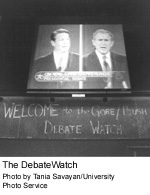
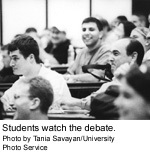
Actually, the students gathered the evening of Oct. 3 in Lecture Center 25 to participate in DebateWatch 2000, a nationwide effort to bring citizens together to view the televised debates. Sponsored by the non-profit, non-partisan Commission on Presidential Debates (CPD), the program - which began in 1996 - also encourages citizens to speak with one another about the decisions they will make in the voting booth in November.
With her colleagues Anne Hildreth of the Department of Political Science and Cherie Strachan of Communication, University Professor of Communication Kathleen E. Kendall, a nationally recognized presidential campaign analyst, organized the event at UAlbany. Participants included students from Kendall�s, Strachan�s, and Hildreth�s classes, as well as campus political activists; graduate students and advanced undergraduates trained by the three faculty members served as focus group leaders.
Kendall watched the debate attentively. In her estimation, "Gore won. I didn�t agree with the first press reactions that no one gained. At first, Bush was quite impressive. He was fluent, informed, confident, the equal of Gore in his answers to questions. Then suddenly, they came to foreign policy questions, and something happened to Bush. He began to pause noticeably and say �uh� a lot. His eyes darted around. He was clearly uncomfortable and unsure. It was a marked change.�
Kendall also watched the watchers: �Our audience began murmuring about [the change in Bush�s demeanor]. Though he recovered and regained fluency, that stumbling interlude revived questions about his ability to handle the demands of the presidency.
�In contrast, Gore was articulate and confident on every question posed, full of information, and good about mentioning his own experience in each area. He shone in the area of competence, one of the crucial constituents of Aristotle�s ethos or credibility. It�s true that Gore is more of a �policy wonk� and can be almost robotic in rattling off his positions. Bush speaks in shorter sentences, in simple language, at times with a heavy Texas drawl. You get the sense that it would be more relaxing to spend time with Bush than with Gore. But it�s doubtful that people will choose that trait over competence. Think of the long list of presidents we�ve had who weren�t charmers, which we might forget under Clinton�s sway,� the professor stated.
Kendall noted that certain issues touched a chord with the audience. �Loud cheers went up when Gore said he advocated tax credits of up to $10,000 for college tuition and when he said he believed in �a woman�s right to choose,� in regard to abortion.� By contrast, �the students laughed at one of Bush�s statements about a charter school in Texas, in which he said the school worked with at-risk children, then misspoke as he explained that the term �at-risk children� meant that �they can�t learn.��
Bush also �pressed the character issue, as when he joked that, while Harry Truman said, �The buck stops here,� in the Clinton administration the slogan should be, �The buck stops in the Lincoln Bedroom.� This was the main zinger in the debate, and will probably be widely quoted,� Kendall said. However, to the extent that Bush focused on Clinton, as with the Lincoln Bedroom joke, �his attack will be less effective than the attacks on Gore himself - as with Bush�s citing the stiff, legalistic Gore phrase regarding his role in making fundraising phone calls from the White House,� she added.
The mood in the room varied. �Mainly, the room was very quiet,� Kendall remembered, �with occasional bursts of applause or cheering in response to particular statements. In general, I found that people listened carefully, although they were more attentive to some parts of the debate than to others, as is natural in any speaking situation. The cheering and applause at certain points indicated active involvement.�
Kendall felt that �some elements in the timing of the debate conspired to hurt Bush.� Gore made one concluding statement shortly before the debate was supposed to end, and had the chance to make another when moderator Jim Lehrer let the debate run overtime.
Kendall observed that, �based on the diffuse and unfocused news coverage October 4, it�s going to take awhile for the media to figure out what people thought of this debate.� It didn�t take long for the students to deliver their verdicts on the candidates� performance, though.
Dennis Kennedy participated in DebateWatch with a group of classmates from COM 517, a graduate course taught by Kendall and Hildreth. Kennedy, who is also University Advancement�s assistant director of marketing, said, �I enjoyed the debate. It was spirited, with all the signs and the students. I learned how the candidates interacted face to face and how they expressed themselves when put on the spot, and I did learn their take on some of the issues, such as taxes, Medicare, and education.�
Alicia Keyser, a sophomore business administration major from Rockland County, likewise found the debate interesting and vowed to �continue watching other debates.� She most enjoyed the focus group: �I had never considered the ways other people would think about this debate.�
Another sophomore, Jared Kamen, decided that DebateWatch would provide a good opportunity to �learn more about the candidates. This will be my first chance to vote in a presidential election, and I�d like to be informed on the issues. Also, the extra [class] credit doesn�t hurt.�
Kamen, a Marlboro, N.J., native and a registered Democrat, found the focus groups particularly helpful. The group, he said, �let me know how others felt about the issues and allowed us to kind of argue about how we felt each candidate performed.�
In Kennedy�s opinion, �DebateWatch was a good opportunity to get involved with the campaigns and elections. The focus group I moderated was fun; the students included both Republicans and Democrats. They, too, got to see how Bush and Gore articulated the issues, but primarily, members of the group seemed to feel that the debate had reaffirmed their original beliefs. They questioned things, though - why it was only a two-party debate, for instance, and why some networks didn�t cover it live. And they got into the specific issues addressed. Young people especially need to do more of that.�
Like Kendall, Kennedy believed that Gore won - �without a doubt. He was the better speaker and offered hard numbers. I liked his take on the issues more; he seemed �presidential� and qualified.� Keyser agreed: �Gore was very professional and seemed to have done his research. Bush, on the other hand, seemed very uncertain and frustrated because Gore was topping him.� Added Kamen: �Bush had many good points, but his unpolished manner and the use of such terms as �fuzzy math� made him come off rather poorly. Gore was the winner. He pummeled Bush, who seemed ill at ease and unprepared.�
The three students� observations were reflected generally during DebateWatch. Said Kendall: �Cheers for Gore clearly outnumbered the Bush cheers, and in the focus groups, too, Gore was preferred. It is likely that the students reflect New Yorkers, in general, in their preference for Gore, as he is way ahead in the polls here. However, it�s significant that many of the students in attendance said they weren�t particularly interested in politics, but they expressed greater interest after the event.�
Overall, �the feedback was very positive,� Kendall reported. �Some students who were not registered to vote said they would now register; they had become interested in the campaign through the debate and the focus group. Some said they now saw a clear difference between the candidates, and they could see why it was important to vote. Several students asked me if we would do the same thing for future debates. Our student moderators were also enthusiastic about the results. They were impressed with the thoughtfulness and articulateness of the students.�
Keyser, affected by what she witnessed during DebateWatch, has promised that she will vote November 7. �This is the first election that I�m taking part in,� she added, �but it won�t be my last.�
UAlbany
Presents Offers Exciting 2000-2001 Season
By Lisa James Goldsberry
Many organizations claim to have �something for everyone.�
In the case of the �UAlbany Presents� 2000-2001 season at the Performing
Arts Center (PAC), it�s actually true. Whether you are 9 or 90, there�s
sure to be something that interests you among the events scheduled for
the season.
Ticket prices are $15 for adults, $12 for seniors, and $10 for students with a valid college ID. For ticket information, call 442-3997.
�The variety of performance types should bring in a varied audience,� said Patrick Ferlo, director of the PAC. �The fact that the series is also available to the public greatly benefits the University�s positive connection to the community.�
The year began with a performance of William Shakespeare�s Othello by the Shenandoah Shakespeare Express on Oct. 17.
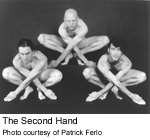
On Friday, Nov. 10, The Second Hand will perform at 8 p.m. in the Main Theatre of the PAC. The performers use their bodies and an odd assortment of props and costumes -- from cutting boards to popcorn poppers -- to create a blend of theatre, wit and muscle. They will present an evening of cutting edge dance, comedy, and audience participation. The Second Hand is internationally-known for its delightfully loony performances.
The first event of 2001 will be The Franciscan Chamber Orchestra, which will perform on Saturday, Jan. 27, 2001, at 8 p.m. in the PAC Main Theatre. Joined by UAlbany�s own world renowned pianist Findlay Cockrell, they will present classical pieces, including Mozart�s Piano Concerti N. 414, as well as works by Mendelssohn and Gliere. The concert will be presented in collaboration with the Siena College of Music Series and UAlbany�s Department of Music.
Lazer Vaudeville, circuslike entertainment for the entire family, will perform on Thursday and Friday, Feb. 1 and 2, at 7:30 p.m. in the PAC Main Theatre. It will feature lasers and black light, juggling, plate spinning, music, and audience participation. The master of ceremonies, a seven-foot-tall fire-breathing dragon named Alfonzo, has been known to perform such feats as ballet and dramatic poetry.
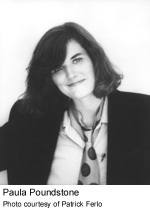
A highlight of the season will be an appearance by comedian Paula Poundstone. She has earned an American Comedy Award and two cable ACE awards for her unique brand of humor. The first woman to headline the prestigious White House Correspondents Dinner in 1992, she can now be seen on the new version of the classic game show, To Tell The Truth.
The final event of the season will be the big band Alumni Weekend Concert of the Tommy Dorsey Orchestra. The performance will take place on Saturday, June 9, 2001, at 3 p.m. in Page Hall on the Downtown Campus. Dorsey, �The Sentimental Gentleman of Swing,� was known for his dance music; the Tommy Dorsey Orchestra has been recognized as one of the best all-around bands for dance music as well as ballads. Conductor Buddy Morrow is renowned as one of the all-time great trombone players.
To find out more, visit the PAC Website at https://www.albany.edu/pac.
Science, Technology,
and the DNA Debate to be Discussed
By Lisa James Goldsberry
Alumni from across the nation will return to UAlbany for
this year�s annual �Conference on the Law�. This day-long event will take
place on Friday, Oct. 27, from 8 a.m. to 4:30 p.m. in the Campus Center.
Titled Science, Technology, and the DNA Debate, the conference
will feature presentations by key alumni and speakers in the legal community.
Among the topics that will be discussed are DNA, e-business, Internet
crimes, and privacy issues. The conference will focus on the past, present,
and future of science, technology, and crime.
�DNA is a component of the body that is now centrally linked, via forensics, to crime evidence and criminal justice,� said James Acker, interim dean of the School of Criminal Justice. �The conference will allow for the exploration of the combination of compelling scientific, legal, and ethical issues that the rapid emergence of DNA applications in a forensics context has required.�
According to Acker, the use of this scientific technology raises a string of complex questions, such as: Who should be required to submit DNA samples for forensic use? Should it be convicted violent felons, all persons convicted of crimes, or should samples be collected from all citizens at birth? Does a DNA sample contain other information which is so private and revealing that it would be dangerous to hand it over to the government? Finally, who has access to the information once it is acquired?
�Applications of DNA-based means of identification in a legal context have the potential to represent compelling evidence of guilt as well as exonerate innocent people suspected or accused of committing crimes. Used judiciously, DNA is an evidentiary tool of almost unrivaled probativeness,� Acker said.
The morning session will address the history of criminal justice and eugenics, which deals with the �improvement� (as by control of human reproduction) of hereditary qualities of a race or breed. Social scientists will discuss the impact of theories about �defective people,� including sterilization and institutionalization of these people, on social policies and practices.
According to the Image Archive on the American Eugenics Movement, eugenics was an effort to breed better human beings by encouraging the reproduction of people with �good� genes and discouraging those with �bad� genes. Elements of the American eugenics movement, from 1910 to 1940, were models for the Nazis, whose radical adaptation of eugenics culminated in the Holocaust.
The afternoon session, called �DNA Debate,� will look at the important role played by DNA technology and the issues raised by the use of this technology, such as privacy issues. In a roundtable discussion, the participants will explain the science of DNA as well as the procedures and policies regarding DNA technology in state and federal agencies.
A reception will be held in the University Art Museum following the conference. Currently on display is the exhibit, Searching the Criminal Body: Art/Science/Prejudice, 1840s to the Present. Nicole Rafter, Ph.D. �78, who will participate in the panel discussion on eugenics, is co-curator of the exhibit.
The conference is sponsored by the School of Criminal Justice and the University at Albany Lawyers Association, in partnership with Albany Law School�s Institute of Legal Studies.
Debate
to Succeed Greenberg Comes to Campus
The Recital Hall of the Performing Arts
Center will be the site when the three candidates battling to succeed
retiring Albany County District Attorney Sol Greenberg '43 meet in debate
on Thursday, Nov. 2, at 7:30 p.m. James Acker, professor and interim dean
of the School of Criminal Justice, will be the moderator for the debate
among current assistant district attorneys Paul Clyne (Dem.) and Paul
DerOhannesian II (Rep.-Con.-Lib.) and private practice attorney Mark Mishler
(Working Families and Green parties).
Home Page/ Front Page/ Campus News/ Features/ Sports/ Date Book