D.D. Tompkins Engine No. 8 [Section 72 Lot 6]
Group burial plot for members of one of Albany’s volunteer companies
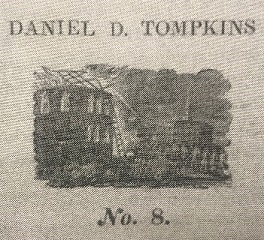
Early fire companies within U.S. cities started as bucket brigades, with each household having their own custom painted bucket to assist in the task of helping put out the fire to prevent it from spreading to another household. As the need for a physical structure within jurisdictions was needed the Daniel D. Tompkins Engine #8 was established in 1813 to help, along with numerous fire companies. Though documents do not indicate who it is named after, it is likely named after Daniel D. Tompkins, who at the time of its founding, served as the fourth governor of New York State (1807 – 1817). Tompkins later served as the sixth vice president under James Monroe from 1817- 1825.
D. D. Tompkins Engine No. 8 was originally located at 259 Broadway. The firehouse sat in this location for over 30 years but was destroyed, as well as 600 buildings, as a result of the Great Fire of Albany on August 17, 1848. The fire engulfed over 37 acres in the area of Maiden Lane to the North and Hudson Avenue in the south. A new firehouse was erected the following year on Bleecker Street but eventually relocated again to 62 Madison Avenue, which at the time was known as Lydius Street.
Similar to the Oddfellows and Masons, firefighting in the U.S. evolved into a fraternal order. “The volunteer firefighters of the early period are sort of the most virtuous members of the early republic.” With the need for being a hero, rivalries were established, with the need to showcase superiority. Their rivalry was with Relief Engine No. 11, which was located near the corner of Rensselaer and South Pearl Streets; their relationship has been documented in minutes by the City of Albany Common Council minutes:
July 23, 1849 – A fire between South Pearl and Broad Street where No. 11 had been dismissed from assisting. Using abusive language towards No. 8, a member used a slingshot attack a member, later returning with more members “with paving stones in their hands,” attacking them even after the fire put out. “It appears from all that we can learn that after No. 11 was dismissed many of their men remained in the neighborhood of the Engine House and drank freely, to say the least of it, it was a disgraceful drunken row on their part, and we think some prompt actions should be taken by the Board to prevent an occurrence of such scenes.”
April 23, 1860 – No. 8 was responding to a fire alarm and was passing down South Pearl Street when No. 11 was waiting for them. “The members of No. 8 who had charge of the hose cart, when in front of Van Zandt Street, found that No. 11 has been drawn into the gutter on the extreme side of the street, and her ropes have been so stretched across the street that in passing by, members of No. 8 were entangled in them, and many discovered the trap laid for them too late to avoid it and were thrown into the ground and seriously bruised and injured.”

The 1860s was a time of decline for volunteers of the fire companies. In addition to the Civil War, the prestige of volunteer firemen started to wane. Though there were over 800 volunteers, participation was about 200, which led to a restructuring throughout the city. On June 1, 1867, the Albany Fire Department was established, making it one of the oldest fire departments in the country. Daniel D. Tompkins Engine #8 was absorbed, with some volunteers becoming early employees of the city. The building survived up into the mid-twentieth century when it was destroyed by way of urban renewal to make way for an onramp for Interstate 787.
Like many other civic and fraternal organizations within Albany, a group plot was purchased at Albany Rural Cemetery for members who may wish to be buried with their fellow volunteers or not have the funds to be buried privately. On July 15, 1864, Joseph E. Taylor, Richard Parr, Jr., James Bowden, William W. Coughtry, and Richard Vanderbilt, trustees of the fire company, purchased a 512-foot plot for $80, which comes up to around $1300 today. On the plot sits a marble monument that pays homage to the volunteers. It is embellished with a crest with a number 8 inside, and at the base, a fire hat is carved along with an inscription that reads “Organized 1813, Erected in 1872 by D.D. Tompkins Engine Co. No. VIII.”
In total six volunteers are buried in the plot: Jeremiah C. Griswold who died and was interred in September of 1871 at the age of 33 of dropsy (heart failure); Hugh Bowden who died on February 21, 1871, and interred on May 28, 1871, at the age of 48; Stephen P. Vanderbilt who worked as an engineer and died on April 2, 1893, at the age of 57; James Bowden who worked for some time in liquor sales, died of suicide of a gunshot wound to the head at the age of 76 in June 14, 1902, and interred a few days later. One those buried, James McCrossen, died on January 3, 1859, at 28, five years before the plot was purchased. McCrossen worked as a mason and lived in Albany’s third ward. It is likely that his body was reinterred to the burial plot, but was not registered with the cemetery, a very common occurrence when bodies were relocated to the Albany Rural.
The sixth volunteer buried was Captain Robert H. Bell. Bell, born in England around 1828 he immigrated to the U.S. first residing in Pennsylvania, where he married a woman by the name of Margaret. By the late 1850s, they lived in Albany’s second ward with their two sons, where he worked as a woodcarver. During this time, he became active in D.D. Tomkins and appointed as a member on July 13, 1857. Calling upon the duties of the Civil War, he enlisted into the Union Army on August 11, 1862, and was commissioned an officer in Company F, New York 7th Heavy Artillery Regiment on 11 Aug 1862. Not even a month later, on September 8, 1862, he was made Captain. Bell was one of the 100,000 Union soldiers at the Battle of Spotsylvania Court House in Spotsylvania County, Virginia, from May 8 – 21, 1864. On May 19, he was wounded in battled and was eventually taken to a General Hospital in Washington, D.C., where his left thigh was amputated. He died on June 19, 1864. Like McCrossen, there is no indication of when his body was interred into the cemetery.