Phoebe Harris Phelps (1818 – 1889) [Section 18, Lot 3]
Children’s book author, Survivor of domestic violence with assistance by Susan B. Anthony
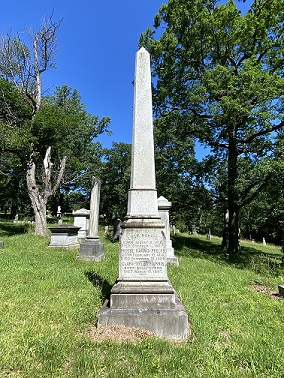
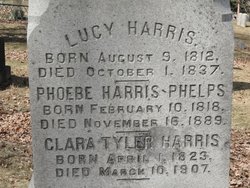
Phoebe Harris was born on February 10, 1818, in Preble, Cortland County to Frederick Waterman Harris, and Lucy Hamilton. One of ten children, Phoebe attended Albany Female Academy, graduating in 1835. She stayed on at the academy and taught for several years after.
In 1841 she married Charles Abner Phelps, who graduated from Union College in Schenectady the same year. Charles was from Boston and from an old New England family who founded Dorchester, Massachusetts and Windsor, Connecticut. The two moved to Boston where Charles attended Harvard Medical School, graduating in 1844, and then Philadelphia where he attended Jefferson Medical College. They moved back to Boston and resided in the Beacon Hill neighborhood. While Phoebe raised their children, one boy, and three girls, Charles worked at his father’s practice. His research on skin diseases abroad eventually lead to the opening of the first skin specialty hospital in Boston.
In 1855 Charles political aspiration led him to be elected to the Massachusetts Legislature, first in the House for two terms and then the Senate, rising to the top-ranking position in both houses. He eventually left medicine altogether and served in a variety of appointed positions under President Lincoln and Grant.
Due to written accounts by Phoebe, Charles was unfaithful as well as abusive towards her. When she confronted him about extramarital affairs, his violence led him to throw her down a flight of stairs and had her admitted to the McLean Asylum for the Insane outside of Boston. Phoebe was institutionalized for nearly eighteen months. She was released to her eldest brother Ira Harris, of Albany. A lawyer and judge, he also was a member of the New York State Assembly and eventually U.S. Senator from 1861 – 1867.
In 1860 Phoebe sought out the guidance of Susan B. Anthony, who was visiting Albany. A detailed account of their meeting mentions that Anthony was having tea when Phoebe arrived drenched from the rain and began to plead to her: “Please won’t you help me? No one else will. I am a wife and mother. When I finally confronted my husband with proof of his adulteries, he beat me and had me put way in an Insane Asylum. My brother had me free, but could not obtain permission for me to see my children. Yesterday, after a year, I was allowed to visit one child. I fled the state with her immediately. And now I am a fugitive.”
Anthony took Phoebe and one of her daughters to New York City, where she aided in their refuge. This act by Anthony was viewed negatively by her friends and colleagues who believed that her actions in aiding Phoebe damaged the work the suffragettes had done to the anti-slavery and women’s right’s movement. Anthony is quoted stating, “Don’t you break the law every time you help a slave to Canada? Well, the law which gives the father the sole ownership of the children is just as wicked, and I’ll break it just as quickly. You would die before you would deliver a slave to his master, and I will die before I give up a child to his father.” Charles was made aware of Anthony’s involvement and threatened to have her arrested during her public lectures; he also hired detectives two return their daughter to him.
Phoebe and her daughter made their way to Philadelphia where she worked as a seamstress and writer. Anthony helped Phoebe file for divorce in 1865 as well as regain custody of her daughters, though detective were successful in locating them where her daughter was brought back to Boston. It was not until many years later that she was able to be reunited with her daughters.
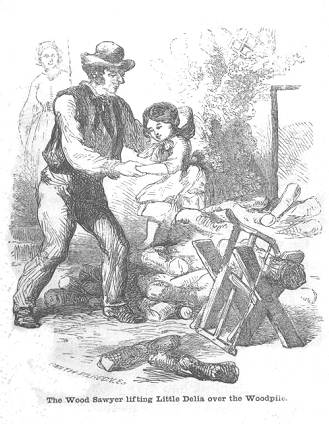
Phoebe died on November 16, 1899, in Reading, Massachusetts and is interred in the Harris family plot. Though Charles was never charged for domestic violence against Phoebe, Phoebe found success as a children’s book author under the name Phoebe Harris Phelps. Her children’s books were a collection of stories whose tone conveyed moral instruction, and often included the names of her children. Her 1865 book The Soldier’s Ring, and Other Stories is dedicated to her daughter Delia.