Jack McAuliffe (1866-1937) [Section 15 Lot 73]
“Napoleon of the Ring,” America’s first World Champion undefeated boxer.
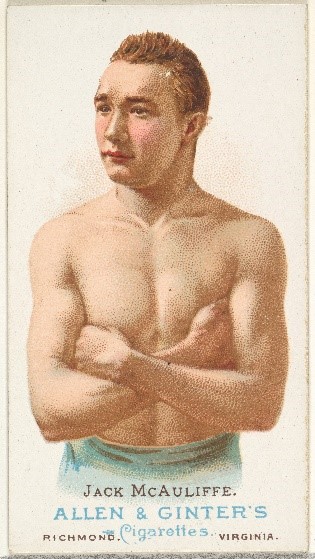
In a time before rules and regulations when fights ended when one opponent was physically unable to continue, or he “threw in the towel,” Jack McAuliffe is known as one of the best lightweights ever. He was inducted into the Ring Boxing Hall of Fame in 1954, and in 1995 inducted into the International Boxing Hall of Fame.
Jack McAuliffe was born on March 24, 1866, in Cork, Ireland. He is the second son to Cornelius McAuliffe and Jane Bailey. His father immigrated to Maine after his birth due to the Fenian Rising, an uprising against the British organized by the Irish Republican Brotherhood. He enlisted in the army and saved money for his family to come. By 1871 the McAuliffe family reunited in Bangor.
Jack attended public school in Bangor, with one of his teachers known to beat his students. On one occasion after class he was subject to this but retaliated and went after him with his fists. Resulting in injuring on both parties, a truce was called and became friends moving forward. This fight with this teacher resulted in taking up fighting as a way to make money, sometimes fighting sailors who were much larger and older that him. He was referred to as “naturally strong, agile, and a gamester… swinging one’s fists in a brisk battle and getting paid cash for such activities was like finding money.”
In 1882 the McAuliffe family moved to Williamsburg, Brooklyn in 1882, which had yet to become part of New York City. Jack’s father took on a job as a cooper at Western Union, with Jack working as an apprentice. His apprentice station was previous held by another soon to be a famous boxer, Jack Dempsey. The two became good friends and were known to train and drink together. During this time with Demsey, McAuliffe learned his “cat-like reflexes” where his self-developed skills and stamina was used to defeat his opponents.
His fighting career began in the 1884 with the featherweight competitions. Location of these fights were behind the walls of the Evergreen Cemetery in Brooklyn to “avoid the local police.” The following year he entered amateur tournaments at the New York Athletic Club hosted by Tammany Hall, becoming a lightweight champion. Bill Maden, who was known to be the best boxing manager in the late nineteeth century, became the manger to Jack, enlisting him into touraments around the country. Maden also served as manager to “Boston Strong Boy” John Sullivan, the first boxing superstar.
On November 16, 1887, Jack went up against the English champion Jem Carney at the Belmont Hotel. The match lasted 78 rounds and lasted into the morning. The manager appealed to end the fight for fear of being arrested. The match was declared a controversial draw with both competitors declaring themselves the holder of world champion.

His elegant and expensive lifestyle alongside his gambling lead him to earn the title “Dapper Dan of the ring.” It eventual led to him going bankrupt and returning to the ring for some exhibit matches in 1896. He came out of retirement again in 1897 for a match with Tommy Ryan, who was notorious for showing no mercy on his opponents. In 1914, at the age of 48 he went up against Dick Burge in a three-round exhibition in London.
In his private life Jack married three times, first to stage actress Katie Hart who died in 1890, and later to Catherine Rowe in 1894, but divorced in May 1898. Rowe was also a stage actress and went by the name was Pearl Irwin of the The Irwin Sisters. During the 1920s Jack married Jennie Lawton, the two resided in Forrest Hills, N.Y. where Jack worked as a bookie. During World War I he served as secretary for the Knights of Columbus. In 1934 he had an unsuccessful bid for political office, running for the New York State Assembly.
Jack McAuliffe died on November 5, 1937, of Throat Cancer. Like Dempsey and Sullivan, he died penniless. Unable to afford a burial site, funeral expenses and burial were handled by his stepdaughter and buried in their family plot.