James Campbell Matthews (1844 - 1930) [ Section 29 Lot 95]
First black law student at Albany Law School, First black male graduate from a law school in New York State, First elected black judge in the United States, Lawyer to the case which desegregated Albany public schools, Successfully lobbied NYS Governor Grover Cleveland on a bill to protect the rights of black teachers
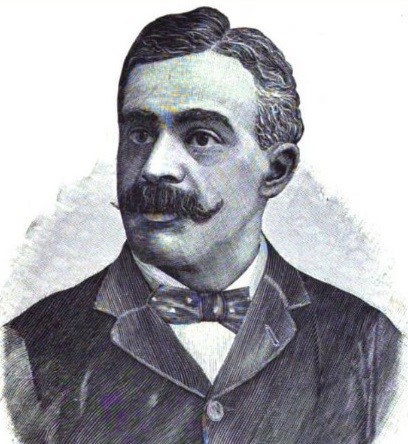
James Campbell Matthews was born on November 6, 1844, in New Haven, Connecticut. One of seven children, Matthews was the son of William W. & Esther A. Matthews. His family moved to Albany around 1850 which had a thriving African American community, and one of the main cities for abolitionists within the northeast. His father was one of the more active members of the local Underground Railroad. In 1857 his parents died, and he was thereafter raised by Lydia Mott and Phebe Jones, two of the more predominant white abolitionists in Albany. In his late teens Matthews was adopted by Francis Van Vranken who was a Black barber in Albany, and also a key member of the Underground Railroad, who had worked closely with Matthews’ father.
Although the schools within the City of Albany were segregated, James was fortunate to initially attend all-white public schools, thanks in part to William Rice, a Democratic member of the Board of Education. He subsequently won a scholarship to the prestigious Albany Academy.. The school itself was at first reluctant to accept him as a student. However, once enrolled Matthews excelled, and became the recipient of the Beck Literary Medal for writing. He graduated from the Academy in 1864.
In 1866 Matthews became a clerk, and later bookkeeper for Adam Blake, a Black entrepreneur who owned the Congress Hotel. (Blake would later establish the Kenmore Hotel on North Pearl Street.) During this time, he studied law with Albany attorney Jacob Werner. A few years later he become the first Black man to attend Albany Law School, graduating in 1871. Today Albany Law School honors Matthews with a faculty member holding the title of the James Campbell Matthews Distinguished Professor of Jurisprudence. James was also the first black male to graduate from a law school in New York State.
One of Matthew”s first cases, in conjunction with Jacob Werner, was for William Dietz, a wealthy and prominent African American merchant from Arbor Hill.” Dietz had taken Matthew under his wing years before as both men served as delegates to the 1864 National Convention of Colored Men in Syracuse. The case involved the Albany school board, where Dietz wanted the board to permit his children to attend School 6, a non-segregated school. In 1873, this case, along with New York State’s enactment of its first civil right law, led to the desegregation of Albany public schools.
In 1875 Campbell married Adella Duplessis of New York City. They had one son, Charles D. Matthews. The family resided for many years at 334 Clinton Avenue, later living in the Pine Hills neighborhood.
Matthews was nominated by President Grover Cleveland in 1885 to take over the position of the Recorder of Deeds of the District of Columbia which was being vacated by Frederick Douglass. Cleveland was familiar with work that Matthews had undertaken in Albany and across New York State. While serving as governor of New York, Cleveland was lobbied by Matthews on a bill to protect the rights of Black teachers within the state. Matthew’s nomination was blocked by the Republican-controlled Senate, alleging the appointee “actively sought to influence Albany Republicans to switch parties”. Even Frederick Douglass opposed his nomination on partisan grounds. (Initially a Republican, Matthews became an active Democratic politics in 1872.) Despite this opposition Matthews was appointed to the position and served from August, 1886 to March 1887.
James aspired to campaign for political office, and ran as Democrat to become Judge of the Albany County Recorder’s Court. His run in 1895 led to an endorsement by the The New York Times: “...Intellectually and as a lawyer he rises head and shoulders above many of his white brethren in the same profession. He is putting up a lively canvas and by his active work and sound reasoning is doing much to brush away the prejudice which at first existed against his candidacy.” Matthews won the election, becoming the first African American to be elected to a judicial seat in New York State. He served for four years.
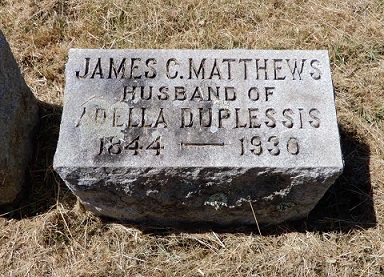
Matthews returned to practice law until the 1920s, most notably dealing with cases involved with insurance companies, mortgages, and personal estates.
On November 1, 1930, Matthews passed away. He is buried near Cypress Pond alongside his wife and son. His parents and siblings are buried in Section 99, Lot 10.