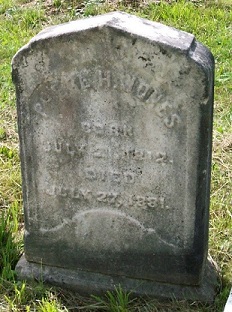
Phebe Hoag Jones (1812-1881) [Section 49 Lot 2 Row 3 Position 7]
Suffragette, Abolitionist and Social Reformer
Phebe Hoag was born in Pittstown, Rensselaer County, into a Quaker family on July 21, 1812. There is no history of her childhood, as the next record of her was in 1832 when she married Eleazer Jones at the Troy-Pittstown Friends Meeting House at the age of 20. In 1834 they are still in Troy, where it appears that Eleazer may be running a grocery store on River Street, near what is now the Green Island Bridge.
In 1835 Jones family made the arduous journey to St. Augustine, Florida, population 2,000 compared to Troy, which was booming as a result of the Industrial Revolution, with a population of roughly 17,000. The same year Phebe gave birth to their daughter Margaret. Eleazer served in the 2nd Florida Mounted Militia of the Florida War but died of consumption, and Phebe and Margaret made the journey up north to Troy. We believe they lived for a time with her father-in-law Aaron Jones in Troy until his death in 1939. By 1840 it appears they were residing with Henry Bristol, who was named Margaret’s guardian in Eleazer Jones’ will.
Phebe spent 40 years of her life dedicated to social and political reform, primarily the abolition of slavery and women’s rights. She was a friend of William Lloyd Garrison, Susan B. Anthony, Frederick Douglass and Elizabeth Cady Stanton. By 1851 she was allied with Lydia Mott in Albany, and together they were the “glue” that held together the structure for lobbying in the New York State Legislature abolition and equal rights. Phebe, a widow, did this all while running a store, a men’s linen shop on First Street, and raising a child by herself and living in a boarding house.
It is clear she was a free thinker; despite being raised a Quaker, she’s linked to the founding of the Unitarian Church in Troy. Throughout the 1850s, she attends women’s rights and anti-slavery conventions and serves on committees with Anthony and Douglass. In the mid-1850s, she moved her shop and residence to Broadway in Albany, about two blocks from Lydia’s haberdashery shop on Maiden Lane. The two women become an unstoppable alliance fighting for political equality. By the 1860s, no visit to Albany by anyone of importance in the world of political reform is complete without visits or accommodations with Phebe Jones or Lydia Mott. The visits become easier when Jones acquired a house at 87 Columbia St. and Mott leases 103 Columbia Street, a stone’s throw from the Capitol.
In the late 1860s, Margaret falls ill to consumption and is disabled by it, passing away in August of 1870. A few years later, in 1875, Lydia died of it as well. Both Margaret and Lydia are buried in the Society of Friends burial plot, which was originally part of the State Street burial grounds of present-day Washington Park.
Over the next years, Phebe, now in her 60s, curtails her activities. However, in 1875 she wrote a touching letter to William Lloyd Garrison on the death of his wife. Garrison was a noted journalist, abolitionist, suffragist, and social reformer, and Phebe was familiar with his family. Her letter makes a point of remarking that she “learned through Miss Anthony” of his restored health and comfort.
<Phebe fell victim to the disease that killed her daughter and close friend and died on July 27, 1881. She is interred in the Society of Friends lot next to her daughter.