| |
Campus News
Albany Institute of History &
Art Features Exhibits by UAlbany�s Galembo
By Greta Petry (October 8, 2004)
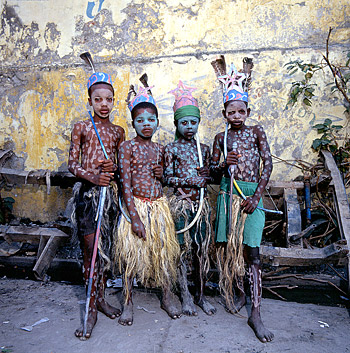 |
Visions of Haiti: Vodou
and Carnaval & Jacmel. Les INdiens
(The Indians), Cibachrome print, 1997,
Courtesy of Diego Corte Arte Ltd., New
York |
UAlbany Professor of Art Phyllis Galembo�s
photographs are featured in three exhibitions
at the Albany Institute of History & Art
that explore magic, mystery, and the power of
transformation through costume and masquerade.
The institute is at 125 Washington Ave.
Galembo�s passion for costumes and masquerade
began in her childhood when she would dress
up in homemade costumes for Purim and Halloween.
�I am fascinated by the way clothing can transform
the self from an everyday person into something
magical,� said the photographer. �The use of
clothing and costume can be theatrical, sacred,
or
simply celebratory.�
Galembo received a Master of Fine Arts in photography
and printmaking from the University of Wisconsin
at Madison in 1977, and joined the University
at Albany Department of Art as a professor in
1978. Galembo broadened her interest in photography
of costumes when she traveled to Africa in 1985
to photograph traditional Nigerian priests,
priestesses, and ceremonial objects. Galembo�s
ongoing interests led her to Haiti in 1993 when
she photographed vodou culture and religion.
On exhibition through December 5, DRESSED
FOR THRILLS: Photographs by Phyllis Galembo
with Halloween and Masquerade Costumes
includes selections from Galembo�s collection
of vintage Halloween and masquerade costumes,
accompanied by her photographs of people wearing
the costumes.
Also through December 5, KINGS,
CHIEFS, AND WOMEN OF POWER: Images from Nigeria
depicts the lives of Nigerian spiritual leaders
and illuminates some of West Africa�s elaborate
cultural and religious traditions. Amid clashing
ideologies and pressures for economic and social
change, kings, chiefs, and women of power continue
to exert a profound influence over the people.
Loyalty to sacred kings and village chiefs ensures
security in unsettled times and their rituals
and trappings embody a view of how the world
is constructed.
VISIONS OF HAITI: Vodou
and Carnaval à Jacmel, on view
through November 7, explores the human and divine
faces of Haitian Vodou and the spiritual power
behind Carnaval masquerade. Vodou is a melding
of European Catholicism and African spirituality.
Carnaval in Jacmel, Haiti, is expressed vividly
with its papier-mâché masks, masquerade
costumes, and body painting. Galembo�s photographs
capture the spiritual ceremony, sociopolitical
commentary, ridicule, and satire through the
role reversal of animals and humans, male and
female, and sacred and profane.
The institute is hosting a variety of public
programs and special events for adult and family
audiences as follows:
October 10: Museum
Explorers Family Art and Gallery Adventure:
The Art and Culture of
Vodou; October 17:
Slide Lecture: Magic, Mystery, and Masquerade
with Galembo and a performance by Haitian dancer
Nadia Dieudonné; October
24: Museum Explorers Day: A
Halloween Extravaganza; November
4: Gallery Talk: Magic,
Mystery, and Masquerade with Galembo
and a dance performance by STOP (Student Theater
Outreach Program) led by Broadway director Alan
Weeks; and November 14:
Museum Explorers Family Art and Gallery Adventure:
Powerful Images/Powerful
People.
|
|










