
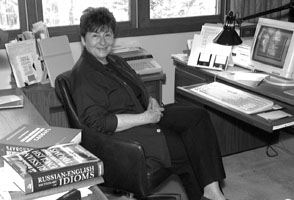
 By Christine Hanson McKnight
When Sophia Lubensky�s ground-breaking Russian-English Dictionary of Idioms came out 18 months ago, it was hailed as a bridge between two different languages and cultures. It was also an overnight success. The first 3,000 copies were quickly snapped up, and it is now in its second printing.
Lubensky, a professor in the Department of Germanic and Slavic Languages and Literatures, reports that her dictionary is being published in Russia by a Moscow publisher under an agreement with her American publisher, Random House. Other than a new introduction by Lubensky, it is the same dictionary, featuring more than 13,000 Russian idioms and their American equivalents in 6,900 entries.
�It�s very unusual to see a book published here be republished in Russia in such a short time,� said Lubensky. Printed from Random House film, the Russian version of the dictionary is the project of Alexei Koshelev, a publisher with the Languages of Russian Culture publishing house, who was impressed by its quality. Support for the book came from the Russian Humanitarian Scholarly Fund. Like the English version, Lubensky said that scholars in Russian expect that all 1,500 copies will also be quickly sold. While the American version was priced at $75, the Russian reprint is expected to cost between $20 and $25.
Lubensky, who emigrated to the United States in 1976 and spent 13 years researching and compiling her Russian-English Dictionary of Idioms, says she is especially gratified to have the book published in Russia.
�Every author wants to have as many readers as possible,� she said. �Now, scholars in Russia � as well as Russian translators, politicians and businessmen � will be able to use it, too.�
Scholars who have reviewed the dictionary have praised it.
�Russian idiom dictionaries are like cable television channels: lots of choices, but nothing you want to look at,� wrote Richard M. Robin of George Washington University in the prestigious journal Slavic Review. �Sophia Lubensky�s dictionary changes all that . . . this comprehensive volume not only fills a long- standing lexicographic void, but also serves as a model of how such a dictionary should be structured.�
Also receiving strong reviews is a college-level Russian language textbook which the energetic Lubensky completed with two colleagues soon after her dictionary project. Called Nachalo: When In Russia . . ., and published by McGraw-Hill, the two-volume textbook has been rapidly adopted by over 60 colleges and universities. Accompanied by a video featuring scenes shot in Moscow under Lubensky�s supervision, the textbook is complemented by workbooks, audio tapes and an instructor�s manual.
Associate Professor of Russian Jonathan Gray of Principia College in Elsah, Illinois, wrote to Lubensky via e-mail: �I love the care with which you present and reinforce words and concepts. The workbook, both sets of audio tapes, the video supplement � all work together well. It�s clear to me that my first-year class this year is markedly superior in listening comprehension and oral production to any of my previous groups of elementary students as a result of their using your program.�
The textbook was co-authored by Gerard L. Ervan, a retired professor at Ohio State University who is now executive director of a national Slavic organization, and Donald K. Jarvis of Brigham Young University. It was generously funded by the Department of Education and the National Endowment for the Humanities. Lubensky�s dictionary project was supported by the Department of Defense.
�Ricardo Tacuchian is one of the most important Brazilian composers of his generation,� said Joel Chadabe of the Department of Music, where Tacuchian will be based. �His presence at the University at Albany will enhance students� awareness of Latin American culture and will reinforce the University�s international visibility.�
Tacuchian has composed six symphonic works, the last the Hayastan Symphony, completed in 1990; he has also composed seven pieces for string orchestra, 22 pieces for smaller groups, about 30 a cappella choir pieces, 20 solo works for piano, guitar, flute, clarinet, harp and xylophone, six song cycles and four cantatas. His work is represented to date on 15 LP records and two CDs, and has been heard in performance in approximately 600 venues.
Since 1996, he has been a full professor at Rio de Janeiro University. From 1965 to 1995 he was on the faculty of the Federal University of Rio de Janeiro. He has received numerous academic honors, grants and Fulbright commissions during those years.
An especially designed lecture course, Brazil: Its Music and its People, will be among the possibilities for Tacuchian�s residency, as well as mentoring up to three undergraduate music composition students, and presenting at lease two public lectures.
�Daily interaction with a Brazilian scholar of Tacuchian�s abilities and reputation will highlight the many similarities and differences among the various Latin American nations,� said Max Lifchitz, chair of both the music department and the Department of Latin American and Caribbean Studies, and principal coordinator for Tacuchian�s residency.
�Furthermore, the presence in the area of a successful South American artist will serve as an example of accomplishment, achievement and success to numerous minority students.�
Already, among community organizations, the Bethlehem Humanities Institute for Lifelong Learning of the Bethlehem School District has indicted it would like to sponsor a lecture by Tacuchian during his visit. The program�s co-chairs, Helen Adler and Frederic Adler, have written that the school district in Bethlehem �will also invite composer Tacuchian to lecture for high school students. They would benefit greatly by having the opportunity of interacting with a prominent artist from abroad.� Other colleges� music departments and local music societies are also expected to arrange appearances and lectures by the artist.
Tacuchian�s CIES four-month grant will include a stipend of $12,450 plus international airfare.
Vinny Reda