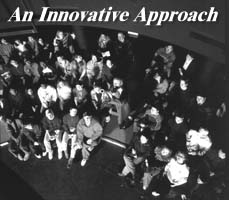
Project Renaissance:
By Greta Petry
Project Renaissance, the University's new approach to teaching freshmen, has been so
successful that next year the program will double in size.
The program, available to freshmen on a first-come, first- served basis, will grow from
200 to 400 students, separated into groups of 100 students each.
In this unique living-learning community, students take an integrated curriculum where the
subjects are related to one another.
"The faculty members work together so the curriculum works together. For example, students
would be reading history, studying literature, listening to music, and exploring the
science of the same time period," said Lil Brannon, director of the Center for Excellence
in Teaching and Learning, which manages Project Renaissance.
The program also gives first-year students a way to take classes in a small group setting,
while adjusting to life at a university of 11,000 undergraduates.
Cindy Batista is a Project Renaissance student who plans to go to medical school. She
likes the program because "the classes are smaller. There are more opportunities for
students to get to know the teachers one-on-one and discuss certain topics, which you
wouldn't be able to do in a lecture."
Batista, originally of the Bronx, said one benefit of the program is an effective support
system. "If I don't understand something during discussion, I can just go down the hall
and ask," she said. The freshman added she likes living with the same group of students
with whom she takes most of her classes, and that this makes it easy to make friends.
Project Renaissance's emphasis on human identity and technology, "is a who we are and
where we come from kind of course. It tries to tie in all those things we learned from the
past; how history ties into science, and how religion has influenced it, and how
technology and medical technology developed. The teachers find a connection among all
their specialties and they teach it to us," Batista said.
One of the most popular aspects of the program has been its focus on technology. Project
Renaissance was designed so that students learn how to access information, build web
sites, search libraries, and talk to one another via computer technology.
"They encourage us to use computers, they require us to use a computer for homework to
keep us up with technology," Batista said.
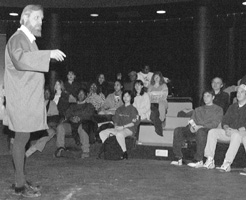
Several weeks ago two groups of Project Renaissance students met in the intimate setting
of the Arena Theater at the Performing Arts Center to see a lively presentation by actor
Mike Francis playing the astronomer Galileo. Francis also has a decade of experience as a
lecturer at the Charles Hayden Planetarium at Boston's Museum of Science. Team faculty
members for the group, Ernest Scatton of Germanic & Slavic Languages, Sue Faerman of
Public Administration and Policy, and Jon Scott of Earth and Atmospheric Sciences joined
in the discussion.
Project Renaissance will be moving to a new location in the fall - from Tuscarora and
Seneca into larger quarters at Mohawk Tower on Indian Quad. Another change will be in the
community action learning aspect of the project, which will now focus primarily on service
to the campus.
The idea for Project Renaissance came about because the Center for Excellence in Teaching
and Literature wanted to create a program for first-year students that would offer them
the best possible orientation to a research university.
"We began developing the program in 1993 by asking students, faculty, residential life
staff, and many other campus professionals what they thought the best features of the
University at Albany were. Every group spoke of the excitement of being at a research
university where everyone is engaged in inquiry," said Brannon.
Project Renaissance courses cover half of the general education requirements, the liberal
arts courses that form the foundation for an educated person.
School of Information Science Among Nation's Leaders
A recent study conducted by the leading journal in the field of library and
information science has ranked the University's School of Information Science
consistently within the top three to four schools in the country.
For the study, faculty designated as "full-time" in 57 schools listed in the 1992-93
Journal of Education for Library and Information Science, were searched online
through the Library Literature database. The search results included total
authorships, the number of book reviews, and the count for each of the full-time
faculty reflecting the number of unique items credited to authors in the school.
Schools were then ranked by total authorships, total papers and total book reviews.
Consistently, when the top 15 schools in each of these categories were listed, the
University at Albany placed either third or fourth in 15 of 16 categories for school
with Ph.D. programs.
"The results of the study reflect the long-term strengths of the school, because we
have people on the faculty who have been leaders in the field for quite a while,"
said Philip Eppard, interim dean of the School. "The field has evolved since its
primary emphasis was on library science, but the faculty productivity and publication
productivity here at Albany has kept pace with that change."
The study went on to determine whether or not a Ph.D. program makes a difference in
productivity. When the schools were ranked again, this time for the top 15 schools
with Ph.D. programs by average total authorships, the University was, again, ranked
third.
There was shown to be a strong correlation between the presence of a Ph.D. program
and publishing productivity. The last comparison made in the study was between
Certificate and Non-Certificate Schools of LIS. In this study, Albany ranked second
among the top 15 schools by average total authorships.
Different tables in the study went on to break down the number of authorships further
by ranking the total papers and then the book reviews. In every ranking, the
University at Albany appeared on all lists.
Eppard pointed out that the Journal of Education for Library and Information Science
findings were consistent with results of the revised Hayes Study published by The
Library Quarterly a year ago. In that study, Albany ranked consistently in the top 15
of all schools of library and information science, and faculty member Joseph H.
Morehead was ranked first in the nation among "individuals with the most journal
articles" over a 12-year period.
