
Reaffirming that “we will not allow fiscal conditions to drive academic decisions,” President Karen R. Hitchcock last week announced the first steps in the academic program plan.
Building on University at Albany strengths, 19 new faculty members were hired in 14 departments. Consolidation of the atmospheric science and geology departments occurred on July 1. Four language departments will be consolidated into one, and the program in German discontinued after 1996-97. In addition, this will be the final year for classes in the Department of Physical Education, although some courses may be shifted to other departments.
“We have made a commitment to employ a strategy of identifying, and investing in, programs central to our mission and to the very special learning environment of a research university,” said Hitchcock in her Aug. 27 letter to faculty.
“While we could have permitted the vagaries of budget allocation, retirement patterns, or other circumstances to shape our academic plan, instead we initiated 19 faculty searches in a number of the programs critical to our continued success.”
New faculty were hired in accounting, anthropology, biometry and statistics, criminal justice, East Asian studies, epidemiology, geography and planning, health policy and management, history, mathematics, physics, political science, psychology, and social welfare. Albany was the only University Center in SUNY to “undertake such a broad program in faculty recruitment,” said the President.
In broad consultation with faculty, four major goals were established to inform all academic and financial planning. These were:
• Maintaining and enhancing Albany’s excellence and reputation as a research university;
• Strengthening Albany as a place where undergraduate education is informed by graduate and research programs and as a place where professional schools and the core arts and science disciplines exist in synergy with one another, each benefiting from the other;
• Strengthening Albany as a place where all graduate and undergraduate programs are of high quality, and where many are increasing their national reputation and stature for excellence; and
• Acting strategically, looking to the future and building on existing strength: by investing in selected units to take them to their next level of excellence; by maintaining the stature and viability of most units; and by disinvesting in units that are not viable given the criterion of program excellence and/or are less strategic to the institution’s future.
After input from all academic departments, assessments by deans and recommendations to Judy Genshaft, Interim Vice President for Academic Affairs, consultation began among Genshaft and members of the University Senate’s Council on Education Policy and the Long Range Resource Advisory Committee. It produced academic decisions for all schools and colleges, including the consolidations and German program elimination in the College of Arts and Sciences.
The President also outlined the implementation of the University at Albany Financial Plan, which takes into account the July 22 approval by SUNY trustees of a system-wide budget that assigned a base reduction to each campus of just over one percent. That, plus a utility-savings requirement and an enrollment adjustment, placed Albany’s base budget reduction at 1.86 percent, or $1.82 million.
“The Financial Plan developed here at Albany also includes, beyond the $1.82 million base reduction, a contingency in anticipation of a mid-year reduction (given the past several years of experience); a possible shortfall in FTE (as opposed to headcount) enrollment; and significantly reduced support for research and academic equipment,” the President wrote in her faculty letter. “Thus the overall impact of these combined factors for the University at Albany is $5.3 million.”
Additional revenue of $1 million was obtained through the University’s new comprehensive student fee, said Hitchcock. “The balance will be met with savings and expenditure reductions that will be achieved across the vice presidential divisions. In an effort to protect the academic program to the greatest extent possible, divisions other than Academic Affairs will implement reductions proportionally greater than each division’s share of the State appropriation.”
President Hitchcock is scheduled to address these and other campus initiatives when she reports to the Fall General Faculty Meeting on Wednesday, Sept. 11, at 3 p.m. in the Campus Center Ballroom.
With the success and growth of the Presidential Scholars Program at Albany, the need to supply individualized attention and new challenges has grown as well.
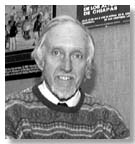
That need can be satisfied now with the naming of Distinguished Teaching Professor Gary Gossen as Associate Dean of Undergraduate Studies and director of honors programs. “The goal will be to provide the kind of intensive encouragement and counseling to these students that has not been possible before,” said Gossen. “And I think the results will have a spill-over effect on the whole climate of the University.”
The Presidential Scholars Program began in 1993-94, guaranteeing its entering students a place in the General Education Honors Tutorials, the freshman year University Seminar Program, specially designed reading opportunities, the option to live in dorms devoted to honors students, and other privileges. From an initial freshman group of 45 students — all required to graduate high school with at least 91 averages — the entering Scholars class has grown this Fall to about 125, bringing the total number of Presidential Scholars at the University to 400.
“The program is clearly a success,” said John Pipkin, Dean of Undergraduate Studies. “It has enhanced recruitment and grown in reputation, and internally the students have developed a real sense of community and done very well academically. A real sense of an intellectual life has been formed in the Honors Halls, Fulton and Ten Eyck. And this year, there will be a new one for freshman in Mahican.
“But as it has grown it has become more difficult to give the additional attention that these outstanding students deserve. That’s why having Gary take this post is so important. He has had for many a very distinguished academic career in both teaching and advisement on this campus. He has already given me a series of ideas for the program that are outstanding.
“In addition, he’s going to be looking more broadly at nurturing high achieving students in order for them to get the scholarships that will enhance their undergraduate and future graduate careers.”
Gossen, who began his career at the University in 1979 and achieved distinguished professor status last spring, said that “both Vice President Judy Genshaft and Dean Pipkin have been wonderfully open in allowing me to create and define the job. And in turn I think I can do the best job in consultation with the students themselves, to discover their needs.
“In fact, one of the secrets of this program’s success was that it was not formed on any national model, but out of faculty interaction and consultation with students on this campus. In other words, it was an outgrowth of the Albany experience.”
Among new projects Gossen will pursue are special information sessions and advisement to prepare students, beginning with their freshmen year, for submission of competitive applications for post-graduate awards such as Rhodes, Marshall, and Fulbright scholarships; and similar efforts to encourage students to take advantage of opportunities for study abroad.
“We have students with the talent to get these kinds of awards, and more of them should be getting them,” said Gossen.
He also said that monthly guest speakers and field trips are also possibilities if student interest exists. He also plans to have an Octoberfest picnic for the scholars at his home this semester.