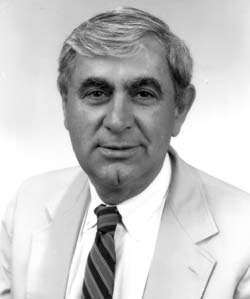

Two SUNY faculty leaders on Nov. 19 announced plans to form a steering
committee to move ahead with the faculty study of general education
requirements at the State University. The announcement of the steering
committee by the faculty leadership was made in Purchase during a meeting
of the Board of Trustees.
Vincent Aceto, president of the University Faculty Senate and an Albany faculty member in the School of Information Science & Policy, and Michael Kinney, president of the Faculty Council of Community Colleges, made their announcement as part of a report to the Trustees on the recently held SUNY-wide Conference on General Education.
“This initiative reaffirms the traditional responsibility of the faculty for the academic programs on their campuses,” said Aceto. The study is designed to examine the system-wide implications of general education and then draft a policy statement and recommendations that will ultimately be reviewed and forwarded by the faculty senate and community college council to the SUNY chancellor.
“The intent of the proposed study is not to develop one required SUNY-wide
general education curriculum with core syllabi,” Kinney added.
SUNY’s computer online degree program has been so successful that plans are in the works to add far more course offerings and to incorporate many more SUNY campuses, SUNY officials have announced. The SUNY Learning Network plans call for adding at least 10 additional campuses during each of the next three years, eventually examined the course offerings into the hundreds and serving an anticipated 1,000 students by 1997-98, and Christine Haile, associate vice chancellor in the Office of Educational Training.
The initial expansion will allow the Network to increase course offering from 14 this Fall to 20 in the Spring. The expansion ultimately will include campuses from all sectors the State University.
The SUNY Board of Trustees on Nov. 19 approved for submission to the Governor budget recommendations for campuses and colleges that hold 1997-98 spending to 1996-97 funding levels. The proposals were prepared in response to a call from the Division of the Budget. For state-operated campuses, the Trustees recommended a total of $3.1 billion in spending authority for all of SUNY’s appropriated funds, with $1.5 billion proposed for the SUNY General Operating Budget.
Muriel A. Moore was inaugurated as the seventh president of SUNY College at Buffalo on Oct. 25. According to the Buffalo News, Moore said in address that the college will rely more heavily on alumni and the private sector . . . We need to enhance and expand our base of financial support. We must become more entrepreneurial. We must have flexibility, and we must forge new community partnerships. We must become, once again, a valued part of our state’s agenda.”
Subject to approval by the State University Board of Trustees, the Board of Orange County Community Colleges has selected Preston Pulliams to be the new college president. Pulliams has served as president of Highland Lakes Campus of the Oakland Community College District in Michigan since 1993. He would succeed Dr. William F. Messner as OCCC President.
“Volunteer Leadership for the 21st Century” was the theme of the State University of New York Alumni Conference Nov. 8-10 at the Albany Marriott Hotel. In addition to the Alumni Honor Roll presentation, the distinguished Service Alumni/us Award was presented for the first time, and a business meeting of the State University Alumni Confederation and workshops on issues important to alumni was held.
A Gannett wire service story on enrollment cited a University report that tuition increases have not meant lower enrollment at University campuses. The newspaper quoted a State University report showing the percentage of New York high school graduates choosing the State University is holding steady.
An Oct. 26 Albany Times Union story on enrollment focused on the suggestion that the State University could lower non-resident tuition to attract more out-of-state students. The Commission on Independent Colleges and Universities found fault with the idea, saying that private colleges are worried about filling their classrooms.
In New York Times (10/28) story on recent unrest at Binghamton and the controversy over control of the Student Association, President Lois De Fleur told the Times that social activism and sit-ins are not new at Binghamton. De Fleur stated: “When we conduct polls, we find that Binghamton students are more concerned about social issues and actively involved in groups. There are no simple answers to bringing people together of different backgrounds.”