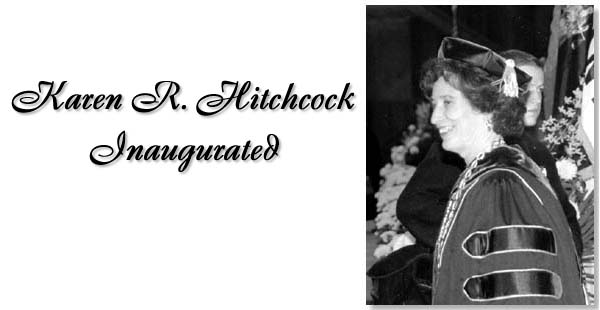

Karen R. Hitchcock was formally installed as the 16th President of the University at Albany on November 8, in a ceremony that praised her power to link the University to all segments of society. The President then charged higher education to “re-examine our most basic assumptions” in dealing with the modern realities of societal change.
The inaugural ceremony, held from 10 a.m. to noon in the Recreational and Convocation Center, saw representatives from the worlds of politics, academia, and research, as well as Albany faculty, alumni and students, speak on behalf of the new President.
“Karen is a gift for all of us,” said Senate Majority Leader Joseph L. Bruno. “She has the gift of communication, because she knows that communication is speaking and listening
“In that way, she has coalesced business, government and education in the most effective way possible. And she has done this not just for enhancement of her university, but with regard for the ramifications it has upon her state, her country, and the world we live in.”
Hitchcock joined the University community as Vice President for Academic Affairs in 1991, and served in that post until being named Interim President in 1995, succeeding H. Patrick Swygert. Local state Assemblyman John J. McEneny said that while a search for a new Albany president “looked all over the world, we were wise enough to not overlook what we had close to home.”
Albany County Executive Michael G. Breslin praised Hitchcock’s new linkages to Albany business and government. “She has seen that we in the community are welcomed in, even as the University is moving outward,” said Breslin. Albany Mayor Gerald D. Jennings and a representative on behalf of Governor George Pataki, Albany alumnus Geoffrey T. Flynn, also brought greetings.
Colleagues from her past returned as well. Donald N. Langenberg, now chancellor of the University of Maryland, recalled welcoming Hitchcock aboard as vice chancellor for research and dean of the graduate college at University of Illinois at Chicago, when he was president there in 1987. Elizabeth D. Hay, professor of anatomy and cellular biology at Harvard Medical School, remembered Hitchcock’s achievements in that area of research in her 15 years at Tufts University in Boston.
C. Peter McGrath, president of the National Association of State Universities and Land-Grant Colleges; Thomas R. Egan, chairman of the SUNY Board of Trustees; John E. Holt-Harris, chairman of the University Council; Harold C. Hanson ’63, Alumni Association president; faculty member Carlos E. Santiago and Michael J. Castrilli, Student Association president, also spoke.
President Hitchcock noted fondly the presence at the ceremony of her mother, her two brothers, and her husband, biomedical scientist Murray Blair. She also pointed out her two predecessors in the office of President, Swygert and Vincent O’Leary. “My particular thanks to President Swygert for bringing me to Albany,” she said, “and introducing me, by example, to the unique potential of this great community.” Also on hand were relatives of two of the longest serving Albany Presidents: Virginia Collins, whose husband Evan Revere Collins served from 1949 to 1969, and John Brubacher, whose grandfather Abram was President from 1915 to 1939.
In her address, the President spoke of Albany’s roots and the roots of American higher education as a whole. “Our universities, simply put, were engaged — engaged with the society which supported them; a society which valued deeply the opportunity they represented for fulfilling the potential of each individual, for advancing our economic well-being, for strengthening the moral and social fabric of our nation.
“Through such engagement, our universities evolved. Through such engagement, society’s expectations grew. Through such engagement, we earned the public’s trust.
“We, in the academy, again face the challenge of a profoundly changing society. We have the opportunity and responsibility to redefine ourselves in the context of a major societal transformation.”
Hitchcock highlighted several challenges of the “Information Age:” “The workplace will be more entrepreneurial, more collaborative, more fluid; and rapidly evolving technologies will lead to a complexity that will demand that learning truly be life-long.” But while she said we are becoming more adapt at using these technologies, “what we in the academy have not yet done with the same degree of rigor is to analyze the validity of our current modes of teaching and the form and content of our curricula.
“Such analysis will require us to eschew provincialism; to work in partnership with all sectors of society; to reassess the educational needs of our students; and to reaffirm, but also reinvigorate, our basic values by realigning our methods and goals to meet more fully these changing needs.”
The President concluded her address with two poems from Nigerian poet Ben Okri, one describing mankind’s natural resistance to change, the other praising its value.
“We have a choice,” she said, paraphrasing the poems: “we can either sleep in our æhidden academies,’ or we can, together, æDance gracefully’ — and imaginatively — æwith Change.’
She added, “I can not think of a group of colleagues with whom I would rather share such a defining moment for the academy.”
The President thanked the Inaugural Committee for planning more than a week’s worth of educational and celebratory events before the Inauguration. Some moments from those events are captured, beginning in this issue on Page 3.
Vinny Reda