

Thanks to the generosity of two major human resource management software developers, University management students are increasing their value to potential employers, thanks to more than a half million dollars worth of some of the most widely used human resources software in the country.
Humanic Design and PeopleSoft, two of the country’s leading developers of software for computerized management of benefits, work histories, evaluations, retirement plans, payrolls, vacation records and other personnel functions, have donated copies of their software to the School’s Human Resource/Information Systems program for teaching purposes. The gifts, with a combined value of more than half a million dollars, will make the University at Albany the only business school in the country whose students learn by using the software many of today’s largest employers are using for human resource management.
“We have been hiring graduates of the University at Albany School of Business for several years and have found them to have an extraordinarily good foundation in the use of information systems in the human resources area,” said Frank Cancro, president of Humanic Design. “So having the actual software that today’s companies are using available to the students as they’re learning seemed a natural extension of what the School is already doing. Graduates will emerge from the program well prepared and able to be effective from the first day on the job.”
“The use of information technology for human resource management is growing exponentially,” said Hal Gueutal, chair of the management department at the School of Business. Career opportunities are abundant for people with the right skills. Working with these HR software packages will provide invaluable experience for our students.”
In 1985, the University at Albany School of Business became the first business school in the country to offer a concentration in human resource/information systems in its MBA program. “As HR functions from employee selection to benefits planning are redesigned to take advantage of advanced information technology,” said Gueutal, “it becomes critical for managers to understand both the management issues and the technology that is available to support the decision-making process. Our classroom curriculum and field projects are designed to provide our students with the understanding of the issues, the hands-on experience and the knowledge of the tools available to them that will help them stand out in a competitive market.” The HR/IS concentration prepares graduates in both the traditional HR skills and in the use of information technology.
Founded in 1982, Humanic Design is dedicated exclusively to HR software and related services, with hundreds of clients throughout the United States, Canada and Europe. A true client/server human resource management system and one of the first to use a relational database for HR applications, the Humanic system is particularly known for its very short implementation cycles. It runs on virtually every hardware platform, operating system or network protocol. Humanic’s gift to the School is valued at approximately $150,000. Companies using Humanic’s HR systems include Motorola Paging Products, Brunswick Corp., Cambridge Technology Partners, US Cellular and Ben & Jerry’s Ice Cream.
“PeopleSoft is delighted to support the advancement of human resource education,” said Paul Salsgiver, V.P. and general manager of higher education for PeopleSoft. “This gift aligns perfectly with the PeopleSoft strategy of identifying best practices and developing joint strategies for addressing industry trends. We are pleased that this commitment has created a demand for knowledgeable users of PeopleSoft HRMS, and applaud the University at Albany for adapting its curriculum to meet the needs of employers.”
Based in Pleasanton, California, PeopleSoft designs HR systems for large or complex organizations with dynamic, rapidly changing business requirements. PeopleSoft applications provide organizations with more than 1,000 employees and/or revenues of at least $100 million with the flexibility and responsiveness they need to manage constant change.
PeopleSoft’s clients include Blue Cross and Blue Shield of New Jersey, AT&T, Capital Cities/ABC, Kmart Corp., Pizza Hut International, Taco Bell, Hewlett Packard Co., NCR Corp., American Express TRS, Eli Lilly and Co., Gerber Products Co., Owens-Corning Fiberglas Corp., Cornell University, the University of Michigan, the city of Pittsburgh and, locally, Albany International. The PeopleSoft gift is valued at approximately $400,000.
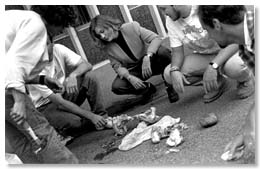
Marilyn Masson guides graduate students in her “Zoo Archeology” class to the proper method of cracking animal bones, used by indigenous peoples around the world since the Ice Age in order to extract marrow for food. The demonstration, conducted on the podium, served to illustrate the particular pattern of “cultural breakage” the students would encounter on archeological digs in such sites as the Iroquois in the northeastern U.S. — as opposed to “natural breakage” of animal bone through erosion and other factors. Masson reports that the animal marrow, for the gatherers, “was highly nutritious.”

The federal Centers for Disease Control and Prevention have awarded the University at Albany’s School of Public Health approximately $70,000 in the first year of a three-year grant to develop a leadership institute that will improve the way health officials identify and solve problems confronting the public health community.
The newly established Northeast Regional Public Health Leadership Institute will develop the executive leadership skills of mid-level public health professionals. Participants will assess and improve their organizational effectiveness in performing essential public health functions related to community health assessment, policy development, budgeting and quality assurance.The year-long training program offered by the Leadership Institute is based on explicit learning objectives leading to measurable outcomes in performance. The program will combine residential and long-distance collaborative study groups and learning activities geared to strengthening the skills of public health leaders.
While based at the public health school, the Leadership Institute will function regionally to attract professionals from the six New England states, New Jersey and Pennsylvania.
Approximately 30 professionals will be selected to attend its first class. Participants will attend workshops, examine case studies, in-teract with nationally known leaders as well as those who have studied leadership qualities. Health professionals will have the chance to collaborate with their counterparts from other states in the region.
The participants will focus on developing strategies to assist local communities in identifying the underlying causes of poor health. Other topics may include the development of strategies to promote reductions in morbidity, mortality and disabilities. Participants will also learn a variety of specific leadership-oriented skills, including organizational communication, team-building and partnership development, outcome assessment and data management.
According to Dwight C. Williams, director of the new Institute, “The School of Public Health is very pleased to have been awarded this start-up grant from CDC. We realize that the Institute has great potential for improving leadership skills in a changing health care environment. The Institute will allow participants to share their collective experiences, examine the implications of developing health policies and learn from nationally recognized experts on how to develop a more efficient and effective approach to meeting public health needs.”
The initial organizational meeting of the Leadership Institute occurred on Oct. 25 at the School, now located at One University Place at the University’s new East Campus in Rensselaer. Representatives from all of the partnership states and the CDC were in attendance.
Claudia Ricci