
In October of 1921, Benton MacKaye, then a relatively obscure specialist in forestry and natural resource management, published an article in the Journal of the American Institute of Architects proposing a public trail along the crest of the Appalachians from Maine to Georgia.
On Friday, Nov. 22, a one-day public conference will celebrate the 75th anniversary of the vision and planning of Benton MacKaye and the subsequent grass-roots mobilization that helped to create the Appalachian Trail. Scholars and environmental advocates will discuss MacKaye and the origins and development of the AT, the potential and limitations of voluntarism, and the future development of trail and greenway systems in the North-East.
The Conference takes place at 8:30 am - 6:30 pm at the Assembly Hall and the Fireside Lounge in the Campus Center. The trail was linked into a much broader scheme for a belt of protected wilderness, agriculture and forestry resettlement zones, shelters, nature centers, community camps, and food and farm camps. MacKaye’s vision of the trail built upon numerous smaller-scale trail-creating initiatives in the North-East, and it won hearty support from the well-established New England and New York hiking and tramping movements. Construction of the trail began in 1922 in the Bear Mountain area of New York State, and over the next decade a remarkable coalition of wilderness, trail and environmental advocacy movements emerged. The trail — more than 2,100 miles in length — was completed in 1937, with relatively little public investment and massive voluntary efforts by many thousands of trail club members.
Fittingly, Benton MacKaye (1879-1975) is now widely recognized as “the father of the Trail”. His 1921 proposal and the subsequent construction of the trail are among the most remarkable examples of grass-roots planning, mobilization and voluntarism in the history of the U.S. Since the 1930s, considerable progress has been made in improving and supplementing the Appalachian Trail (AT), and in public land acquisition to conserve adjacent areas. Despite these achievements, however, much of MacKaye’s broader vision for recreation, resettlement, land-use planning and wilderness conservation in the Eastern United States has not been realized.
The principal speakers will include many of the best known experts and writers on MacKaye’s life and work, and on the history and literature of the Appalachian Trail: Paul T. Bryant (Radford University), John L. Thomas (Brown University), K.C. Parsons (Cornell University), James E. Coufal (SUNY College of ESF, Syracuse), Keller Ann Easterling (Columbia University), Larry Anderson (RI), Ian Marshall (Pen State University, Altoona), Robert McCullough (VT), Paul Sutter (University of Kansas), and Matthew Dalbey (Columbia University).
In addition, the directors of ten major contemporary trail and greenway projects in the Northeast will present summaries of their projects. Many of these projects will also be featured in wall displays and hand-outs.
Pre-registration is required and attendance will be limited to 160 people. The Registration Fee will cover participation, documentation, refreshments, lunch, and a post-conference reception. A list of hotels, maps and directions can be supplied to anyone who needs them. Participants wishing to do so can join a trail excursion in the Bear Mountain area on Nov. 23.
In order to receive a full program and registration form, send your name, address and phone number to MacKaye & AT Conference: Attn. Ray Bromley, Dept. of Geography and Planning, Earth Science 218. If possible, fax to 442-4742 or e-mail [email protected]. For information, call 442-4766.
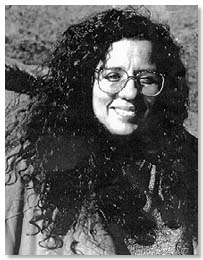
A Latino-American political organizer who is now the U.S. representative for the radical Zapatista revolutionary group in Mexico will speak in Humanities 354 on Tuesday, Nov. 5, from 3 to 5 p.m.
Cecilia Rodriguez, whose talk is jointly sponsored by Fuerza Latina of the Student Association and the Central American Study Group — an ad hoc organization of students and faculty — is now on a fall speaking tour of the Eastern Seaboard and New England States areas. She will be addressing the Zapatista struggle against the Mexican government, which it battles from Chiapas, the home territory of the Zapatista movement in southeastern Mexico.
“This is a unique opportunity to learn about one of the most important developments in Mexico and Central American from one of its most important spokespersons,” said Robert Carmack, a member of the Department of Anthropology and the faculty representative to the Central American Study Group.
Rodriguez has spent the better part of her life as a political organizer. She began her activism as a student, eventually working with farm workers and with autoworkers in South Texas on such issues as housing and the environment.
As director of La Mujer Obrera, Rodriguez and five Chicana garment workers chained themselves to sewing machines as a tactic in a year-long campaign to eliminate sweatshops on the Texas-Mexico boarder. While with La Mujer Obrera, she also participated in two hunger strikes that prompted an investigation of the garment industry by the Department of Labor. The Texas Senate eventually passed a bill making failure to pay wages a crime.
In 1994 Rodriguez became representative of the Zapatista Army of National Liberation. The Zapatistas claim that conditions and human rights abuses result from a “low-intensity warfare” being waged by the Mexican government against them; and add that U.S. involvement and participation with the Mexican government in such efforts as NAFTA and expanded capitalist markets are adversely affecting the living conditions of thousands of Mexicans, as well as hurting the U.S.