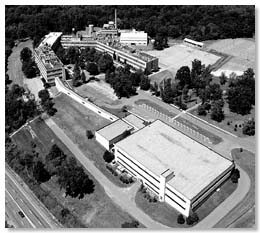
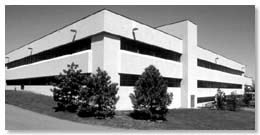

State Senate Majority Leader Joseph Bruno will be the keynote speaker on Friday, Nov. 1, when the University dedicates its new 50-acre campus in East Greenbush. The campus, which will serve as the home of the University’s School of Public Health and spur regional economic development, is the largest single expansion of University facilities since the construction of Albany’s Uptown Campus in the 1960s.
The East Greenbush parcel, which is part of the former Sterling Winthrop complex, offers 370,000 square feet of laboratories, office space, classrooms, and conference facilities. Bruno, R-Brunswick, provided pivotal support for a $5 million state economic development grant that financed acquisition of the site last February by The University at Albany Foundation.
The ceremonies are scheduled to begin at 11:30 a.m. on the First Floor Atrium. Before the dedication, the facilities will be open for tours beginning at 10:30 a.m. A symposium on “Science and Public Policy” will follow the ceremony at 1 p.m.. in the first floor auditorium.
“This project will enhance the Capital Region’s growing reputation as a center of high technology and create tremendous new employment opportunities,” said Bruno. “This is an excellent example of an academic institution working with government and the private sector to expand our educational goals, create new jobs and revitalize our local economy.”
University President Karen R. Hitchcock said that the facility’s mixed-purpose buildings unite the University’s educational, scientific and economic development capabilities with those of industry and other research institutions.
“It accommodates our public health, telecommunications and related scientific and high-tech resources in a way that will enable University researchers to seek solutions to the challenges that face the Capital Region, the state and the nation,” she said.
One of the buildings on the site, which is located across the Hudson River directly east of downtown Albany, is the new home of the University’s School of Public Health. Established in 1985, the School of Public Health has steadily grown, both in the number of programs it offers and the number of students it serves. As it grew, the School found itself spread out across several separate buildings.
David O. Carpenter, M.D., dean of the School of Public Health, said “We are delighted to have a permanent home for the School of Public Health, bringing our faculty and students together at these beautiful and spacious new facilities.
“With increasing frequency, our faculty researchers are working collaboratively on projects and programs. Public health problems are by nature multi-disciplinary, and they demand multi-disciplinary responses. It is most helpful to us that our faculty and students have immediate access to one another’s expertise while still being in close proximity to our partners in the Department of Health and Albany Medical Center.”
About 300 students began attending classes at the new campus this fall. Among those students were the first ones admitted to the School’s new doctor of public health (D.P.H.) program. This one-of-a-kind program provides doctoral students in public health the same type of internship training that medical students normally receive.
The University is also using the new campus to spur economic development in the region. A five-wing laboratory building accommodates both existing and start-up companies. VEC TECHNOLOGIES; Albany Molecular Research and Greenbush Associates have already moved in, and other companies are negotiating with the University to rent space at the campus. Health Research Inc. moved to the campus this fall.
The state-of-the-art laboratories at the site also offer the University additional opportunities to collaborate — with Albany Medical College, Albany College of Pharmacy, Rensselaer Polytechnic Institute, Hudson Valley Community College, the New York State Department of Health and other Capital Region educational institutions and businesses — on biomedical and other scientific and high-tech initiatives to boost the area economy.
To enhance such collaborations, the University will establish a number of centralized research resources, such as a tissue culture facility, a protein synthesis unit, a pilot manufacturing plant based upon fermentation systems, and a video conferencing center, all of which both tenants and other regional businesses and universities may use in a cost-effective manner.
In addition to the superb facilities, the East Greenbush campus offers an attractive, park-like setting with a view overlooking the Hudson River and the cities of Albany and Rensselaer.
When Karen R. Hitchcock is inaugurated as the 16th President of the University at Albany on Friday, Nov. 8, her inaugural theme will be “Engaging the Future.”
But for the present, Inaugural Week, Nov. 1-8, includes much of the festive, the discursive, the expanding and the refurbishing.
On Sunday, Nov. 3, at 7 p.m., four area college presidents will be featured in a gala concert honoring President Hitchcock. Sponsored by the University’s Department of Music, it will take place in the Main Theater of the University Performing Arts Center and is open to the public.
The University-Community Orchestra, conducted by Findlay Cockrell, will begin the program followed by The University-Community Symphonic Band, conducted by Henry M. Carr; The College of Saint Rose Jazz Ensemble, conducted by Paul Evoskevich; and Albany Pro Musica, guest-conducted by Stephen M. Curtis, President of Hudson Valley Community College.
Other college presidents joining Curtis in a six-hand composition for the piano will be James W. Hall of Empire State , Jeanne K. Neff of Russell Sage, and David H. Porter of Skidmore. The program will include works by Strauss, Brahms and Moussorgsky. Admission is $5 general and $3 for students. Tickets are either available at the door or by reservation by calling 442-3997.
Celebrations include the student-led campus block party on Wednesday, Nov. 6, from 11 a.m. to 4 p.m., and 6:30 p.m. fireworks; and the more formal Inaugural Dinner, which takes place on Thursday evening, Nov. 7, in the Campus Center Ballroom.
Intellectual discourse takes center stage beginning Oct. 31 with the Inaugural Seminar Series on Extracellular Matrix and Development, part one. Part two is Nov. 5 (see Oct. 16 University Update).
On Monday, Nov. 4, at 1:30 in the CC Assembly Hall, a symposium on “Social Science and Public Policy” will feature Nancy Denton of the Department of Sociology as moderator, and a panel comprising Richard Alba of sociology, Irene Lurie of the Graduate School of Public Affairs, Rockefeller College Provost Richard P. Nathan, and Carlos E. Santiago of the departments of Latin American and Caribbean Studies and Economics.
Then, on Thursday, Nov. 7, from 12 to 3:30 p.m. in the Campus Center Ballroom, a symposium, “Public Higher Education in the 21st Century: New Dynamism, New Challenges,” will have as keynote speaker Andrew A. Sorenson, president of the University of Alabama, Tuscaloosa, and a leading researcher on medical ethics and medical sociology.
Featured in a 1:30 p.m. panel, moderated by Sorenson, will be the Salvatore Belardo of the University’s School of Business; Charles R. Nash, vice chancellor of the University of Alabama; Donald N. Langenberg, chancellor of the University of Maryland; and Sherry H. Penney, chancellor of the University of Massachusetts, Boston.
“The symposium will discuss several challenges confronting the contemporary public university, including technology, financing, access, globalization, and institutional adaptation,” said Judy L. Genshaft, Interim Vice President for Academic Affairs. “It is our hope that this symposium will provide a forum for thoughtful and substantive dialogue on the issues facing public universities as we move into the 21st Century.”
The dedication of the new campus in East Greenbush will happen on Friday, Nov. 1. (See story, this page)
A gift of gratitude will occur on Tuesday, Nov. 4, when a refurbished MBA classroom on the second floor of the Business Building will be unveiled — courtesy of of a $25,000 contribution to the School of Business from The New York Business Development Corporation (NYBDC û Business New York).
The classroom, which has been outfitted with new tables and chairs, carpet, and a state-of-the-art, multi-media computer system, will be dedicated at a reception at 5 p.m. A major provider of financing to small businesses across the state, NYBDC û Business New York is a privately owned financial organization established by the state Legislature and funded by 150 banks from around the state.
The company is headed by an Albany alumnus, Robert W. Lazar, MS ’77, who started as a loan officer with NYBDC in 1971 and rose through company ranks to become president and CEO in 1987. Lazar attributes his support of the gift to the business school as well as his participation on the University at Albany Foundation to the gratitude he has for his alma mater and the education it provided him.
The University’s Department of Psychology and faculty member Edward Blanchard have been placed near the top faculties and authors in the world in a 20-year survey of published articles in the leading journals of applied behavioral psychology.
The University ranked second in the world in a top-50 ranking of institutions whose faculties have contributed to the 12 leading journals in the field, according to a study by University of Nevada professors Steven C. Hayes and Adam M. Grundt appearing in the September 1996 issue of the Behavior Therapist. The Univer-sity, finishing behind only the University of Pittsburgh, totaled 310 articles in the 12 publications over the 20-year period.
In Hayes and Grundt’s second study, of individual authors, Blanchard ranked third in the world with 63 entries. Former faculty members David Barlow, with 52, and Richard Heimberg, with 20, ranked sixth and tied for 45th, respectively, in the survey.
“These data provide a glimpse into 20 years of development in cognitive therapy,” wrote the study’s authors.
“Dr. Blanchard has produced an impressive number of publications over a period of more than two decades,” said V. Mark Durand, chair of the Department of Psychology. “His record has brought attention the psychology department as the home of one of the preeminent groups of applied behavior analysts in the world.”
Applied behavioral work defined itself as a distinct sub disciplinary area of psychology about 30 years ago, becoming a “substantial area,” according to the authors, by the mid 1970s. Their current paper therefore, they say, examines the most published researchers and institutions “from the first maturing of the behavioral movement to the present.
“Many of the top behavioral researchers are well known and respected throughout psychology and related behavioral sciences.”