Kenneth Able Receives Brewster Award for Bird Research
By Linda Chavis
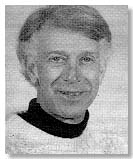 Professor Kenneth Able has been given the William Brewster Memorial Award for 1996 by
the American Ornithologists Union (AOU) for what it calls “his success in unraveling
some of the mysteries of bird orientation and navigation and his record of excellence
in field and laboratory research.”
Professor Kenneth Able has been given the William Brewster Memorial Award for 1996 by
the American Ornithologists Union (AOU) for what it calls “his success in unraveling
some of the mysteries of bird orientation and navigation and his record of excellence
in field and laboratory research.”
The migration and orientation of birds is one of Able’s major research interests. “I
have been studying birds for most of my life,” he says. “I first started watching
them when I was 11 years old and it was when I went to college that I chose to make
their study my career. My plans for the future are to continue studying some of the
remaining questions having to do with bird orientation and navigation and also work
with birds of other species going through migration.”
From Able’s research of birds, major new insights into many questions have been found
regarding bird navigation and orientation. Able has made effective use of what is
termed the “cue-conflict experiment,” his results challenging the dogma so long held
by many ornithologists that birds use a “sun-compass” for orientation. In a series of
experiments conducted in collaboration with his wife, Mary, he has shown that birds
often use the plane of polarized light, especially at sunset, to determine migratory
direction.
Furthermore, through studies of the ontogeny of orientation behavior in young
Savannah Sparrows, Able’s research has demonstrated that birds can learn to use
celestial rotation of stars at night and of polarized skylight during the day to
determine their orientation.
Able has recently extended these kinds of experiments to mature sparrows, and has
shown that they too can calibrate their magnetic compass during the migratory period
when exposed to clear day and night skies. From a practical point of view, this also
means that such research can now be done with older birds, making the time-consuming
and often difficult process of hand-rearing the young birds needed for ontogenetic
studies unnecessary.
According to a released statement from the award’s committee of the AOU, “Able’s
ability to synthesize and analyze diverse experiments and findings has contributed
greatly to the understanding of and the dispersion of knowledge about bird
orientation and navigation.”
Able’s investigations have resulted in more than 35 published papers in the last 10
years. He has also written a number of important reviews that have analyzed recent
developments in studies of avian orientation and navigation, as well as in the
historical development of the field.
The William Brewster Memorial Award is the highest award of the AOU and is given to
authors or co-authors of the most meritorious body of work on birds in the Western
Hemisphere published during the 10 calendar years preceding a given AOU meeting. The
award consists of a medal and honorarium provided through the endowed William
Brewster Memorial Fund of the American Ornithologist Union.
Gebhardt Instructs and Learns at Utah Conference
Thomas L. Gebhardt, the director of Personal Safety and Off-Campus Affairs, recently
presented a workshop with John Ellis from the College of Saint Rose on “Town-Gown
Relations” at the 10th Annual National Meeting on Alcohol, Other Drugs and Violence
Prevention in Higher Education, held in Park City, Utah. The conference focuses
specifically on prevention issues related to colleges and universities.
The meeting provided an opportunity to learn new prevention skills, to network with
higher education prevention specialists and to participate in a variety of drug-free
activities. The theme was “After Ten Years . . . Still a New Frontier.” Seven
different workshops on prevention, a workshop by students on peer prevention, and
Project Adventure Challenge, an interactive prevention strategy were among the events
at the meeting, designed to leave participants enthused and better prepared to
implement prevention activities on their campuses.
“We picked up ideas on safety programs and how students can be responsible when
drinking alcohol off campus,” said Gebhardt. “The people who attended were also
interested in the Whistle Watch Program and we have mailed a copy of the program
along with a whistle to them. They thought the program was very worthwhile.”
Gebhardt and Ellis presented the workshop “Town-Gown Relations: The Committee of
University and Community Relations,” which focused on the founding of the Committee
of University and Community Relations in Albany and its success in 1) improving
community and university relations; 2) improving safety and security off campus; and
3) delivering alcohol and other drug-prevention and education.
Co-sponsors for the 1996 meeting included: the U.S. Department of Education, the Utah
State Division of Substance Abuse, the Utah State Board of Substance Abuse, the Utah
Association of Substance Abuse Program Providers, the Network of Colleges and
Universities Committed to the Elimination of Drug and Alcohol Abuse, the Higher
Education Center, and the Southwest Prevention Center at the University of Oklahoma.



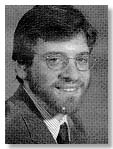 Julian Emmanuel Zelizer, new faculty member in the Department of History, is an
expert on recent American history, as reflected by his conference participation
during the last two years: “Fiscal Conservatism and the American State: Wilbur Mills
and Medicare,” in 1996, “From Wildcats to Technocrats: the AFL-CIO, 1955-1965,” in
1995, and “The Power of State Culture: Wilbur Mills and American Fiscal Policy,
1946-1974,” in 1994.
Julian Emmanuel Zelizer, new faculty member in the Department of History, is an
expert on recent American history, as reflected by his conference participation
during the last two years: “Fiscal Conservatism and the American State: Wilbur Mills
and Medicare,” in 1996, “From Wildcats to Technocrats: the AFL-CIO, 1955-1965,” in
1995, and “The Power of State Culture: Wilbur Mills and American Fiscal Policy,
1946-1974,” in 1994.