
Boosting Cycling & Recycling
Bicycle riding, such a carefree pleasure in the days of our youth, currently, it is being used as a serious means to benefit communities, for mobility, and liberation. Jeff Olsen and Karen Overton illustrate this through the work they are doing: teaching people how to fix and recycle bicycles and also bicycle planning.
Overton, B.S. ’85, M.A. ’94, has pursued a career helping inner-city underpriviliged young people and people in other parts of the world obtain mobility and liberation through bicycle riding. She is now the director of Recycle-A-Bicycle, an innovative outreach program in northern Manhattan that works with hundreds of disadvantaged teenagers.
“In the program we teach young people how to fix bikes that are donated by the community and they are allowed to keep one if they don’t own a bicycle,” says Overton, who received her bachelor’s degree in inter-American studies and her masters is regional planning. “This is not only a great way for hands on learning experience, but it is also giving them an opportunity to participate in helping the community while focusing their energy on positive group activity and offering them mobility.”
Overton is also associated with Pedals for Progress and Bikes not Bombs,and has international development and women’s liberation projects in Mozambique, Barbados and Nicaragra. She also was the main organizer and director of the Recycle-A-Bicycle Program for Albany Service Corps., done with support from the Department of Transportation and the City of Albany, which provided volunteers to work on bicycles that had been donated or had come from landfills. The bicycles were then rebuilt for the use of those in the community. Overton’s experience running the program resulted in her authoring a a book, Tools for Life: A Startup Guide for Youth Recycling and Bicycling Programs.
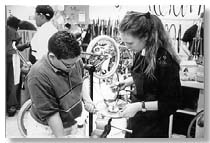
Olsen, an adjunct professor in the Department of Geography & Planning, participated in this program along with Overton. However, his focus is now on providing a place where bicycles can be ridden rather than providing bicycles for those that don’t own them. He is currently teaching the class Bicycling and Pedestrian Transportation Planning.
“Alternative transportation is a growing field, and the University is delivering one of the first three courses of its kind in the U.S.” he said. “Students will learn to intergrate bicycling and walking into balanced, cost-effective transportation systems. This course has made Albany a part of a core group of universities interested in developing bicycle and pederstrian programs; it is hoped that a consortium of these schools will participate in a national program to cooperatively expand these efforts.”
Overton and Olsen both share similar beliefs regarding why bicycle riding, planning and recycling are so important to the communities in Albany and likewise in the rest of the world.
“Through bicycle riding we are helping to create friendlier urban communities that are more liveable with a sustainable form of transportation,” said Overton. “Bike riding is also a better alternative to motor vehicle transportation, especially in places like New York City. It reduces pollution, traffic and fatal accidents and helps to create friendlier neighborhoods.
“Studies have shown that construction of highways destroy neighborhoods. There’s been activist movements against it in areas like New York and also Boston.”
Said Olsen: “Bicycling and walking account for more than 7 percent of commuter travel in New York State and these modes of travel are healthy, good for the environment, and enhance our quality of life. Bicycling and walking are critical transportation choices for people — and communities — with limited financial resources these forms of mobility are cheap, they’re easy and they work.”
Linda Chavis