
By Vinny Reda
Interviews were held on Sept. 26 with five consulting firms vying to help lead a master planning process for future University at Albany construction — beginning with a new chemistry building, a 75,000 square-foot structure with a groundbreaking envisioned for 1998.
Along with the start of the new library, the acquiring of the new campus in Rensselaer, and the ongoing construction of CESTM, it marks a new era of campus physical expansion. Yet, as President Hitchcock cautioned in her address to the faculty on Sept. 11, the new acquisitions and construction “represent a wonderful beginning — but only a beginning.”
The chemistry structure in fact becomes the beginning of a larger “Master Plan,” that will in turn lend to the even more comprehensive Strategic Planning Process that will be a blueprint for the University’s future. The Master Plan will not only assess new construction needs, but also the refurbishing requirements of the current campus.
“If we are to aspire to (Carnegie Foundation) Research I status, if we are to foster the kind of dynamic learning environment which will sustain and increase our national prominence, addressing our campus’ infrastructure needs must remain a key institutional priority,” the President said in her address.
Carnegie has designated Albany a Research II institution, a high ranking reflecting the campus’ more than doubling of external funding in the last six years.
Noting that the new library is the first SUNY-funded academic construction project on campus since 1967, Vice President for Academic Affairs and University’s Master Planning Committee member Judy Genshaft said, “construction at Albany is long overdue. The campus has moved very strongly and deliberately over the past two decades to a stronger research institutional profile that will match our undergraduate strengths. But while we have academically grown in real positive directions, we have outgrown our buildings.”
She said that Albany has been requesting renovations to the chemistry facility for more than five years, and that SUNY is now funding renovations to the building that will finally bring it “up to standards for conducting experiments in undergraduate classes.”
The State University Construction Fund (SUCF), the overseer of construction on SUNY’s 64 campuses, commissioned Albany’s master plan, and it agrees in principle with the University’s broad needs for growth.
“It’s clear that SUNY has defined Albany as a major player in research and graduate education,” said Irving Freedman, SUCF’s general manager and SUNY Vice Chancellor for Capital Facilities.
A master plan was previously developed for Albany in 1974, but was not followed up during the ensuing years by SUNY. Between then and 1994-95, debt service and rent for past and new construction at the Albany campus fell to the lowest per full-time student in the SUNY system — among University Centers about half the rate of Binghamton’s, less than a third of Stony Brook’s, and less than a quarter of Buffalo’s.
“The buildings we have on campus now were built in 1967 to accommodate undergraduate education and relatively few research needs,” Genshaft pointed out. “The Master Planning Process aims to balance our excellence across the disciplines and at all levels of scholarship.” She added that the primary focus for physical expansion now remains the Uptown Campus property.
The Master Planning Process has three general stages, according to Carl Carlucci, Vice President for Finance and Business, and chair of the planning committee: 1) inventory and analysis; 2) setting goals and objectives; and 3) developing and selecting alternatives. “The focus is not on having us do technical tasks, but on decision-making,” he said.
The Master Planning Committee is designed as a steering committee comprising key elements of the campus community. It will manage stage two of the process, appoint subcommittees to deal with in-depth analysis of specific topics (such as academic programs, student services, research, and general support services), and work with the State University Construction Fund to develop final options of the plan.
In addition to Carluccie and Genshaft, the Committee consists of Judith Baskin (Judaic studies); Meredith Butler (University Libraries); Thomas Church (political science); Sid Decker (Academic Affairs); Vice President for Student Affairs James Doellefeld; Bill Dosch (Physical Plant); David Duffee (criminal justice); Cecilia Falbe (business); Vice President For Research Jeanne Gullahorn; Frank Hauser (chemistry); J.J. Haywood (Physical Plant); Edward Mayer (art); Sheila McLaughlin (College of Arts and Sciences); Lenore Mullin (computer science); Thom O’Connor (art); Dean of Undergraduate Studies John Pipkin; Steve Schafer (Office of Financial Management); David Shub (biology); Dennis Tillman (Office of Financial Aid); and Stewart Tolnay (sociology).
Final options go to the second major entity recommended by SUCF, the Advisory Committee. This generally includes the President and her cabinet, and is responsible for the development of the final stage of the process, which in essence is the presentation of a coherent master plan. The current time frame calls for completion of the process by July 1, 1997, so that it can be reflected in the FY 1998 budget submission. With a blueprint in place, SUNY will then ask the State Legislature for funding to carry it out.
The Master Plan will also be incorporated into the larger Strategic Planning Process that will shape the University’s mission and goals into the next century.
“Commissioning a master plan really fits right into President Hitchcock’s vision for the future,” said Genshaft. “She has announced that a strategic planning process will be initiated in the fall, and that it will go hand and hand with the master plan.”
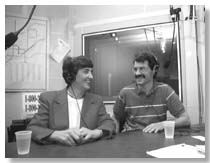
For those looking for an alternative to all the usual radio talk shows, Richard Lachmann, a professor of sociology at the University, has just the thing. He is the host of the new “Social Science Forum” on WAMC-Radio.
In a different twist, the monthly show focuses on current events issues from a social science point of view. Among the topics addressed on the show are the new federal welfare bill, and media coverage of elections. Currently, the show airs on the last Friday of each month at 2 p.m.
Lachmann said he got the idea for the show by listening to a WAMC program called “Science Forum.” As a social scientist, he felt that a lot of the debate that goes on concerning politics was nonsense. “People would ask questions like, ‘Is it true that women have more babies to get more welfare?’ Social scientists have proven that to be wrong, but this belief got serious attention from the media,” he said.
So far, the response to the show has been promising. Lachmann said that approximately 12-15 callers get on the air during each show and many more call the station trying to get on the air. “Most of the callers are a lot like our students. They ask questions based on personal experiences,” he said.
Helen Desfosses, a professor in the Department of Public Administration and Policy and a regular panelist on the show, said the conversations are always lively. “It shows that there is a strong interest out there in what social scientists have to say about critical public policy issues.” In addition to Desfosses, there is one other participant on the show, usually a university professor from the social sciences, depending on the topic.
This is Lachmann’s first venture into the public radio arena and he said he hopes his program will become a regular show. He added that the most difficult aspect has been time. “There is a skill to taking a large body of knowledge and condensing it to address a particular question in a rather short period of time,” he said.
Lisa James
President Presents Project Renaissance Concept to SUNY TrusteesThe University's new living-learning program, Project Renaissance, was praised by SUNY officials after its details were unveiled by President Hitchcock at the monthly meeting of the system's Board of Trustees on September 25.
“An innovative program” and an example of how a “campus seeks to attract and keep students,” was how the weekly briefing “SUNY News” described the Albany initiative, which debuted this semester.
The President described how Project Renaissance--which recruits superior students, offers a common living-learning community environment, provides enhanced general education programs, and fosters interactive and collaborative learning--addresses five key areas impacting campus quality and that therefore affect student recruitment and retention: quality of academic programs, residential and co-curricular life, student service, resources and facilities, and costs and financial aid.
“Project Renaissance is a distinctive academic experience that combines the advantages of a small college with the opportunities of a major research university,” she told the Trustees. “The move from high school to college brings exciting and challenging changes: new places, new people, new responsibilities, new ways of thinking and learning.
“Any effort at recruiting and retaining students must therefore be a multifaceted approach that includes all areas impacting the quality of campus life.”
The University now offers Project Renaissance to two groups of 100 students each that get the chance to live together and participate in a year-long course of study covering 12 credit hours of the general education requirement.
“This broad-based program is intellectually challenging, as well as socially and personally rewarding,” said Ken Goldfarb, SUNY spokesman. “Project Renaissance highlights the quality and innovative of the curriculum, while focusing on the integration of important co-curricular experiences.
“Providing this living-learning environment better allows the continuation of classroom discussion and academic exploration after the course period ends.”
Details of Dr. Hitchcock's presentation were sent to all SUNY campuses.