World Expands for Perservering Student
By Greta Petry
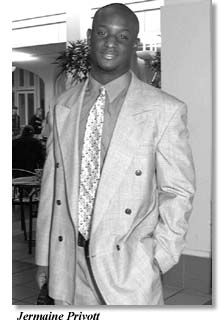 When Jermaine Privott was growing up in Harlem, he could not have foreseen that in
his senior year in college, he would be making plans to travel to Venezuela, Brazil,
South Africa, Kenya, India, Vietnam, the Philippines, Hong Kong, and Japan as part of
the Semester at Sea program.
When Jermaine Privott was growing up in Harlem, he could not have foreseen that in
his senior year in college, he would be making plans to travel to Venezuela, Brazil,
South Africa, Kenya, India, Vietnam, the Philippines, Hong Kong, and Japan as part of
the Semester at Sea program.
Privott, an EOP student who plans to go on for a master’s degree at the University so
that he can teach high school English, says he is going to take a camcorder with him
so that he can show his future students that there is more to the world than their
little neighborhood.
“I have always thought about how I could better myself as a person and a teacher. It
has also been my dream to go abroad again,” said Privott, who volunteered in the
summer of 1995 to teach conversational English to students in Eritrea, East Africa,
through the Operation Crossroads Africa program.
In order to pay the roughly $12,000 needed for the Semester at Sea program, he is
taking out a substantial loan and has received a partial scholarship. But Privott
still needs to raise $1,000 to pay for books, field trips within the countries, and
personal expenses, and he is seeking help from the University community for this
purpose. Checks may be made out to the Institute for Shipboard Education, and may be
sent to or dropped off at the Academic Support Services office, LI 94, in care of EOP
director Dr. Carson Carr.
Perseverance enabled Privott to get to college in the first place, and he is applying
that same determination and positive attitude to making his dream become a reality.
As the only child of a single mother, he knew he wanted to go to college, but he
didn’t know how he could pay for it. So he went to the library, looked up information
about financial aid programs and on his own discovered the state’s Educational
Opportunity Program.
“Albany was my first choice. I was accepted at Binghamton as well as Albany, but I
chose Albany,” he said. “My guidance counselors made Albany sound like Harvard. It
was my top choice. I was given a break when I was accepted to the EOP program.”
While at Albany, Privott has gained public speaking experience at local high schools,
churches and the city jail, where he went on behalf of the Educational Outreach
Program. At these speaking engagements he received feedback to the effect that he
would make a good teacher.
An English major, Privott has been the recipient of the Presidential Leadership and
Community Service award. He has been a Resident Assistant for Residential Life and is
a former chair of public relations for the Albany State Black Alliance. This semester
he is a student assistant for international students on Alumni Quad.
The first hurdle he faced in reaching the Semester at Sea program was to raise $1,000
for the deposit required by last February. Trying to figure out how to raise that
money, he entered an essay contest sponsored by the African-American Latino
Pre-Professional Association. He won $500.
“From then on I knew this was a trip that was meant for me,” he said.
Attending Louis D. Brandeis High School in Manhattan, Privott was encouraged by his
mother and his teachers to do well in school.
“The teachers always helped me. They’d say, æI know you have potential. You just have
to concentrate a little more. You can do better,’ “ he said. “I’d like to keep that
cycle going. I’d like to give back what was given to me. That’s why I’ve been an R.A.
for transfer students at Alumni Quad. That’s why I’m a student assistant now. I am
really determined to be a success and to be a good teacher. I want to make myself a
better teacher by going abroad. Then I can bring the world to my classroom,” he said.
Privott gained teaching experience in East Africa. Eritrea is a former province of
Ethiopia which declared independence in April 1993 after 30 years of civil war. It
borders on the Red Sea in the east, Sudan in the west and north, and Ethiopia in the
south.
Conflicts over religion and territory between Christian highlanders and Muslim
lowlanders have been a part of Eritrea’s history, with its strategic location on
trade routes between the Nile River valley, the Red Sea, and Central Ethiopia making
it vulnerable to frequent invasions. During the long civil war, 80 percent of the
population was dependent on food aid. Even today, the life expectancy of the average
Eritrean is 45.
The government of Eritrea continues to receive foreign aid and seek private
investment to rebuild the devastated infrastructure.
Part of that rebuilding process is the reforestation project in which Privott worked
with Eritrean students each morning. In the afternoon he taught about 25 students
conversational English. Their native language is Tigrinya, of which Privott knew not
know a word when he arrived.
“In the beginning, I’d talk and talk and I thought they understood me because they
were all sitting there so quietly and attentively.” It took him awhile to realize
that while they could understand written English, it was harder for them to hold a
conversation.
The Operation Crossroads Africa program was volunteer work, for which Privott raised
the entire $3,500 cost to participate.
CAT Draws Semiconductor Giants to ‘Industry Day’
By Mary Fiess
 Leaders in the semiconductor industry say that their partnerships with the
University’s Center for Advanced Thin Film Technology (CAT) are a model for success
in their extremely competitive field.
Leaders in the semiconductor industry say that their partnerships with the
University’s Center for Advanced Thin Film Technology (CAT) are a model for success
in their extremely competitive field.
At “Industry Day,” sponsored by the CAT on Oct. 2, corporate sponsors gathered to
hear scientific and technical updates on work being done by the Center, and to report
on specific collaborations between companies and the CAT.
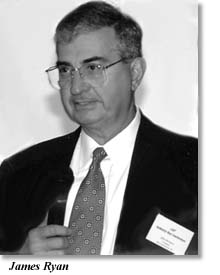
“The center gives us access to equipment that we don’t have in our factories yet,”
said James Ryan of IBM Microelectronics. “We get early exposure to new technology
(prior to commercialization) and the center facilitates interaction with vendors and
end-users . . . The center is a source of highly skilled professionals.”
IBM worked with the center to explore the use of a process known as chemical vapor
deposition (CVD) for depositing copper interconnects on computer chips. Aluminum is
currently the metal of choice for interconnects within and between computer chips,
but chips of the future, on which circuits will be more densely packed, are likely to
require new interconnect materials.
Through its state-of-the-art facilities and research expertise, the CAT has developed
the technology to produce copper interconnects that show promise for the next
generation of computer chips.
Mehrdad Moslehi, senior vice president and chief technical officer of CVC Products,
offered a “tool supplier’s perspective” on partnerships with the CAT. CVC’s specialty
is cluster tools that deposit thin film materials, and CVC equipment is a critical
part of the CAT’s state-of-the-art facilities.
At the CAT, CVC can test its equipment with emerging technologies and, as a result,
make design improvements based on results, noted Moslehi. Through its collaborative
work, CVC has also gained greater technical understanding of specific processes for
which its cluster tools are used. In turn, the CAT’s research efforts are
strengthened through the use of proven commercial cluster tools, he said.
MKS Instruments is a component manufacturer that has worked since 1992 (even before
the University was designated a Center for Advanced Technology) with Alain Kaloyeros,
CAT director. MKS manufactures components that measure and control gases and
materials that are delivered to chambers, like CVC cluster tools, where thin films
are applied.
For MKS, a major benefit of its CAT partnership is its “association with leading
center scientists, device manufacturers, tool supplies, and materials companies,”
said John Bertucci. At the CAT, MKS has also been able to find “innovative solutions
to immediate processing challenges” and to “test and improve products at process
development stage.”
