 The 17th Century is the last time that Europeans had any contact with non-Europeans
without racializing them. From the 18th Century onward, race becomes a central
category for Europeans in their transactions with a different world, and gender
undergoes radical transformation. In Bachelors of Science: Seventeenth-Century
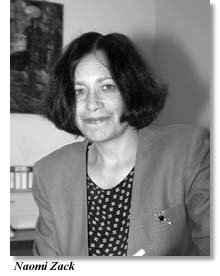
Identity, Then and Now, Naomi Zack, an assistant professor of Philosophy, discusses
this as she takes the reader through a lucid tour of the lives, times and writings of
such key “bachelors of science” as Bacon, Descartes, Newton and Gassendi.
The 17th Century is the last time that Europeans had any contact with non-Europeans
without racializing them. From the 18th Century onward, race becomes a central
category for Europeans in their transactions with a different world, and gender
undergoes radical transformation. In Bachelors of Science: Seventeenth-Century
Identity, Then and Now, Naomi Zack, an assistant professor of Philosophy, discusses
this as she takes the reader through a lucid tour of the lives, times and writings of
such key “bachelors of science” as Bacon, Descartes, Newton and Gassendi.
“ I have always been interested in Locke, Descartes, and Newton because they were the
architects of modern science,” she said.
Zack begins with the premise that in order to understand Western conceptions of
racialized and gendered identity, one needs to go back to a period when such
categories were not important and examine how notions of identity in the 17th century
were fundamentally different from subsequent years. Among the subjects examined in
the book are pre-racial conceptions of slavery, witchcraft trials and their
connection to homosexuality, and the highly sexualized nature of women’s identity in
the seventeenth century.
“The book combines intellectual history with philosophy and liberatory concerns such
as feminism and race,” Zack said. In Bachelors of Science, she suggests a link
between elite bachelorhood, the profession of philosophy, and scientific pursuit as
recreational activity. This book will help the reader to understand the precedents of
modern scientific identity, race, and gender.
For years, Zack has written numerous articles and given many presentations about
issues related to race, philosophy and public policy. A member of the University
faculty since 1990, she is also the author of Race and Mixed Race, published in 1993.
Lisa James
White Men Get Top Policy Posts from Governors,
CWG Reports
By Christine Hanson McKnight
The nation’s governors have appointed mostly white men — and relatively few women and
people of color overall — to the top policy posts in their administrations, according
to a study released today by the University’s Center for Women in Government. The
report found that in every racial or ethnic category, women lag significantly behind
men in percentage of political appointments.
Nationwide, women appointees hold less than one-third (30.7 percent) of the 1,428
top-ranking posts in the executive branches of state government, according to the
study. Underwritten by a $157,000 grant from the Ford Foundation, the two-year study
is based on data collected from all states except South Carolina and Texas.
 Whites account for 86.6 percent of the top policy leaders appointed by governors in
the U.S. People of color hold a small fraction — less than 15 percent — of all
gubernatorial policy leadership posts in state government. African Americans hold 7.1
percent of these posts, followed by Latinos (2.8 percent) Asian Americans (2.5
percent) and American Indians (0.8 percent).
Whites account for 86.6 percent of the top policy leaders appointed by governors in
the U.S. People of color hold a small fraction — less than 15 percent — of all
gubernatorial policy leadership posts in state government. African Americans hold 7.1
percent of these posts, followed by Latinos (2.8 percent) Asian Americans (2.5
percent) and American Indians (0.8 percent).
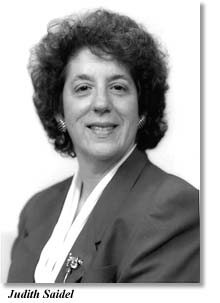
Judith Saidel, executive director of the Center and project co-director, said that,
as the federal government downsizes and hands off more programs to the states,
appointed officials are joining elected officials in developing and implementing an
increasing number of critical policy decisions.
“We decided to do this study because little was known about the representativeness of
executive branch leadership in the United States,” said Saidel. “We believe it will
shed light on who participates at the state level as top-ranking appointees in
executive branch decision making.”
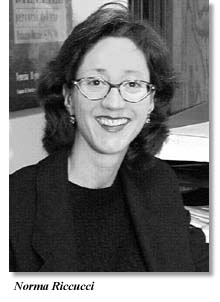 Project Co-Director Norma Riccucci, associate professor in the Department of Public
Administration and Policy, said that, until the completion of the Center’s study,
there was no consistent and complete data source to inform policy makers, researchers
or the general public about the gender, race and ethnicity of appointed policy makers
who are department heads and members of executive chambers or governors’ personal
staffs.
Project Co-Director Norma Riccucci, associate professor in the Department of Public
Administration and Policy, said that, until the completion of the Center’s study,
there was no consistent and complete data source to inform policy makers, researchers
or the general public about the gender, race and ethnicity of appointed policy makers
who are department heads and members of executive chambers or governors’ personal
staffs.
“We wondered, for instance, whether African American, Latino, Asian and American
Indian women and men are part of gubernatorial staff meetings when strategic
decisions with wide-ranging programmatic implications are made,” Riccucci explained.
Some other highlights from the report:
• Nevada, where women hold more than half (53.8 percent) of the top appointed policy
posts, has the highest representation of women appointees compared to women in the
state’s population, followed by Maryland (48.5), Virginia (46.7), Massachusetts
(47.2) and Oregon (44.8). Nebraska has the lowest representation, with women holding
only 5 percent of the policy-leader positions, followed by Oklahoma (9.1), Iowa
(11.1), Rhode Island (17.6) and Connecticut (17.9).
• Although women are still underrepresented nationally in governors’ offices, they
have attained a substantially higher proportion of leadership positions on
gubernatorial staffs than as heads of state bureaucracies.
• Women are overwhelmingly appointed by governors to head departments in such fields
as civil and human rights, labor and human resources. Women are underrepresented as
agency heads in departments of police, fire, corrections, utilities, transportation
and highways.
• African Americans are significantly underrepresented as executive advisors in
governors’ offices and as heads of departments, agencies, offices, boards,
commissions and authorities.
• Current governors have appointed Latinos, who represent 9.0 percent of the
population, to only 1.7 percent of the top policy advisor positions in governors’
offices. Only two American Indians, both men, hold top advisor posts.
• Democratic governors appoint about the same proportions of women and men to top
policy leadership positions as Republican governors.
Data for the study was collected from the 50 states in a mailed survey. All states
responded to the survey except South Carolina and Texas. Only persons appointed by
current governors, and who have policy-making responsibility, were included.
This is the first in a continuing series of publications to be produced and made
available by the “Appointed Policy Makers in State Government” project at the Center
for Women in Government. For subscription information, call the Center at 442-3900. A
complete copy of the 16-page report, “Appointed Policy Makers in State Government,”
is available on the University’s Website at https://www.albany.edu.

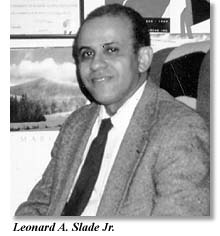 Writing about everything from shoeshines to the late Commerce Secretary Ron Brown,
Leonard A. Slade Jr. uses words to describe the world around him as he sees it. In
Pure Light, his seventh collection of poems, he mixes personal tales of loved ones
with observations on current events such as the arrest of the unabomber.
Writing about everything from shoeshines to the late Commerce Secretary Ron Brown,
Leonard A. Slade Jr. uses words to describe the world around him as he sees it. In
Pure Light, his seventh collection of poems, he mixes personal tales of loved ones
with observations on current events such as the arrest of the unabomber.