
By Vinny Reda
The celebration that accompanies the Inauguration of President Karen R. Hitchcock will not overlook her roots as a scholar and academic.
On Thursday, Oct. 31, and then again on Tuesday, Nov. 5, the Inaugural Seminar Series will have as its topic “Extracellular Matrix & Development,” the area of research furthered by the President in her years on the faculties of Tufts and Texas Tech universities, and the University of Illinois at Chicago.
“I thought this seminar would be particularly appropriate and so I made a suggestion to the President,” said Joseph Mascarenhas, professor and chair of the Department of Biological Sciences, and co-coordinator of the event with fellow department member Albert Millis. “I think she was flattered, and excited at the prospect of attending the two events.”
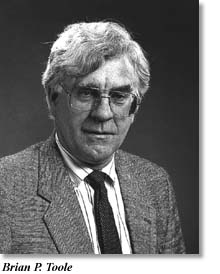
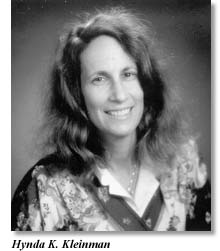
Mascarenhas calls Bryan P. Toole, who speaks on “Hyaluronan-cell interactions in morphogenesis & tumorigenesis” on Oct. 31, and Hynda K. Kleinman, who discusses “the roll of basement membrane in cell differentiation” on Nov. 5, as “extremely eminent in their field.” Both seminars take place at 4:10 p.m. in Biological Sciences 248A.
Extracellular matrix refers to a collection of macromolecules that surrounds the plasma membrane of a cell and comprises the substratum on which the cell may be attached or embedded. Its molecules are synthesized and secreted and/or derived from blood plasma, and include both small growth factors as well as large glycoproteins. Science now studies this structure’s involvement in tissue development, angiogenesis and cancer.
Hitchcock, as George A. Bates Professor of Histology at the Tufts Schools of Medicine and for years afterward, was principal investigator for several large research grants, funded by the National Institutes of Health, that focused on extracellular matrix and lung development.
“I don’t know how many in the campus community outside the biology department know how very successful as a scientist President Hitchcock was,” said Mascarenhas. “I know that both of the seminar speakers have told me they are excited about talking with her while they’re here.”
Toole is a member of the department of anatomy and cellular biology at Tufts, and Kleinman a member of the Laboratory of Development Biology in the cell biology section of National Institute of Dental Research of the National Institutes of Health in Bethesda, Mary.
Mascarenhas said that the field is very relevant to several scientists in the area, with two faculty members in the University, and several at Albany Medical Center and the State Department of Health focusing their current research on extracellular matrix. “I anticipate most or all of them will attend,” he said.
The Institute of Gerontology of the School of Social Welfare has been awarded a $1.2 million grant to study the effectiveness and efficiency of health education groups in health maintenance organizations (HMOs).
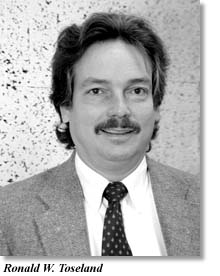
Principal investigator Ronald W. Toseland, director of the Institute and faculty member in the School, will lead the four-year project. The first two years will involve the development and implementation of a year-long health education group-intervention program for 80 caregivers and their frail, elderly spouses receiving care. Another group of 80 couples, like the first group chosen from Community Health Plan (CHP) enrollees in the Capital Region and Hudson Valley area, will act as a control group.
The last two years of the study, funded by Agency for Health Care Policy & Research in the federal Department of Health and Human Services, will analyze the data to determine the effect of the Health Education Program (HEP) on the well-being, health care utilization, and health care costs for the caregivers and care recipients.
“The study has important policy implications because it examines the question of whether preventive health education groups sponsored by an HMO can reduce health utilization and the costs, while increasing the psychological well-being of the both the caregivers and the recipients,” said Toseland.
The design for the HEP was created by Toseland and fellow School of Social Welfare faculty member Philip McCallion, who will be co-principal investor on the new project. “The intervention has previously been implemented at a Veterans Hospital facility to good effect,” said Kim Jaffee, a research associate at the Institute, a doctoral student in the School, and now project director of the new HEP/HMO study.
In that study, funded by the Department of Veterans Affairs and conducted by Toseland, the effectiveness of a Caregiver Support Program for spouse caregivers of frail, aging veterans was examined.
“It found that compared to caregivers who received no intervention, those in the group program showed significant increases in use of active behavioral coping strategies & knowledge of community resources,” said Jaffee. “They also experienced significant decreases in subjective burden and the stress and severity of caregiver problems.”
In addition, she said, the veterans’ study concluded after one year that per capita health care costs for patients whose spouses were not in the Caregiver Support Program were about $8,000 higher than those who did participate in the program.
By Vinny Reda
•••
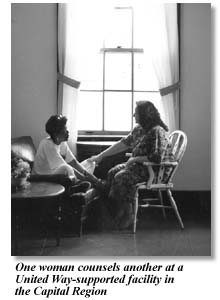
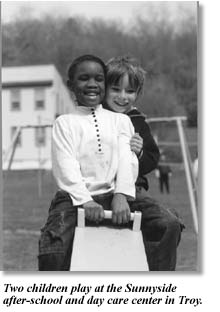
The campus community will attempt to scale the charitable goal of $75,000 for its 1996 United Way/SEFA campaign.
 “The campaign will be reaching out to every member of the University community,
asking for a contribution at any level,” said William Hedberg, assistant vice
president in the Office of Academic Affairs, and campus administrative coordinator
for the campaign.
“The campaign will be reaching out to every member of the University community,
asking for a contribution at any level,” said William Hedberg, assistant vice
president in the Office of Academic Affairs, and campus administrative coordinator
for the campaign.
“Whether it’s for assistance to the elderly, support for children growing up in difficult circumstances, aid to the sick and disabled, or any of a number of efforts that help individuals, families and communities, the campaign touches our lives,” said Donald J. Reeb, professor of economics and faculty coordinator for the second straight year.
“Contributing to it is an expression of how much the campus acknowledges its place within that larger community.”
 A network of campus coordinators comprising all divisions and schools will be
available to speak to any faculty or staff members inquiring about the campaign and
the funding agencies. Payroll deduction will once again be a convenient method of
giving. Donations can be targeted that way or by lump sum to a large variety of
Capital Region social service agencies.
A network of campus coordinators comprising all divisions and schools will be
available to speak to any faculty or staff members inquiring about the campaign and
the funding agencies. Payroll deduction will once again be a convenient method of
giving. Donations can be targeted that way or by lump sum to a large variety of
Capital Region social service agencies.
About 95 percent of all money donated to the campaign goes directly to these agencies.
Nearly 500 members of the campus contributed to last year’s total of more than $74,000. “We are looking for an increase in the number of donors this year,” said Hedberg, “and we believe that reaching them about the great need in the area for charitable efforts will ensure another tremendous response from the University community.”