 Is there a relationship between stressful events in our lives and the onset of a
headache?
Is there a relationship between stressful events in our lives and the onset of a
headache?
Is there a relationship between stressful events in our lives and the onset of a
headache?
The University’s Center for Stress and Anxiety Disorders now seeks 150 individuals who suffer from chronic headaches to participate in a federally funded project which will examine that question.
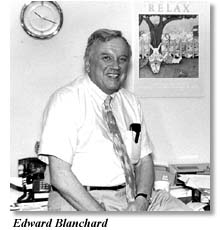
The $927,679 study is funded by the National Institutes of Health and will examine the relationship between headache, stress and mood, according to Center Director Edward Blanchard.
“Many headache specialists and many, many headache patients believe there is a connection between stressful events in the headache patient’s life and the onset of a head,” Blanchard said. “The National Institutes of Health, in its Migraine Headache Initiative, has given us the funds to try to get a definitive answer to this question.”
Blanchard, a distinguished professor of psychology, said that the Center hopes to study 150 individuals with chronic headache over the next three years. Eligible patients will be paid $20 a week for six weeks to monitor their headaches, mood and stressful events on a daily basis. They will have the option at the end of the study to receive free non-drug treatment of their headache instead of the $120.
Blanchard said there is a conventional clinical wisdom that headaches are stress-related, but there is no good scientific data to confirm the link. A 1978 study in the journal Headache found, among other things, that five percent of the population does not get aches, that about 150 million workdays are lost each year to headaches, and that women suffer the migraine type of headache at about two and a half to three times the rate of men.
Blanchard himself has been studying headaches and their treatment through non-drug procedures since 1979 at the Center for Stress and Anxiety Disorders. He said that a contributing factor to a headache could be over-medication, and that headache in turn could produce further stress in one’s life.
The grant is the largest that Blanchard and the Center have ever received to study headache, and it came after a lengthy review process by the NIH.
Interested headache patients should call the Stress Disorders Clinic at 518-456-4143 for more information.
By Christine Hanson McKnight
By Linda Chavis
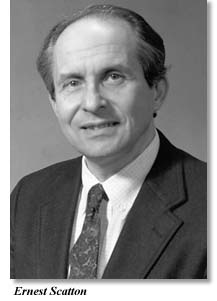 On April 22 the Academic Council of the University of Sofia, “St. Kliment Ohridski,”
voted unanimously to confer upon Ernest Scatton of the Department of Germanic and
Slavic Languages & Literatures the degree of Doctor Honoris Causa in recognition of
his research and service in the field of Bulgarian and Slavic linguistics and also
for his considerable contribution to the academic cooperation that exists between the
University of Sofia and the University at Albany.
On April 22 the Academic Council of the University of Sofia, “St. Kliment Ohridski,”
voted unanimously to confer upon Ernest Scatton of the Department of Germanic and
Slavic Languages & Literatures the degree of Doctor Honoris Causa in recognition of
his research and service in the field of Bulgarian and Slavic linguistics and also
for his considerable contribution to the academic cooperation that exists between the
University of Sofia and the University at Albany.
Scatton’s portfolio of scholarship on Bulgaria and its language began in 1975, when he completed a study of “Bulgarian Phonology.” In 1984 he wrote A Reference Grammar of Modern Bulgarian, and in 1988 he translated, edited and typeset Proto-Slavic and Old Bulgarian Sound Changes. Now the director of Albany’s Russian & Eastern European Studies Program, he has also written more than 30 articles dealing with problems in linguistic language. In 1993 he contributed to an instructional course in reading Bulgarian and created a reader for the course.
Scatton was awarded a Fulbright grant to study in Bulgaria during the summer of 1984, when he was Albany’s chairman of the Department of Slavic Languages & Literatures.
In 1993 he, along with the chair of the English department at Sofia University, submitted a proposal to the United States Information Agency (USIA) for a three-year grant of approximately $100,000 under the auspices of USIA’s University Affiliation Program. Its aim was to foster the development of American studies at Sofia English Department.
The project included the exchange of faculty members for a semester and librarians for the summer, so that University of Sofia faculty could see how the Albany campus and its University Libraries operated. Seven faculty members from Sofia have since come to the University for a semester and while here have taught English language, American literature, Women’s studies and linguistics courses in the College of Arts and Sciences, and other offerings within the School of Education.
Meanwhile, five faculty members from the University have gone to Sofia. In addition, two University librarians worked at Sofi, while one librarian from there worked at Albany. The grant was also used to bring about 300 to 400 titles relating to American literature, language and culture to the Bulgarian institution that did much to help develop the library system at Sofia University.
“The cooperative program with Sofia University has been one of the most successful and productive initiatives in the international arena for us, and we are all aware that this achievement is due primarily to Ernest Scatton’s persistent and intelligent leadership and commitment,” said President Hitchcock.
The honorary degree will be given to Scatton at Sofia’s conferment ceremony, which will take place during the period of Nov. 25-Dec. 2 in the “Aula” of the university. Scatton will also be giving an academic speech of his choice.
New Counselor Sherry Baird has become an Academic Counselor in the Office of Academic Support Services. Her role will include assisting the monitoring of students admitted through the Multicultural Recruitment Program (MRP) and the Talented Student Admissions Program (TSAP). Much of this work, according to Carson Carr, Assistant Vice President for Academic Affairs.
“Ms. Baird’s availability as a professional in the Office of Academic Support Services provides MRP/TSAP students with addition academic and personal advisement insights,” said Carr. Baird received both her bachelor of science (1994) and master of science (1995) degrees in social welfare from the University. For the last year, she was employed by the Office of Residential Life as a resident director.