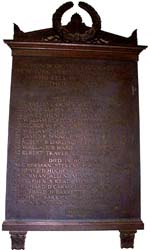
Visitors to the University at Albany's administration building will find a large plaque to the right of AD 125 honoring 18 State Normal School graduates who were killed in the Civil War. One might ordinarily walk past this plaque, which is a bit dusty on top, without stopping to read it. Yet it's worth a second look. The story behind it is a dramatic one about undergraduate men leaving college to go to war, joining up with alumni volunteers, and heading into battle with three weeks of military training under their belts, led by two math teachers from the State Normal School, predecessor to the University.
In historian Allen Ballard's May 30 Op-Ed piece in The New York Times, "The Demons of Gettysburg," he refers to a particular spot on the battlefield called Little Round Top. At that site at Gettysburg, a crucial battle of the Civil War, "Col. Joshua Chamberlain made his now famous stand with the sturdy men of Maine," Ballard wrote.
Professor Ballard, who earned his Ph.D. at Harvard, explained recently that fighting near Chamberlain's men were the soldiers of the Normal School Company, known as New Company E of the 44th New York Volunteers. There is a monument to the 44th at Little Round Top, which mentions the Normal School Company. Ballard taught a graduate research seminar in Spring '99 on the 44th Regiment, particularly New Company E. More information about the 44th can be found at http://nystatehistory.org/.
The Civil War had a great impact on the school and its students. "Nearly one out of five men (106 of 583) who graduated before 1863 served in the conflict. Eighteen of them died," noted Kendall Birr in A Tradition of Excellence. (1994)
The Normal School Company was founded by two of the school's math teachers, Albert N. Husted '55 (for whom Husted Hall is named) and Rodney G. Kimball, and which numbered about 100 men, including 25 undergraduates and alumni. Kimball was the captain and Husted a lieutenant.
"When, in July, 1862, the Union forces were defeated in the `seven days' battle' before Richmond, and there came up from the Capital of the nation a new call for men - soldiers to drive back the rebellious invaders - the young men of the State Normal School felt that it was time for them to shoulder their muskets and do what they could to save the land they loved, and preserve the institutions for which their fathers fought." (A Historical Sketch of the State Normal School at Albany, N.Y. and a History of Its Graduates for Forty Years, 1884).
Husted and Kimball left the State Normal School to join the Union army. They recruited and drilled the recruits in September, 1862, and joined the regiment the following month at Antietam Ford, Md. Graduates and friends gave each of the two professors a revolver as a gift, and raised funds to donate a rubber blanket to each soldier.
"The company saw much severe service, participating in the great battles of Fredericksburg, Chancellorsville, Gettysburg, Wilderness, Spottsylvania, Petersburg, and numerous smaller engagements," noted the school's student, literary, news and alumni publication, The Echo, on April 27, 1905. Company E fought in 17 battles.
By the Battle of Gettysburg, Husted had taken over command from Prof. Kimball, who was honorably discharged and had returned to the Normal School.
The head of the committee that raised money for the plaque that hangs near the Student Affairs office today was Husted, who returned to the Normal School after the Civil War and was promoted to professor in July 1869. He taught math until 1912, and gave a lecture on the Civil War to history students once a year.
The first plaque for which Husted raised funds was destroyed in a fire that ripped through the school's former building on Willett Street. It was preceded by a framed document listing the names of the war dead.
Included on the current plaque is the name of one graduate, Elbert Traver, Class of '62, from Rhinebeck in Dutchess County, who died at Gettysburg.
Undergraduates who left school to fight were not mentioned. Private George B. Wolcott of Milan, Yates County, for example, was killed at Gettysburg, but because he was an undergraduate his named is not listed on the plaque.
In a wartime letter from the front, reprinted later in The Echo, Husted mentioned Wolcott:
"I will now tell you of the Normals and others who have left us recently. First the killed: Wolcott, L. Burnham, and S. Munson, all shot through the head, I believe, and died almost instantly. We buried them side by side beneath a black walnut tree and placed a board marked with their names and the order of interment. They fought bravely and well."
After the war, Husted went on to be named acting principal at one point, when the school was seeking a new president. The Science Hall was renamed Husted Hall in 1928. The first school scholarship, known as the Husted Fellowship, was named for him. The scholarship was used for graduate study in education.