 Making
The Grade
Making
The Grade
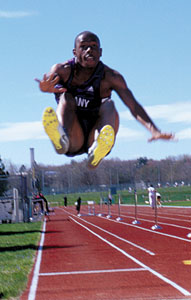
Junior Ronald Edmundson predicts that it will be "a whole new vibe" for the campus. The University's record holder in the triple jump, Edmundson is talking about Albany's move this fall to NCAA Division I athletic competition. He clearly relishes the challenge—both as an athlete and a student.
"You're going up against top athletes, so I know I'm going to have to improve athletically. But because I'm working harder in athletics, I know I'm going to have to work doubly hard in academics. I'm going to have to pay attention to both."
So far, Edmundson has achieved that balance with style. A double major in history and education, the 20-year-old from Highland in Ulster County has a cumulative grade point average of 3.45. But he says he's not satisfied with that.
"After going to the Spellman Awards Dinner and seeing people with 3.9s, I decided I'm not going to settle for a 3.45. I want to graduate with a 3.7," he said at the conclusion of his sophomore year last spring. The Spellman Awards recognize the scholarship, leadership and community service of students of color.
 As
an athlete, Edmundson has goals, too: to qualify for the Division I national
championships, and to score points for Albany at another prestigious track
and field event, the IC4A. As a freshman, he broke the University triple
jump record with a leap of 47 feet, 10 � inches to help lift his wildly
cheering team to victory in the New England Collegiate Conference Indoor
Championships at Southern Connecticut State University. "We were down
by three points, and I was competing against an All-American. He jumped
and then I jumped. I had a personal best and I beat him by a foot. Everyone
was going crazy."
As
an athlete, Edmundson has goals, too: to qualify for the Division I national
championships, and to score points for Albany at another prestigious track
and field event, the IC4A. As a freshman, he broke the University triple
jump record with a leap of 47 feet, 10 � inches to help lift his wildly
cheering team to victory in the New England Collegiate Conference Indoor
Championships at Southern Connecticut State University. "We were down
by three points, and I was competing against an All-American. He jumped
and then I jumped. I had a personal best and I beat him by a foot. Everyone
was going crazy."
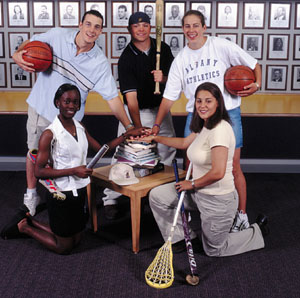
Few of the approximately 400 student-athletes on Albany's 19 intercollegiate teams have an electrifying moment like that to recount, but their coaches have observed that most of them have certain things in common: They are spending more time in the weight room to become stronger and more confident. They are experts at managing their schedules. They are highly motivated. And the most successful bring a remarkable sense of balance to the demands of being both scholars and athletes.
 "For
me, it seems like the harder things get, the more willing I am to put
in the effort—and the better I'm going to end up being," says the 5-foot-10-inch,
140-pound Edmundson.
"For
me, it seems like the harder things get, the more willing I am to put
in the effort—and the better I'm going to end up being," says the 5-foot-10-inch,
140-pound Edmundson.
That kind of attitude, which carries over into the classroom, is not all that unusual, says James P. Doellefeld, Albany's vice president for student affairs. He points out that better than 45 percent of Albany's student-athletes have at least a 3.0 GPA. "Albany's intercollegiate athletic program will continue to excel, producing competitive teams, successful coaches, and outstanding student-athletes who are recognized for their accomplishments both on the field and in the classroom," Doellefeld predicted. He added that he expected the move to Division I to strengthen the University's ties with alumni and the community and to enhance the quality of life for students, faculty and staff.
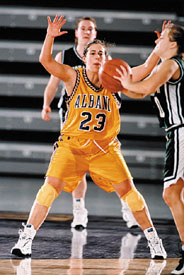
Liz Tucker, a guard/forward on the women's basketball team, says she does much better academically during the playing season than off season. "That's because I have a schedule, and I know I have to manage my time," says Tucker, a 20-year-old junior psychology major from Plaistow, N.H. with a 3.49 GPA. Known for her trademark gold knee pads, the 5-foot-10-inch, 165-pound Tucker is a versatile player who averages 10.3 points per game and leads the team in rebounding with 6.7 per game.
"The big thing is that we're all student-athletes. Most of the student-athletes I know really care about their sport, but they realize they have to be students first. We don't talk about our grade points, but my teammates and I know we have to pay attention to academics if we want to play," Tucker says.
 Nineteen-year-old
Amy DiMicco, who scored a record 41 points in lacrosse and 31 points in
field hockey last year as a freshman, also had an impressive academic
mark after her first year: a 3.77. She, too, lives her life on a schedule.
"As an athlete, I feel like it's a necessity, but I honestly don't find
it hard at all because I've been doing it all my life," says DiMicco,
who began playing field hockey in second grade and lacrosse in ninth grade.
"Coming in, I was really concerned. I thought, 'I'm not going to have
a life.' But I found that's not the case." DiMicco attributes her first-year
success to a combination of great coaching, careful attention to academics
and athletics, a strong network of friends—both athletes and non-athletes—and
the support of her family. Older sister, Dawn DiMicco, a junior, plays
both basketball and lacrosse. Their parents make the two-and-one-half-hour
drive from Westchester County to see both their daughters play in as many
home games as possible.
Nineteen-year-old
Amy DiMicco, who scored a record 41 points in lacrosse and 31 points in
field hockey last year as a freshman, also had an impressive academic
mark after her first year: a 3.77. She, too, lives her life on a schedule.
"As an athlete, I feel like it's a necessity, but I honestly don't find
it hard at all because I've been doing it all my life," says DiMicco,
who began playing field hockey in second grade and lacrosse in ninth grade.
"Coming in, I was really concerned. I thought, 'I'm not going to have
a life.' But I found that's not the case." DiMicco attributes her first-year
success to a combination of great coaching, careful attention to academics
and athletics, a strong network of friends—both athletes and non-athletes—and
the support of her family. Older sister, Dawn DiMicco, a junior, plays
both basketball and lacrosse. Their parents make the two-and-one-half-hour
drive from Westchester County to see both their daughters play in as many
home games as possible.
Another two-sport athlete, football and baseball standout Michael Oliva, has a 2.85 GPA as an English major and a double minor in history and education. "I love English, I love to read, and I like to write," says Oliva, a 5-foot-10-inch, 190-pound quarterback. Last fall, he came off the bench to rally the Great Danes from a 24-point deficit in a heart-stopping 25-24 Eastern Football Conference championship victory. Albany, which will play Division I-AA football, went
21-2 over the last two seasons in Division II competition. In baseball, Oliva has started every game at centerfield since his freshman year and is a .358 career hitter, with more than 50 stolen bases and 100 runs in the lead-off spot.
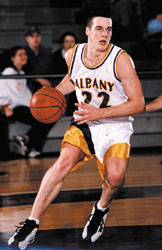 Senior Matthew
Haggarty, a presidential scholar who is also a team captain and the starting
shooting guard on the men's basketball team, says the secret of his success
is staying focused and not wasting time. "I go to classes, I take good
notes, and I do the readings. But I make sure to go to classes. It's no
secret, really. It's just called focus, but that's probably the hardest
thing," says the 6-foot-3, 195-pound Haggarty. His GPA is 3.3.
Senior Matthew
Haggarty, a presidential scholar who is also a team captain and the starting
shooting guard on the men's basketball team, says the secret of his success
is staying focused and not wasting time. "I go to classes, I take good
notes, and I do the readings. But I make sure to go to classes. It's no
secret, really. It's just called focus, but that's probably the hardest
thing," says the 6-foot-3, 195-pound Haggarty. His GPA is 3.3.
 Head
men's basketball Coach Scott Hicks says that Haggarty is a role model
for the other members of his team. "The commitment to be a Division I
athlete today is tremendous," said Hicks. "By his example of hard work,
discipline and perseverance, Matt has shown that it is possible to excel
in the classroom and on the court."
Head
men's basketball Coach Scott Hicks says that Haggarty is a role model
for the other members of his team. "The commitment to be a Division I
athlete today is tremendous," said Hicks. "By his example of hard work,
discipline and perseverance, Matt has shown that it is possible to excel
in the classroom and on the court."
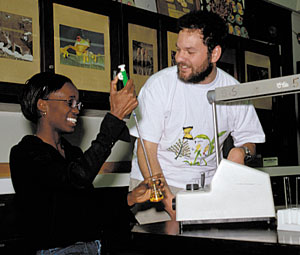
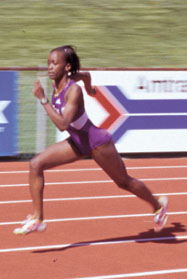
Sophomore Onieka Randall, who was one of the top 400-meter high school runners in New York City, graduated in the top 10 percent of her class at Tilden High in Brooklyn. Recruited by a number of Division I schools, she chose Albany, she says, because "Coach (Roberto) Vives was the only coach who talked more about academics (than athletics). He said schoolwork should be the priority, and that there should be a balance. Also, I knew Albany had a good science program." Juggling a tough first-year schedule that included classes in biology and chemistry and a job as a work-study, Randall still managed a 3.59 GPA—even as she was toppling records on the track. At the Penn Relays last spring, the 5-foot-4, 116-pound Randall ran the second leg on Albany's championship 4x400 meter relay team, which set both an event and school record in 3:53:23. She also found time to participate in the Charles Drew Science Club.
 Albany's
student-athletes also have their eyes on the future. "I'm going to become
a pediatrician. It's something I've always wanted to do," the soft-spoken
Randall says with conviction, adding that she hopes to practice medicine
in her native Jamaica. Edmundson plans either to go to law school or to
become a teacher and coach. DiMicco expects to major in business and eventually
work in a corporate setting. Oliva wants to go to graduate school and
become a teacher and coach. Tucker is considering a career as a guidance
counselor, teacher, or coach after first taking a crack at playing professionally,
either in Europe or in the Women's National Basketball Association. Haggarty,
a communications major who worked as an intern under Professor Alan Chartock
at public radio station WAMC last semester, is planning a career in marketing,
public relations or advertising.
Albany's
student-athletes also have their eyes on the future. "I'm going to become
a pediatrician. It's something I've always wanted to do," the soft-spoken
Randall says with conviction, adding that she hopes to practice medicine
in her native Jamaica. Edmundson plans either to go to law school or to
become a teacher and coach. DiMicco expects to major in business and eventually
work in a corporate setting. Oliva wants to go to graduate school and
become a teacher and coach. Tucker is considering a career as a guidance
counselor, teacher, or coach after first taking a crack at playing professionally,
either in Europe or in the Women's National Basketball Association. Haggarty,
a communications major who worked as an intern under Professor Alan Chartock
at public radio station WAMC last semester, is planning a career in marketing,
public relations or advertising.
 For
head track and field Coach Roberto Vives, watching the development of
students like Randall and Edmundson is rewarding. "For me, the academic
portion (of a student-athlete's life) is why I became a coach. I like
to see young people get the opportunity," said Vives, adding his team's
overall GPA is currently in the 2.9 to 3.0 range. "I'm real happy with
our academic performance, and I don't see that changing" with the move
to Division I, he said.
For
head track and field Coach Roberto Vives, watching the development of
students like Randall and Edmundson is rewarding. "For me, the academic
portion (of a student-athlete's life) is why I became a coach. I like
to see young people get the opportunity," said Vives, adding his team's
overall GPA is currently in the 2.9 to 3.0 range. "I'm real happy with
our academic performance, and I don't see that changing" with the move
to Division I, he said.
Head field hockey Coach Deborah Fiore has the same view about the academic performance of her team. "My players are very dedicated to their academics, and that's not going to change." She added that when she recruits, "I'm looking for student-athletes who have a great work ethic regarding their academics and athletics—in that order. We want students who can be successful academically. Then, as coaches, we'll help them achieve their athletic goals." Head women's basketball Coach Mari Warner, whose team last year had a 3.2 GPA, says she firmly believes that "when students excel in the classroom, they will also excel on the court."
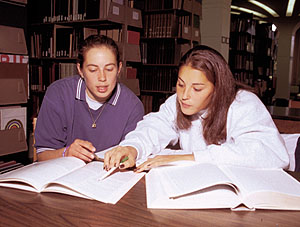
The proof of that, says Rick Kopp, is in the numbers. Kopp, Albany's director of academic support services for athletics, closely monitors the academic performances of all of Albany's student-athletes. Assisted by two part-time coordinators, and with an extensive database, he develops a profile of every student-athlete. Kopp can quickly spot an individual who is struggling academically and then point that student toward tutors and other help. All first-year student-athletes, and any athlete whose GPA falls below a 2.3, must attend mandatory study sessions.
"Our athletes have to meet our general admissions criteria, plus be good athletes," Kopp explained. "This university has academic support programs in place for all students, but here (in athletics), we initiate the contact. The Number One thing we do is to educate our student-athletes to get help if they need it. We make them accountable academically."
Win or lose, Oliva knows he will be making athletic history when Albany
takes the gridiron September 4 against Central Connecticut State. "Years
from now, when (Albany) is playing the big Division I schools, I'll be
able to say that I was there when it all started," he said. "That makes
me feel proud."