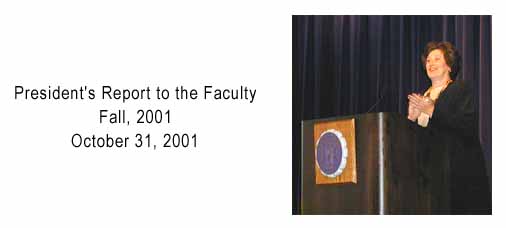
Thank you so much, Ed�and, good afternoon everyone.I'm sorry that an old "football" injury of mine necessitated delaying this event. I can tell you, without a doubt, that I would have preferred being here with all of you on October 17th than with my dedicated and talented, yet merciless, physical therapist!
Seriously, I want to thank so many of you for your concern and good wishes�it really is wonderful to be back.
As part of my preparation for these semiannual presentations to you, the faculty of UAlbany, I usually find myself reviewing my previous Reports and assessing the progress we've made and the challenges still before us.
In each and every one of these Reports, I have spoken of my pride in being a part of the UAlbany family� a part of an academic community whose values include compassion, tolerance and understanding.
And never have I been as proud as on September 11 and during the days and weeks which followed the horrific acts of hate and violence which shattered our complacency and ignited our resolve as citizens of a country dedicated to justice and democratic ideals.
I stood with many of our students in a prayer circle at noon on the 11th, sharing our fears and the anguish of not knowing the fate of family and loved ones.
I stood with so many of you that night as the lights from thousands of candles reflected our shared mourning for the lost and hope for the safety of the missing�as faculty, staff, students, alumni and community members joined hands and drew comfort from the knowledge that no one was alone in their grief. The young woman who planned and led this moving ceremony is with us today�please join me in thanking the President of the Presidential Honors Society, Ms. Stephanie Coon.
Like Stephanie, so many of our students, faculty and staff reached out to comfort and support those most directly affected by the tragic events of the 11th. Thousands attended the Unity Walk on the 12th�and many participated in the various "teach-ins" led by our faculty and staff as, together, we attempted to comprehend the incomprehensible.
At the memorial service held on the 21st of September, thousands of us drew strength from the words of Bishop Howard Hubbard and the other clergy representing many different faiths and beliefs; we were all comforted by sharing our grief and confusion.
As of today, we know of 9 students and 2 staff members who lost members of their family: fathers, brothers, uncles and aunts�indeed, one student lost both a father and a brother. We have also learned of at least 10 alumni who were killed.
Please, join me now in a moment of silence for all who have been lost in these senseless acts of terrorism.
Thank you.
On October 11, one month to the day from these tragic events, I stood with a group of alumni and friends of the University on the 64th floor of Number 30 Rockefeller Plaza, looking out on the shockingly empty skyline of lower Manhattan. With us that evening was Tim Carey, President of the Battery Park City Authority�an alumnus who helped hundreds that day, as people were evacuated from the neighborhoods surrounding the World Trade Center. We were gathered together that evening to celebrate our common bond with this University � and to thank those individuals who have given of their time and resources to help move our University forward�to let these major donors and benefactors of our University know how much their gifts mean to our students and faculty. It was, as you can imagine, a bittersweet moment. And, yet, we were united in our commitment to continue to foster an environment for learning here at Albany�an environment which also supports the values epitomized by Stephanie Coon and Tim Carey, epitomized by those of the UAlbany family who went to serve at Ground Zero, who gave blood, raised funds, and collected food, who reached out to those among us who felt threatened by racial profiling, who simply grasped the hand of someone in need.
Throughout the terrible days following September 11, the constant refrain here on campus � from students and faculty alike � was "we need to know more;" know more about the Islamic faith, know more about the Middle East, know more about United States foreign policy; know more about the tension between security and civil liberties.
As many of you know, a new web site has been developed here at Albany which provides a wealth of references and information�I urge you to visit it � and add to it; just as I urge you to provide opportunities � be it new courses or simply discussion time with each other and your students � to address the new realities facing us. Not long ago, someone asked John Egan, head of Albany International Airport, when things would return to "normal." His answer? This is our new "normal."
Across so many fields, this University has much to offer in this time of confusion and fear and pain. I urge you to foster the conversations which will help us to heal, help us to understand, not only with your students, but with all those in our surrounding communities�
Michael Brooks, Executive Director of Hillel at the University of Michigan said, and I quote, "A university is a[n] historic wager that people of different beliefs can sustain passionate conversations."
I have heard such "passionate conversations" here at Albany�and they have brought me comfort and immense pride in being a part of this exceptional community.
Indeed, I would submit that our nation's colleges and universities have a special obligation at times such as this�an obligation to provide opportunities for our students and the public to discuss the historical and political contexts of such unspeakable acts of violence; to examine our curricula to assure ourselves that all our students are exposed to the policy issues which help to define our nation's interactions with its global partners; to assess the degree to which our core curriculum prepares all our students for the increasingly complex international relationships which will characterize their lifetimes; and, to assure that our students develop the habits of mind essential to an informed citizenry�that their analyses and recommendations for action are grounded in knowledge and informed by the democratic ideals upon which this country was founded. Such "passionate conversations" are at the heart of a vibrant and relevant university.
And so, as I have so often done in the past, let me say "Thank you"�thank you to all those who make this University a source of pride, a source of hope, and a source of expanded opportunities for so many�to all the faculty, staff and students who assure that UAlbany will always be a place of "passionate conversations" and endless possibilities.
The creation and sustenance of such an environment requires leadership�and, so, a very special thank you is due the chairs who have recently completed their service to their Departments and the entire University. You have helped to shape our future. We are all deeply grateful to you for your leadership.
Please stand so that we can all express our thanks and appreciation.
Now, would all chairs � continuing or just commencing their service � also please stand.
To all of you � our deep thanks. Your vision for the advancement of your disciplines will ensure the continuing evolution of our University.
It is also my great pleasure to acknowledge and congratulate three of our colleagues who have recently been promoted by the Board of Trustees to the highest rank within the State University of New York, that of Distinguished Professor. The three faculty members so honored represent the highest ideals of our profession. They are:
- Distinguished Professor Judith A. Langer of the Department of Educational Theory and Practice;
- Distinguished Professor Charles A. Micchelli of the Department of Mathematics and Statistics; and,
- Distinguished Professor Terrence P. Thornberry of the School of Criminal Justice.
Please join me in congratulating our three new Distinguished Professors!
This is also the time that we join together to welcome the new faculty and professional staff who have joined us here at Albany. You are becoming part of an exceptional institution� an institution which will be much richer for your presence.
Would you all stand and be recognized?
There will be a reception and formal introduction of all our new faculty and staff immediately following this meeting in the Fireside Lounge�I hope you all can join us to extend your personal welcome to our new colleagues.
The theme of my remarks at this past Spring Faculty Meeting was "the need to maintain our expectations for excellence," and I spoke of an institution distinguished by the courage of its members to make the choices necessary to achieve such excellence. I reviewed the many examples of excellence which characterized the 2000–2001 academic year � from new academic programs, to improvements in our physical facilities, to an enhanced quality of student life, to vibrant research programs across a multitude of disciplines, to a vast array of educational and research programs which enhance the quality of life here in the Capital Region and across the State. And I spoke of a need to maintain our momentum — "even in the face of budgetary uncertainty." It will come as no surprise that the 2001–2002 academic year will most certainly challenge all of us as we seek to "maintain our momentum" in the face of what is now a budgetary certainty � that is, tremendously constrained state tax dollar resources.
Even prior to the tragedy of September 11, we were facing, at best, a flat state budget for the current academic year. And now the devastation of September 11 has led to projections of the State budget which fluctuate from a deficit of some $3 billion to a deficit of $9 billion. While negotiated salary increases will be covered this year, it appears that the new monies needed to address a major increase of some $2 to $4 million in our University's utility budget will not be forthcoming. Thanks to the wise financial management of Vice President Stec and his colleagues, we will be able to manage this shortfall without directly affecting the delivery of our academic programs. However, as you know, we are limiting our hiring in the various support areas of the University, except in areas directly related to health and safety or in areas which are revenue-generating. This so-called hiring "freeze" is essential if we are to meet the exigencies of this year's financial plan, as well as prepare for the challenges of the next fiscal year. Indeed, the 2002–2003 budget which is now being developed may provide even greater challenges.
As you know, the Governor has proposed a Rebuild New York Renew America plan to the federal government which would, if funded, provide some $54 billion to cover needs in the areas of basic rescue, recovery and rebuilding, economic recovery assistance and support for New York's homeland security efforts. However, even if funded, a more robust higher education budget may still not be possible given the tremendous needs facing our state as it recovers from the tragedy of September 11.
As the planning for the 2002–2003 budget progresses, rest assured that we will, with the Chancellor, be advocating for the resources necessary to preserve, indeed strengthen, our areas of strategic focus. The economic health of the state is predicated on a dynamic, well-educated workforce. The access we provide to a quality education must be an essential part of any recovery plan implemented by the State. Further, our students and their families also may be required to share in the solution of the fiscal challenges faced by the State. Under the leadership of the Board of Trustees and its Chairman, Tom Egan, and our Chancellor, Robert King, SUNY has, in the past, advocated for a rational tuition policy, one which is coupled to some index, like the Higher Education Price Index, and, hence, is understandable and predictable. At this juncture, implementation of such a policy, coupled with inflation-responsive state tax dollar appropriations alone, would provide a stability to our budget which would allow us to plan effectively and leverage these state and tuition revenue sources in meaningful ways.
And, finally, all of you, each and every member of the University at Albany community, can be a part of the solution to these financial challenges. More on this in a moment. We must maintain our momentum � our expectations for excellence � even in the face of financial constraints and budgetary shortfalls. And there is every indication that, together, we can move forward in productive and creative ways. As in the past, the institutional priorities and goals for the current academic year grew out of rich discussions with faculty, Deans and Chairs, and staff from across all of our many units. They flow directly from our University's Strategic Plan and, in every case, they offer opportunities for each member of the UAlbany community to participate in ways which will add to the richness of our academic programs. Indeed, your very participation in meeting these various goals will help our institution address the financial challenges before us.
First and foremost, we must continue our recruitment and retention of the very finest faculty colleagues. And, even in the face of financial constraints, we must continue to increase the overall number of our full-time faculty. This year we welcome 48 new faculty. And, despite the projected financial constraints of the 2002–2003 budget, Provost Santiago has programmed sufficient faculty recruitment to assure a net increase, albeit small, in faculty numbers for next year as well.
There can be no higher priority than this. The quality of our faculty will be the measure of us, and each and every one of us has a role to play. We can't hope to recruit the best if we are not articulate advocates for the greatness of this institution. Further, as at our peer institutions around the country, we cannot rely on the resources provided by the State. Thanks to the creativity of faculty members across a number of our disciplines, faculty lines have been funded through successful foundation grants, as well as productive collaborations with private sector partners. The time is past when we can meet our goals and aspirations through State tax dollar appropriations. We must realize that the continued growth of our institution depends, in large part, on us�on our ability to recognize and assume responsibility for moving our institution forward. A new paradigm is needed for fiscal growth�a paradigm built on leveraging our resources with private sector and government partners who depend on our unique strengths and capabilities.
We must also be strategic as we seek to expand our faculty ranks. One of the Strategic Values we have adopted as a University is "Distinctiveness." To quote from our Strategic Plan, "While remaining committed to our Mission as a comprehensive research university, [the] value of Distinctiveness acknowledges that choices will need to be made as we continue to invest in programs of strength and importance to our overall missions." Further, and I quote, "Investment in strength [or emerging strength] will clearly require the reallocation of resources on campus."
Indeed, I wish to congratulate Provost Santiago and our Deans on their commitment to achieving such "distinctiveness" here at Albany. Over this past academic year, a process of reallocation has been carried out which has garnered some $3 million to allocate to distinctive program areas of particular strength and potential here at Albany. These resources have resulted from a 1% reallocation from our academic units, and a 5% reallocation from our various support areas, and they will be utilized largely to enhance our faculty ranks in areas that set us apart from our peer institutions. I urge all of you to continue to engage in the difficult — but necessary — task of evaluating your departmental programs in order to reach consensus on the distinctive strengths which set you apart from your national peers�.areas of current and emerging strength which are � or could be � evaluated as distinguished by nationally recognized measures. Targeted investment in such areas will help to assure our future as a nationally-prominent research university.
Clearly, such an approach will test our collective will and ability to cooperatively engage in true strategic planning. However, such an approach to investment will also assure that our students receive the very highest quality academic experience here at UAlbany.
Ever since I arrived here at UAlbany� some ten years ago� I have heard our faculty express their strong desire to have� and I quote from our Strategic Plan� "�a student body�with an academic profile comparable to the most selective of this nation's public research universities." And, while progress has been made, we must redouble our collective efforts if we are to be an institution of choice for increasing numbers of the most talented student applicants.
This can only be accomplished if every unit, every division of our University accepts this goal as fundamental to the continuing vitality of our institution.
A talented student body will help attract and retain nationally respected faculty�but it is also true that unless our best faculty commit themselves to finding avenues of engagement with our students, we will not succeed in attracting and retaining such students here at Albany. Student recruitment is not the sole province of our Admissions staff � as excellent as they are. Our Admissions staff does not create a challenging and personalized learning environment; they do not create fulfilling co-curricular experiences or expand quality housing options or assure that each and every encounter of a student with a faculty member, an advisor, with staff in financial aid or the parking office or at the registrar's office is productive and supportive of their needs.
Each and every one of us has a role�each and every one of us has the potential to do great harm or great good as we seek to attract and retain the dedicated and talented students we all desire.
As I said, progress is being made.
The GPA of our entering class has again increased, as has the number of students in the top 10% of their graduating class. The credentials of our Presidential Scholars have improved yet again. All this while slightly exceeding our overall enrollment target. Indeed, for the past two years, we have been able to set undergraduate admissions at a level to assure a continuing increase in the academic profile of the entering class. This strategy has been successful given increases in undergraduate student retention and, this past year, substantial increases in graduate enrollment.
As you all know, much of our budget is driven by enrollment; and, yet, we cannot afford to sacrifice the quality of our student body for the sake of revenue generation. We must maintain our expectations for excellence. Hence, our continuing challenge is to create the kind of academic and co-curricular environment which will attract sufficient numbers of highly qualified students to assure not only our aspirations for student quality, but also the financial stability which will allow us to grow across all of our missions. We must evaluate ourselves in this context. We must evaluate and be responsive to the input we receive from our students � indeed, I applaud the Educational Policy Council of the University Senate, chaired by David McCaffrey, for their decision to analyze the Student Opinion Surveys in relation to our delivery of academic programs. And, I applaud the work of our Student Affairs Division which, under the leadership of Vice President Doellefeld, has done so much to improve the quality of student life here at Albany. We must continue to identify the ways we can each contribute to our Strategic Goal of providing a student-centered, challenging learning experience here at Albany. In so doing, we each will also contribute to the overall fiscal health of our institution. And, congratulations to you all. I'm sure you'd agree that the Wall Street Journal's recent inclusion of UAlbany as a "hot school" is sweeter music to our ears than the Party School ranking of a few years ago.
Pursuing our goal of excellence in research affords yet another avenue to address the financial challenges we face. Indeed, during the past academic year, there was a 20% increase in research funding. You, our faculty, received some $64 million in research awards�funds which are critical to the recruitment and retention of quality graduate students and to the equipment and physical infrastructure so vital to many areas of research excellence. The funds you generate are a testament to the quality of the scholarship ongoing across all our disciplines.
The prestigious fellowships garnered by our faculty; the funds to access critical data sets; the grants received to purchase the equipment and supplies necessary to understand the human genome�all of these externally — derived resources are key to our ability to further advance our national and international reputation as a major public research university; and, all of these resources are essential if we are to continue to grow even in the face of no-growth state budgets. We can continue to be successful in attracting such external support if we are willing to focus our faculty recruitment around distinctive areas of current and emerging strength. Faculty hires must be strategic if we are to compete nationally for the resources we need.
Likewise, institutional resources in support of research must be allocated strategically. I applaud the initiatives of Vice President D'Elia as he works with the Council on Research of the University Senate, chaired by Bruce Dudek, to evaluate the current distribution of institutional research support, and as he brings faculty groups together around emerging areas of interdisciplinary research.
Indeed, many issues confronting our society require just such an interdisciplinary approach. And, it is in responding to such ongoing challenges as AIDS prevention, aging, youth violence, environmental conservation, health care delivery, mathematics and science education and, yes, domestic preparedness, that we not only fulfill our strategic goal of societal responsibility, but we also garner extensive resources to support our programs of research and teaching.
As we partner with governmental and private sector partners to address such issues, as we join with them to assure the economic health of our state and nation, we become the kind of engaged institution envisioned by our founders � an institution able to respond to the changing needs of the region, the state, the nation � indeed the whole of our now global society.
As stated in our Strategic Plan, "To fail to [recognize the role of faculty in meeting societal needs through their programs of teaching and scholarship] is to abandon our traditions, sacrifice our distinctiveness, and place ourselves at risk in terms of societal support."
We have been extremely successful as a University in fostering such programs of outreach while, at the same time, garnering the resources so crucial to our ongoing needs for student support, faculty recruitment and research infrastructure.
David Gilbert, Vice President for Strategic Development and Economic Outreach, has provided creative leadership as we have worked with the state and federal governments to support these initiatives. Indeed, it is likely that we will receive some three million federal dollars to support our workforce training initiatives in nanosciences, and some 2.5 million federal dollars to support our partnership with the State Police in the area of forensics. Further, since last we met, a partnership with the Saratoga Economic Development Corporation and the New York State Energy Research Development Authority has enabled us to join in the establishment of the only technology park in the country devoted to clean energy business development. This partnership will support the research of our faculty and the education of our students, even as it addresses critical environmental and energy-related issues of great import to our society.
Goal 6 of our Strategic Plan states simply that we will expand and diversify [our] sources of revenue to assure [our] continued growth in the context of [our] mission and strategic goals.
At this time of fiscal constraint in our State, I urge each of you to apply your creativity and energy to meeting this critical institutional Goal. Are there on- or off- campus continuing education courses you could develop which address societal needs for life-long learning while at the same time generating revenues in support of our academic programs?
What are the ways you could participate in our enrollment and retention strategies to maximize both the quality of our student body, as well as the institution's level of support derived form tuition and state tax dollar appropriations? Are there independent study opportunities or honors courses you could offer? Would you be willing to go to a recruitment event, or meet with admitted students to encourage them to select Albany?
Are there sources of support for your research that you have not yet considered? When you apply for federal grants, do you utilize strategies to increase your support consonant with the goals of the research and the very real need to be competitive in terms of graduate student support levels?
If each and every member of the University community identified but a single action to recruit quality students, or to foster the kind of learning environment which would increase student retention, or to develop a partnership with a community organization, or to enrich our region's quality of life, or to work with a private sector business to advance your research and provide a learning experience for our students, the collective impact would be enormous.
Such strategies and partnerships have already garnered some half a million square feet of research and educational space, have provided funding of well over $100 million to recruit faculty, professional and technical staff and support dozens of new postdoctoral and graduate students; indeed, such partnerships have enabled us to acquire an entire new campus. Yes, your capacity to create new opportunities for continued growth is remarkable.
And it is both the quality of your programs of research and education, as well as their potential to address areas of pressing societal need which have positioned us so well for the rollout of the largest comprehensive fund-raising campaign in the history of the State University of New York. Under the leadership of Vice President Ashton, we have achieved yet another record in Annual Giving and, with your help, we will continue to achieve our private fund-raising goals. As I meet with alumni all over the country, they are, in a word, overwhelmed by what their University has become. They want to remain a part of the institution which figured so heavily in fulfilling their personal and professional goals, and they express tremendous pride in the continuing growth of their alma mater�the same kind of pride which was reflected in the eyes of our graduates this past Spring at a Commencement Weekend made exceptional by all of you. The heads of foundations and corporations remark on the quality of your programs in the humanities, the arts, the social and natural sciences and the professions...they, too, wish to be a part of what you are accomplishing.
Each of us can play a role in "telling our story"...in increasing the awareness of our various stakeholders regarding the quality and importance of what we do. Over the coming years we will need to invest in the personnel and infrastructure necessary to bring the message of the University at Albany to numerous external audiences, to publicize our accomplishments and to engage our alumni and other friends of the institution in the life of our University. We must continue to increase the University's endowment to ensure a stable funding source for scholarships, faculty positions and our various academic programs.
And, each of us has a role to play as 0we seek to stabilize our financial base. Indeed, each of us can and should be a steward of the legacy of this great institution.
Examples of such stewardship are all around us: our new science library which reached its full potential through the generosity of donors impressed with your programs of research and education; the CESTM complex and the East Campus, facilities made possible through faculty partnerships with industry, State and federal government and private donors; the new Life Sciences building growing before our eyes � and let me take this opportunity to invite you all to the ceremony on November 13th at which the Governor will lay the cornerstone of this remarkable building � this state-funded facility, like the new Library, will reach its full potential only with federal and private sector support; the new Boor Sculpture Studio has already received a naming gift from a donor, Ms. Terri Boor, who wished to express her gratitude to the superb faculty with whom she has interacted over the years; and private and federal support for programs in Jewish Studies, aging, forensic sciences, East Asian studies, the arts, business, education.
And on and on.
Our ability to grow in excellence and stature — even in the face of financial constraints � is truly remarkable. And, at the heart of each of these successful initiatives, are faculty and staff who are committed, who care deeply about our institution and whose creativity and professional excellence have engendered the non-state support which has enabled their programs to thrive and our University to advance.
Through such initiatives, we can maintain our momentum, our expectations for excellence. Each and every one of us has the ability to help shape the future of this institution.
Indeed, we are all beneficiaries of the individual contributions of our predecessors; and, we must continue this tradition of committed stewardship.
The incomprehensible tragedy which marked the beginning of this academic year will never be forgotten. The pain and suffering caused by these horrific acts of hate and violence will be with us all for years to come.
But we must not become paralyzed by these memories.
Our nation, our state and our university are now challenged in different ways than ever before. Yet, we have shown many times before that we have the strength and resolve to deal with new and demanding challenges. To do so we must constantly exercise leadership and project optimism. As faculty and staff of a great university, we have a special opportunity to lead by example. What we do will demonstrate for our students � tomorrow's leaders � the courage and optimism they will need to have as they take our places in an ever-challenging world.
Indeed, such courage and optimism arise naturally from other memories of September 11: the compassion and caring of our entire University community; the rich and open discussions which will help us all to heal; the careful analyses of our curriculum to assure that our students can approach complex global issues with wisdom and informed understanding; the critical role our University played as faculty and staff shared their varied expertise both at Ground Zero and here at home. From counseling to foreign policy discussions, to emergency services to public health, this University made a difference; each of you made a difference.
I am so very proud to be a part of this exceptional community. And, so, I end as I began, with thanks. Thanks for your commitment�for your willingness to accept responsibility for the future of this very special place of learning, and thanks for the compassion and caring you bring to all that you do.