Faculty Perspectives on the Future
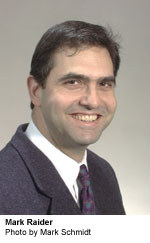 Mark Raider
Chair, Department of Judaic Studies, director,
Center for Judaic Studies
The tragedy of the events of September 11 is still a shock for us all. I am proud to let you know that the UAlbany community — administrators, faculty, instructors, staff and students — dealt with this crisis superbly.
On both September 11 and 12 Judaic Studies faculty were available all day, keeping the coffee pot on and the doors open for any student who might need help or someone to talk with. In addition, we assisted Jewish students (those who were not able to travel home for the Rosh Hashanah holidays) with local home hospitality and synagogue arrangements.
I must tell you how impressed I am by the caliber of our students at this difficult time. When I entered Lecture Center 20 the day of the tragedy to teach my fall course on Antisemitism in Historical Perspective, I was met by a sea of a hundred or so nervous students, many of whom were fighting back tears or openly crying. When I suggested that we talk about what was going on and asked how we — I was thinking of the UAlbany faculty — could help them, a few students responded that �we all need to come together and help each other.� We thereafter compiled a list of suggestions and requests to be forwarded to Provost Carlos Santiago. A few of the class leaders even suggested that our course should be used as a forum in coming weeks to discuss some of the troublesome social, political and religious issues that make it possible for intolerance and hate to turn into violence and terrorism — and �what we should do about it.� This was, I believe, a marvelous demonstration of what a good Liberal Arts education is all about: empowering students to think critically about the world around them and how they can change it for the better.
What I learned at UAlbany immediately after the crisis is something you won�t see reported in the news, namely that there is a generation of college-age youth whose belief in a better world and civilized society is profound and unshakeable.
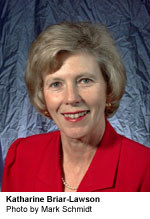 Katharine Briar-Lawson
Dean, School of Social Welfare
These have been horrific times. Along with massive grief over casualties, trauma or stress have affected most everyone. Social workers are trained to be effective helpers during times of crisis, grief, and tragedy. The School of Social Welfare has undertaken a series of initiatives to support students and others on the campus, in the region, and to reach out to traumatized victims in New York City. Within an hour or two after the tragedies struck, social welfare master�s and doctoral students, staff, and faculty were on the main uptown campus offering assistance to undergraduate students and others.
Associate Deans Anne E. (Ricky) Fortune and Janet Perloff and their staff assembled names of trained social workers who could be available to help with traumatization. Since then, the school has served as a clearinghouse for volunteers with counseling talents to help with different needs both in the region and in New York City.
These needs include trauma training for New York City managers who are reopening their offices and want to support their workers. It includes trauma and grief work with individuals and groups whose family, friends, and co- workers are missing. It includes debriefing and stress-related help for exhausted and traumatized workers who have been working overtime to serve others. It includes support for those who witnessed the deaths or who share the horror vicariously.
Volunteers from the school have been counseling individuals and groups, training others to provide support, and building cross-site teams among social workers in the region and in New York City. Working in response to calls from the Governor�s Office for Employee Relations, the School has mobilized both upstate and downstate social workers and related volunteers.
For example, teams of social workers, including SSW doctoral students, are in New York City, debriefing workers, addressing symptoms, and imparting strategies for coping with trauma. State agencies are also using the talents of our dedicated alumni and others, such as the National Association of Social Workers, positioned to be resources in such troubling times.
The School held the first of several teach-ins focused on trauma. Additional training is planned to prepare advanced students in social work to enlarge the core of helpers.
These workshops address:
- trauma theory and identifying effects f trauma
- maintaining and maximizing functioning
- addressing delayed responses
- risk reduction involving traumatization
consequences
- creating unity and community building;
mobilizing social supports, helping families with young children and
vulnerable elders
- creating effective trauma response initiatives
Faculty members are also working in their classes to address the tragic events. Some of the longer-term teamwork of the School will involve �diversity appreciation initiatives� to help the campus community model ways to foster unity during a crisis.
The stress, trauma, and related effects of the tragedies will be felt for a long time. Thus, the school is working closely with the American Red Cross on ways to sustain the volunteers and to be a resource for the long term. For strategies to identify and address trauma in the aftermath of the tragedy, visit the School of Social Welfare Web site at www.albany.edu/ssw. Trained crisis intervention volunteers who wish to have their names forwarded to the Red Cross can contact the School�s Help Desk at 442-5320.
 Edelgard Wulfert
Associate professor and director of clinical training, Department of Psychology; and chair, University Senate
The hijacking of four passenger planes by Islamic terrorists and subsequent mass murder of thousands of innocent people constitute an unfathomable tra-gedy. Although the human spirit is resilient, it is difficult to predict the psychological aftermath of these horrific acts of terrorism on the members of our University community. For most of us, the immediate reaction to the events was probably one of disbelief, followed by fear and grief at the colossal loss of life, even for those of us who have not personally lost a loved one. In such times, it is almost a natural reflex for people to come together and find comfort in being with others. Talking about what happened, participating in events that unite us with others, such as the candlelight vigil, the unity march, the teach-ins and the memorial service, all become important occasions for beginning the process of healing and re-establishing a sense of safety and community.
Once the immediate danger has subsided, another normal human reaction is to experience anger and outrage. However, we need to be very careful as to how we direct these emotions because, from a newfound sense of community, often a sense of �communal fury� emerges. I have heard Arab-American and foreign students from the Middle East express concerns about glares from some fellow students. As a University community, we must continue to send a strong message that it is utterly unacceptable to single out any individual because of his or her national origin, ethnic background, or religious beliefs. However great our anguish or anger, by targeting innocent people we are putting ourselves at the same level with the terrorists. Faculty members and students can work together to integrate the events of these past days by engaging in reasoned and informed dialogue whenever the occasion or need arises.
 Thomas A. Birkland
Associate professor, director, Center for Policy Research;
author of After Disaster: Agenda Setting, Public Policy, and Focusing Events
The WTC and Pentagon attacks, together, are among the most important events of our era, and we can therefore expect extensive news coverage of these events, both in the immediate aftermath and in the weeks and months ahead.
Because the event is so huge, it will have an influence on the research and policy agendas of innumerable organizations and institutions, in both the public and private sectors. Those changes to the agenda include:
A careful re-examination of aviation security. In particular, poorly paid and poorly trained security personnel at the screening positions (the X-ray machines) are very likely to be replaced by better trained, better paid professionals who may well be employees of the federal government, not low-bid contractors. At the same time, the conveniences enjoyed by air travellers — e-tickets, curbside check-in, etc. — are likely to be curtailed. Only passengers will be allowed past the security point and on to their gates. I would imagine a larger security presence throughout airports, and perhaps plainclothes law enforcement officials on aircraft, although their value has not been proven.
This is what I see as the beginning of a solution to this problem. In the past, the Federal Aviation Administration (FAA) has often fought safety improvements because they would impose costs on airlines, and the FAA was sympathetic to airline cost containment. Now, cost containment won�t work as a reason not to proceed because passengers are likely to stay away from air travel if the airlines don�t begin to take security very seriously. Indeed, the airlines this time are saying that they don�t think the FAA is going far enough in addressing the security problem, to which one might say that the airlines are entirely free to institute stricter measures than the FAA. I imagine that people are willing to pay more for a safer flight, particularly in light of the horrific nature of the September 11 attacks. No one wants to be on a plane that will crash into a building, and given the precipitous drop in bookings and the large number of flight cancellations, the airlines will have to take this issue very seriously indeed.
Americans and their elected officials will begin to pay much greater attention to hard news about terrorism and national security than we did before September 11. Frivolous news such as Gary Condit�s carryings-on, or celebrity gossip, such as Mariah Carey�s mental health, will creep back into the gossip columns, but won�t be topic one among serious news organizations any more — one can see a major qualitative change in CNN�s coverage of the WTC and Pentagon attacks compared with its breathless but ultimately vapid coverage of Gary Condit several weeks ago. This may mark a change toward better journalism.
These questions will dominate Congressional agendas for months. Any committee or subcommittee of Congress that has even the slightest connection with antiterrorism, national security, emergency response, the financial markets, etc., will hold hearings on this event. The WTC attack is now issue No. 1 across the board in Congress.
As regards disaster policy, there are some potentially very interesting outcomes. First, I think New York City will be held up as a model of sound emergency response — its only fault, I think, was in locating its emergency management center in 7 WTC, which unfortunately was too close to the emergency. But the mayor, in particular, and the uniformed services performed well, once again showing how response is a local, not a national, function.
Perhaps the most important outcome from a disaster management perspective is the question of mitigation. A lot of my work is on disaster mitigation—how do we keep bad disasters from being worse ones? In this case, there is already talk about how to protect structures from this type of terrorist attack. These are tough questions for architects and engineers to address, but there is already talk of improved building techniques. Any building could be collapse proof, but perhaps no one could afford it.
Finally, because I study agenda setting as an important process in the policy process (I use disasters primarily to illustrate important issues in agenda setting), it is clear that terrorism in all its forms — chemical, nuclear, biological, etc. — is going to be very much a focus of the government. This may knock missile defense off the agenda, because when crises like WTC happen, people seek solutions that have a clear link to solving the revealed problem.
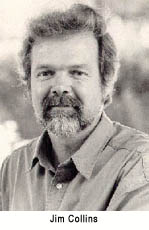 Jim Collins
Professor, Department of Anthropology Department of Reading
The events and aftermath of September 11 are deeply saddening and profoundly troubling. The sudden, massive loss of life can only leave us sorrowed, confused, and seeking an answer. We must remember the victims, show our solidarity with their loved ones, and seek to prevent such horrors from occurring again. We must not, however, simply �rally round the flag.� Now is not the time to follow our leaders unquestioningly. We must remember that the United States had an acknowledged role - a complicity - in the Cold War training of Islamic militias, the Taliban, and, yes, Osama bin Ladin. We must defend the civil rights that have made this country a �beacon of liberty� when many call for removing freedoms in the name of security. We must seek peace and reconciliation rather than war and revenge.